RomeCabs Transfers and Tours in Italy (Rome Cabs)
Informative travel tips and blog by ROME CABS: provider of Civitavecchia Transfers, Day Tours, and Shore Excursions in Rome and throughout Italy
Why RomeCabs is the Best Choice for First-Time Visitors to Italy
Buongiorno and welcome to RomeCabs’ Italy travel blog! When planning your first trip to Italy, you may feel both excited and overwhelmed by the many decisions ahead. With so much to consider—choosing the best attractions, navigating Rome’s bustling streets, and managing transportation logistics—it’s easy to feel uncertain. That’s where RomeCabs is the best choice for first-time visitors to Italy. With over two decades of expertise in the travel industry, we specialize in offering a reliable, luxurious experience that allows you to focus on what truly matters—enjoying the magic of Italy.
RomeCabs stands out not just for its top-notch private transfer services but also for fun-filled tours of Rome and day tours from Rome to other top destinations in Italy. Whether you’re arriving at Rome’s Fiumicino Airport or docking at Civitavecchia Port, you can rely on RomeCabs to simplify your journey with convenient transfers, personalized advice, and handpicked itineraries. Here’s why RomeCabs is the best choice for your first trip to Italy.
Why RomeCabs is the Best Choice for First-Time Visitors to Italy
RomeCabs has Over 20 Years of Expertise and Trustworthiness
With over 20 years of experience in the travel industry, RomeCabs is a trusted leader in providing private transfers and tours in Rome and across Italy. Since its founding in 2004, the company has pioneered Rome tours by car and day trips from Rome to popular destinations throughout Italy, such as Florence, Sorrento, and Pompeii.
As a first-time visitor to Italy, it’s important to choose a company that is reliable and established. RomeCabs’ longevity in the business means that you are dealing with a trusted, professional service—a company that has weathered the test of time, providing thousands of travelers with unforgettable experiences. Unlike some lesser-known companies that may not have the same track record or infrastructure, RomeCabs ensures that you’re working with a seasoned operator who values quality and customer satisfaction.
Leave the Stress of Trip Planning Behind with RomeCabs
When planning a trip, one of the biggest challenges is the research and planning of getting from one place to another, what to see in Rome, or what are the best day trips from Rome, travel planning can quickly feel overwhelming.
However, with RomeCabs, you can forget about the stress of logistics. Simply book the transfers or tours you need, and you’re all set—no need to spend hours researching destinations or studying maps.
RomeCabs offers a full range of services to ensure that every aspect of your journey is effortless. Whether you’re arriving at Fiumicino Airport, docking at Civitavecchia Port, or planning to explore Italy from Rome, RomeCabs takes care of all your transfer and tour needs. With a private transfer, there’s no hassle in figuring out how to reach your hotel or the port. You’ll be greeted by a professional driver who will take you directly to your destination, allowing you to focus on enjoying your trip.
RomeCabs also offers a wide selection of day tours from Rome by car with English-speaking drivers designed to make your Italian adventures unforgettable. From the romantic streets of Florence to the coastal beauty of Positano, these expertly curated tours ensure you don’t waste time dealing with complicated public transportation systems. RomeCabs handles all the logistics, leaving you to explore with ease and make lasting memories.
Simplify your Trip start to finish with RomeCabs’ Private Tours & Transfers
For first-time visitors to Italy, navigating unfamiliar transport systems and planning an itinerary can quickly become a daunting task. RomeCabs removes all of the guesswork and stress, allowing you to focus on enjoying your time in Italy.
From the moment you arrive—whether at Fiumicino Airport or Civitavecchia Port—RomeCabs provides reliable private transfers in comfort and style. There’s no need to worry about how to get to your hotel or whether a taxi is available. Your professional driver is there to take care of everything, so you can relax from the moment you land.
RomeCabs also simplifies your sightseeing experience with a range of convenient day tours from Rome to some of Italy’s most popular destinations. Whether exploring Tuscany or the picturesque towns of the Roman countryside, these tours are designed to maximize your time and minimize the stress of public transportation.
No more waiting for trains or buses—RomeCabs ensures your transportation is taken care of in your private deluxe vehicle and a personal driver at your service, allowing you to enjoy your trip without unnecessary delays or confusion. By handling all the logistics for you, RomeCabs ensures that every step of your journey is effortless, so you can truly immerse yourself in Italy’s beauty and culture.
No Language Barriers, Just Seamless Communication
For first-time visitors to Rome, language can often feel like a barrier. But when you book with RomeCabs, there’s no need to worry about speaking Italian or struggling with miscommunications.
RomeCabs’ website is entirely in English, and the office staff are fluent native English speakers, so you can easily navigate the booking process without any confusion. Whether you’re arranging airport transfers, port pickups, or day tours, you’ll find that everything is tailored to English speakers, ensuring your travel plans are crystal clear.
Your RomeCabs driver will already know exactly where to take you, based on the details you’ve provided in your reservation —no need for complicated translations.
Additionally, if you have any questions before, during, or after your trip, RomeCabs’ team is just an easy email away. From adjusting your itinerary to accommodating special requests, the RomeCabs customer service team is ready to help, ensuring a smooth and stress-free experience. With RomeCabs, you can focus on enjoying your trip, knowing that clear communication is always a top priority.
Fun-Filled Tour Itineraries of Rome and Beyond
RomeCabs isn’t just about getting you from point A to point B—it’s about offering you a memorable experience. For first-time visitors to Italy, trying to figure out a new city or region can be overwhelming. Instead of joining overcrowded group tours or struggling to plan each day on your own, RomeCabs offers curated private tour itineraries designed to maximize your time and enjoyment.
If you’re interested in exploring Rome’s iconic landmarks, venturing into nearby Tuscany, or learning about ancient civilizations in Cerveteri or Tarquinia, RomeCabs makes it possible to explore Italy with ease. Some of the popular offerings for first-time visitors include:
Rome Tours by car:
RomeCabs offers a variety of private Rome tours by car, providing travelers with a comfortable and efficient way to explore the city’s rich history and iconic landmarks. Our luxury tours by car are conducted in deluxe Mercedes vehicles, driven by expert English-speaking drivers, ensuring a personalized and informative experience.
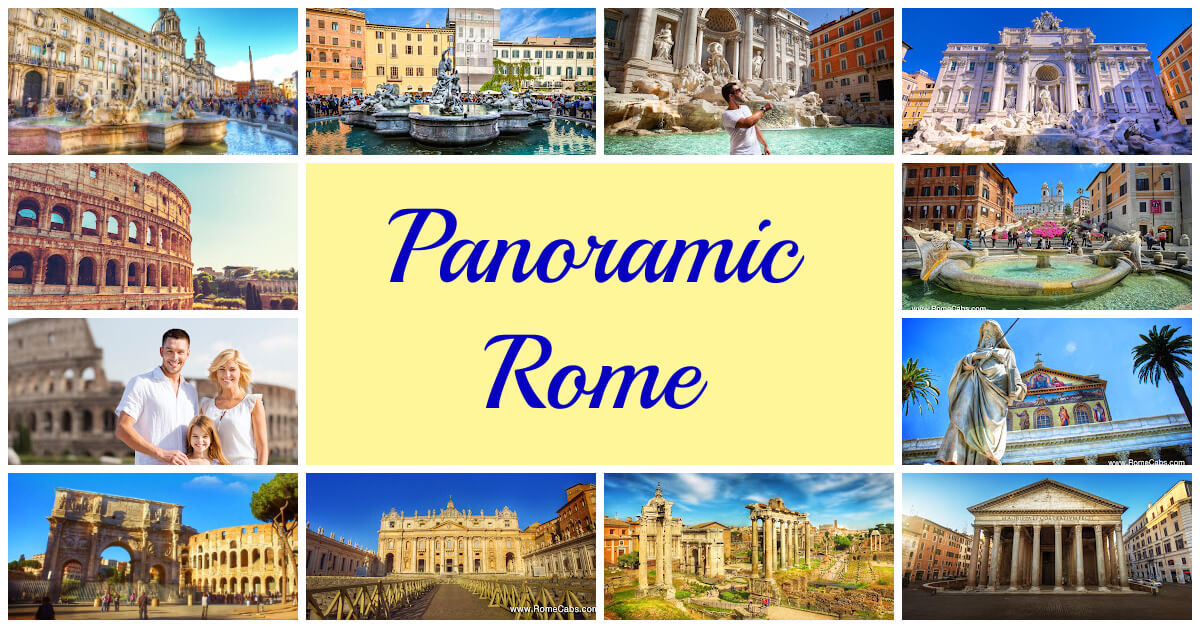
Panoramic Rome Tour
This 8-hour tour allows visitors to discover Rome’s most famous monuments, vibrant squares, and hidden gems, offering a comprehensive overview of the Eternal City.
Rome Town & Country Tour
For those interested in experiencing both urban and rural Italy, this full-day tour combines the highlights of Rome with the majestic Italian countryside, providing a diverse and enriching experience.
Tour Rome as Romans Do
This full-day tour offers travelers the chance to experience Rome like a local, visiting both renowned sites and off-the-beaten-path locations for an authentic taste of Roman life.
Along Rome’s Empire Roads Tour
Ideal for history enthusiasts, this full-day tour takes visitors to ancient sites along Rome’s historic roads, offering insights into the city’s distant past.
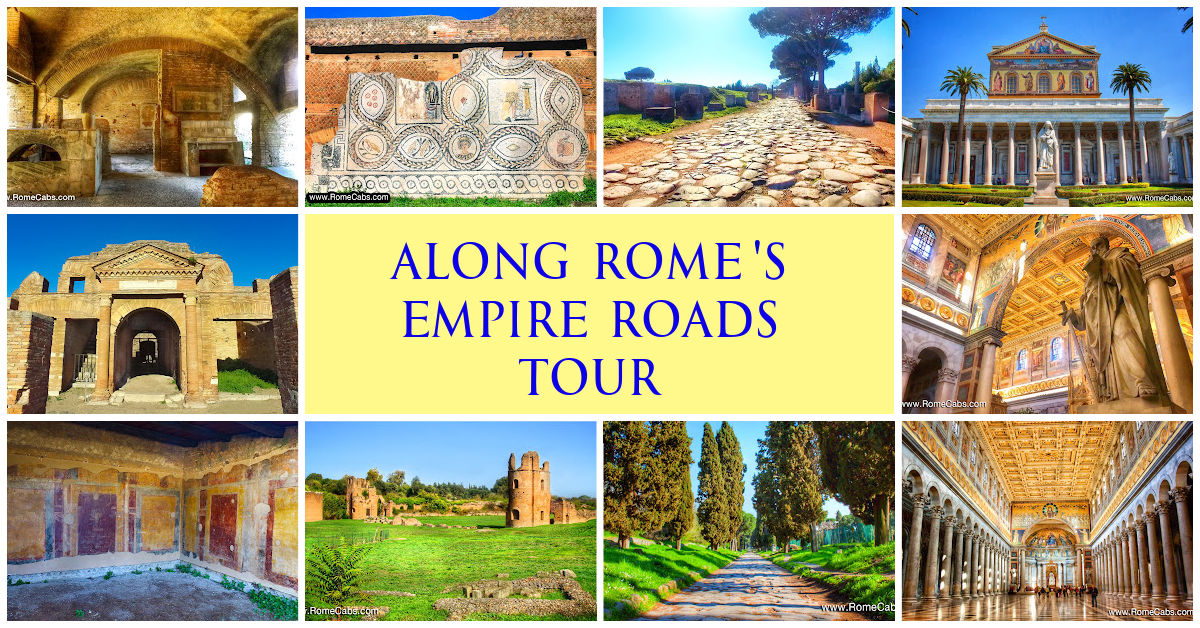
These private tours by car are designed to maximize sightseeing opportunities while minimizing the challenges of navigating Rome’s bustling streets and crowded public transportation. With convenient hotel pick-up and drop-off, travelers can enjoy a seamless and stress-free exploration of Rome’s treasures.
Day Trips from Rome:
RomeCabs offers an exceptional selection of private day trips from Rome, providing the perfect opportunity to explore some of Italy’s most beautiful and culturally rich destinations. From Tuscany’s rolling hills to the enchanting Amalfi Coast, these tours allow you to enjoy a seamless and stress-free experience with private transportation and expert itineraries. Below are some of the top-selling tours to inspire your next Italian adventure:

Enchanting Tuscany Day Tour from Rome
Discover the heart of Tuscany with visits to charming medieval villages, scenic drives through the iconic Val d’Orcia, and a taste of authentic Tuscan flavors. Highlights include Bagno Vignoni, San Quirico d’Orcia, Pienza, Monticchiello, and an ancient castle farmhouse. This UNESCO World Cultural Landscape is one of the most picturesque regions in Italy, featured in films like Gladiator.
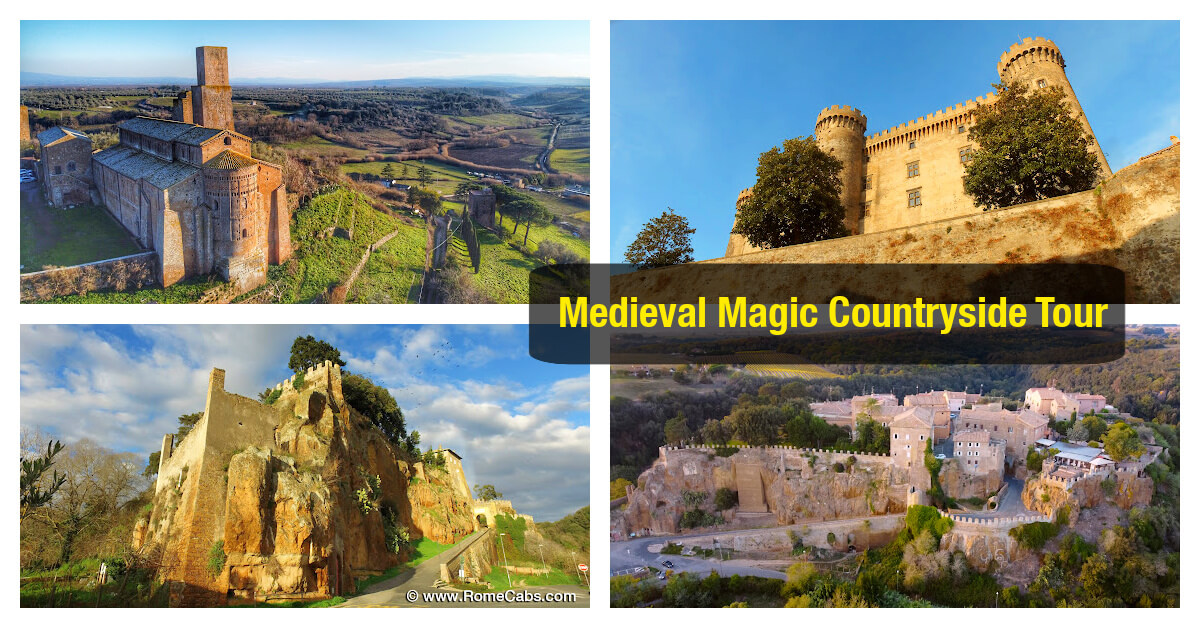
Medieval Magic – Rome Countryside Tour
Step back in time with a journey through medieval towns and castles. Explore Tuscania with its breathtaking landscapes, the clifftop hamlet of Ceri, and the historic lakeside Castello Orsini-Odescalchi in Bracciano. Whether as a day tour from Rome or a shore excursion, this tour offers a magical escape into Italy’s storied past.
Mysterious Etruscans Countryside Tour
Step back in time with a journey through the Roman countryside, once the heart of the Etruscan civilization. This tour includes visits to the Monterozzi Necropolis and the National Etruscan Museum in Tarquinia, as well as the enchanting medieval town of Tuscania.
Discover the rich history and legacy of the mysterious Etruscans who ruled this region over 2,800 years ago.
Montepulciano and Pienza Private Tuscany Tour
Experience the ultimate blend of history, culture, and natural beauty with this private tour to Montepulciano and Pienza. Traverse Tuscany’s iconic countryside, enjoy rolling vineyards and olive groves, and explore these two historic towns known for their breathtaking views and rich heritage.
Tivoli Villas and Gardens Full Day Tour
Visit two UNESCO World Heritage Sites on this tranquil day trip from Rome. Explore Hadrian’s Villa, a testament to ancient Roman architecture, and Villa d’Este, renowned for its stunning gardens and fountains. Afterward, enjoy a relaxing lunch in the charming town of Tivoli.
Private Tour from Rome to Pompeii, Sorrento, and Positano
This unforgettable tour combines history and coastal beauty. Spend two hours exploring the ruins of Pompeii, followed by visits to the picturesque towns of Sorrento and Positano along the Amalfi Coast. Experience the convenience of private transportation and the charm of Italy’s most beloved destinations.
Shore Excursions from Civitavecchia
RomeCabs offers a diverse selection of private shore excursions from Civitavecchia, providing travelers with the opportunity to explore Rome and its surrounding regions in comfort and style. Their services include convenient pick-up and drop-off directly at the pier, ensuring a seamless experience for cruise passengers.
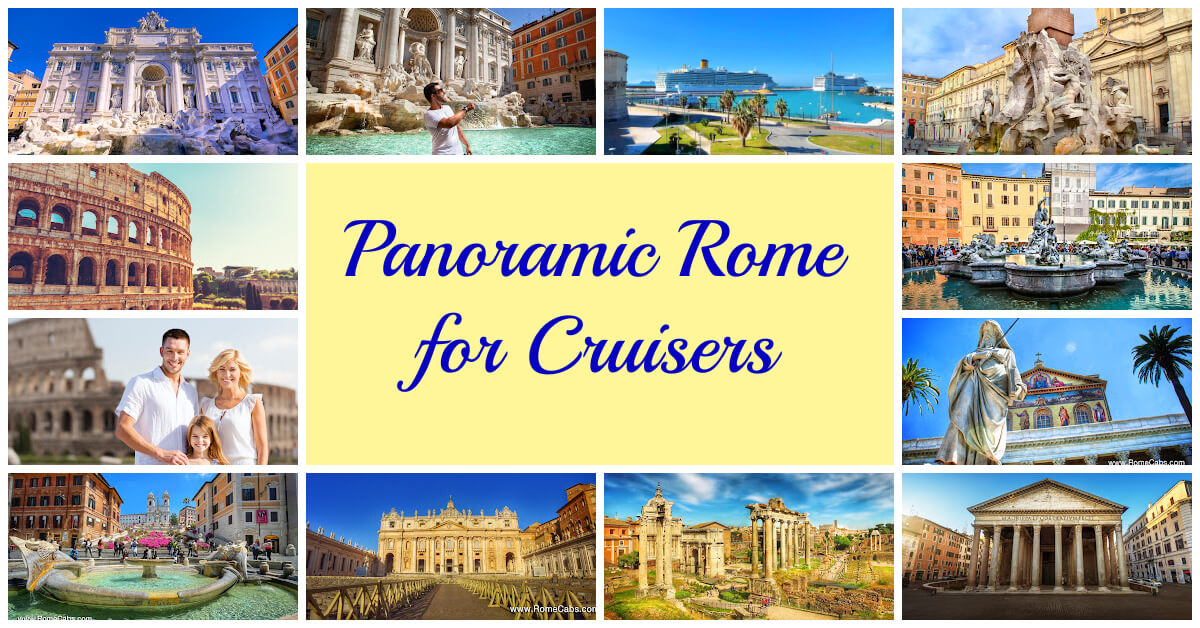
Panoramic Rome for Cruisers
This top-selling excursion allows visitors to immerse themselves in Rome’s iconic landmarks, vibrant squares, and hidden gems. It’s an ideal choice for those looking to experience the city’s rich history and culture within a single day.
Rome Town & Country Tour
This excursion combines the best of both worlds, allowing visitors to explore the highlights of Rome and the majestic Italian countryside. It’s an excellent option for those looking to experience the diverse beauty of the region.
Tour Rome as Romans Do
For a more leisurely experience, this tour offers travelers the chance to explore Rome like a local, visiting both renowned sites and off-the-beaten-path locations. It’s perfect for those seeking an authentic taste of Roman life.
Countryside Splendor Tour
This excursion takes visitors to Bracciano Castle, the medieval village of Ceri, and the Etruscan Necropolis of Cerveteri, providing a rich cultural and historical experience.
With over two decades of experience since 2004, RomeCabs has been a trusted provider of private shore excursions, ensuring that travelers can maximize their sightseeing opportunities with ease and comfort. Their professional English-speaking drivers and deluxe Mercedes vehicles enhance the travel experience, making it both enjoyable and informative.
For more information on these and other shore excursions from Civitavecchia, visit RomeCabs’ official website.
Post-Cruise Tours from Civitavecchia with RomeCabs
For cruisers looking to make the most of their time after disembarking in Civitavecchia, RomeCabs offers a range of Post-Cruise Tours that ensure a smooth and enjoyable experience. Whether you want to explore the historic city of Rome, delve into Italy’s countryside, or visit iconic landmarks, RomeCabs provides private, flexible tours designed around your schedule and preferences.
When your cruise docks at Civitavecchia, you can easily transition from ship to shore without the hassle of navigating public transportation or waiting for crowded taxis. RomeCabs offers private transportation to popular attractions, giving you the freedom to choose your itinerary without worrying about time constraints or navigating through large groups.
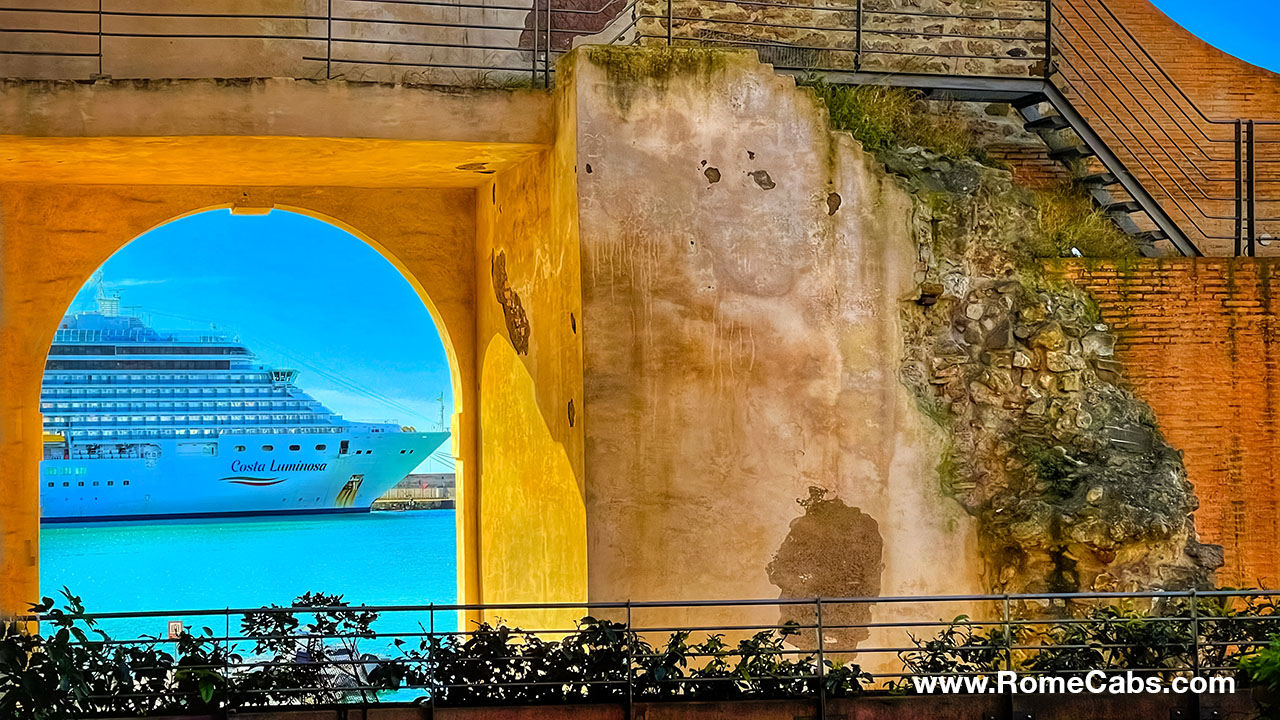
Post-Cruise Panoramic Rome Tour from Civitavecchia
For those looking to take in the highlights of Rome in a short amount of time, the Post Cruise Panoramic Rome Tour is the perfect choice. This tour covers the city’s must-see landmarks, including the Piazza della Rotonda with its view of the Pantheon, the iconic Trevi Fountain, Spanish Steps, and Piazza Navona.
You’ll also visit St. Peter’s Square, the Capitoline Hill with panoramic views of the Roman Forum, and enjoy an outside view of the Colosseum and Arch of Constantine in Colosseum Square. A brief stop at Circus Maximus and a visit to the Basilica of Saint Paul Outside the Walls are also included, along with free time for lunch at a local trattoria.
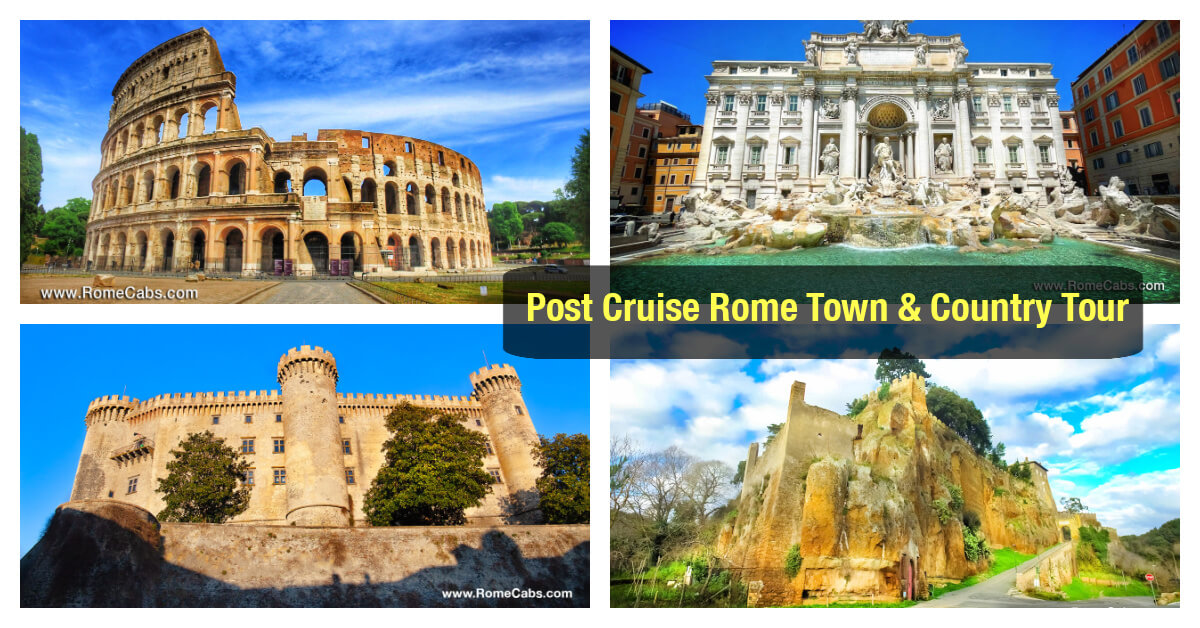
Post Cruise Rome Town and Country Tour from Civitavecchia
For those seeking a blend of history and the countryside, the Post Cruise Rome Town and Country Tour offers the perfect mix. This tour includes a visit to the medieval town of Bracciano, home to the stunning Orsini-Odescalchi Castle, and the quaint, picturesque village of Ceri. In addition, you’ll explore Rome’s classic landmarks, including Colosseum Square, Piazza della Rotonda, Piazza Navona, Spanish Steps, and the Trevi Fountain, ensuring you experience both the charm of rural Italy and the grandeur of its capital.
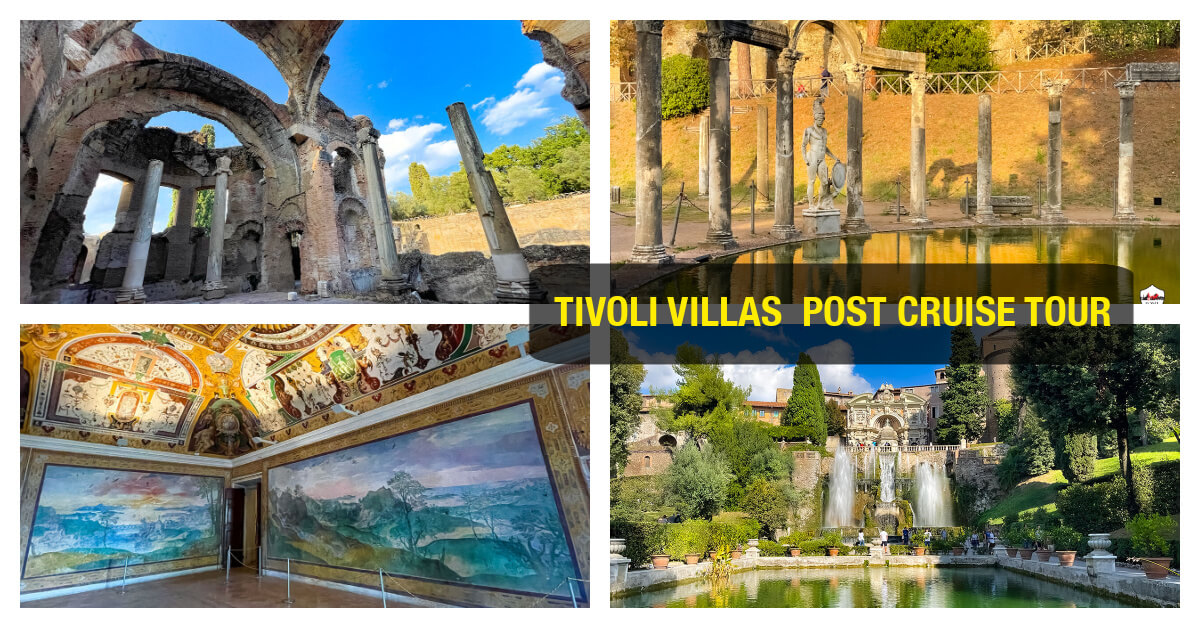
Tivoli Villas Post-Cruise Tour from Civitavecchia
Step back in time and discover the Villa d’Este and Hadrian’s Villa in Tivoli, two UNESCO World Heritage Sites that showcase the grandeur of ancient Roman architecture and Renaissance-era gardens. The stunning Villa d’Este is renowned for its exquisite fountains, while Hadrian’s Villa gives you a glimpse into the luxurious lifestyle of the Roman Emperor Hadrian.
Post-Cruise Medieval Magic Tour from Civitavecchia
Journey to the past with the Medieval Magic Tour. This fascinating tour takes you to the charming villages of Tuscania, Ceri, and Bracciano, where you can explore ancient castles, medieval streets, and stunning lakeside views. Visit Bracciano Castle, the imposing stronghold that once housed noble families, and feel transported back in time to an era of knights and chivalry.
Post-Cruise Montepulciano and Pienza Tuscany Tour from Civitavecchia
For those who want to experience the breathtaking beauty of Tuscany, the Montepulciano and Pienza Tour is the perfect day trip. You’ll explore the medieval town of Montepulciano, famous for its wine and picturesque streets, and the idyllic town of Pienza, a UNESCO World Heritage site known for its Renaissance architecture and stunning landscapes. This tour allows you to immerse yourself in the rich culture and history of one of Italy’s most beloved regions.

Information-Rich Website for Informed Travel Planning
One of the key features that sets RomeCabs apart is its highly informative website, designed to make planning your trip to Italy easier and more enjoyable. Whether you’re a first-time visitor or a seasoned traveler, the website offers a wealth of resources to help you make informed decisions every step of the way.
The website provides clear and comprehensive details about RomeCabs’ private transfers and tours, so you can easily browse through the services available and understand exactly what you’re booking. From airport transfers to city tours and day trips, the website offers all the information you need to tailor your travel arrangements with confidence.
But the website isn’t just about booking transfers. It’s also home to a rich collection of insightful blogs that cover a wide range of travel topics. Whether you’re looking for advice on the best day trips from Rome or want to explore hidden gems in Italy’s countryside, the blogs on RomeCabs’ site provide valuable insights and inspiration to enhance your journey.
By offering this treasure trove of helpful content, RomeCabs ensures that you are well-equipped to plan your trip with ease and confidence. You’ll have all the information you need to make the most of your time in Italy, allowing you to focus on the experiences that matter most—without the stress of navigating travel logistics.
Transparency with No Hidden Fees
First-time travelers to Italy often worry about hidden fees or unexpected costs when booking transportation services abroad. Many companies add to this anxiety with undisclosed prices, requiring travelers to fill out lengthy forms or leaving them unsure if they’re being charged fairly based on their nationality or other factors. These practices can create unnecessary stress, especially when trying to stick to a travel budget or not keen on jumping through hoops just to find out basic prices.
RomeCabs eliminates these concerns with its transparent pricing policy. When you book a transfer or day tour with RomeCabs, the price you see is the price you pay—no surprises, no hidden fees. Whether you need an airport transfer, a port pickup, or a day trip to Italy’s top destinations, RomeCabs provides clear and consistent pricing that allows you to plan your trip with confidence.

Peace of Mind with Secure Bookings and Payments
Traveling to a foreign country can be overwhelming enough without the added stress of managing currency exchange, carrying large amounts of cash, or worrying about unexpected expenses. RomeCabs understands these concerns, which is why they offer the convenience of prepaying for your transfers and tours in advance. This simple option lets you focus on enjoying your Italian vacation without the distraction of handling financial logistics once you arrive.
By prepaying, you ensure that all your transportation needs are taken care of ahead of time, offering you peace of mind throughout your trip. No need to worry about exchange rates or carrying cash; everything is fully secured and confirmed before you even step foot in Italy. This also helps you stay within your travel budget, avoiding any hidden or surprise charges along the way.
RomeCabs’ secure, user-friendly booking system ensures that your reservations are safely stored and your personal details are protected. The robust booking engine ensures that your arrangements are locked in, giving you the assurance that nothing will be overlooked.
Once your reservation is confirmed, you’ll receive a detailed voucher for each service, clearly outlining the services you’ve booked. This allows you to travel with confidence, knowing that RomeCabs has your bookings secured and all your information is accurate and up-to-date.
With prepayment, not only do you streamline your travel experience, but you also eliminate the stress of managing payments once you’re in Italy. It’s one less thing to worry about, leaving you more time to explore and enjoy all the wonders Italy has to offer.

Thousands of 5-Star Reviews from Satisfied Customers
RomeCabs is proud to boast an exceptional reputation, with thousands of 5-star reviews across platforms like TripAdvisor and Google. These glowing testimonials highlight the company’s reliability, knowledgeable drivers, and personalized service, offering assurance that you’re making the right choice when booking your Italian tour or transfer.
Cruisers also recommend RomeCabs on Cruise Critic, praising the ease of booking, professionalism, and the comfort of private transfers from Civitavecchia Port to Rome and other destinations. With such a high level of customer satisfaction, RomeCabs stands out as one of the most trusted transfer and tour companies in the industry.

Texasfriends from Prosper, Texas wrote:
Wonderful Tour
We developed our own itinerary for a full-day in Rome. RomeCabs were very helpful in devising this schedule. Everything was wonderful and we got to see so many of the sites. The driver was courteous, knowledgeable and attentive. He also drove us to a wonderful restaurant for lunch. And we made it back to the cruise ship with time to spare. I would highly recommend RomeCabs.
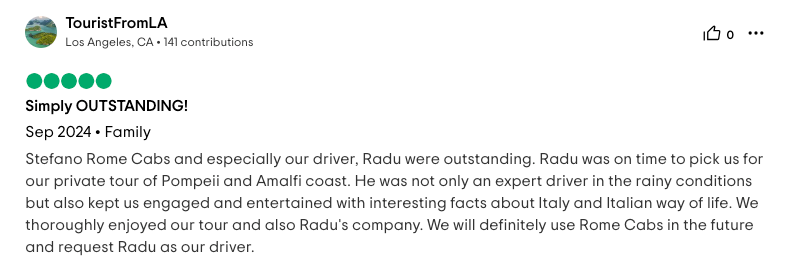
TouristFromLA from Los Angeles, California wrote:
Simply OUTSTANDING!
Stefano Rome Cabs and especially our driver, Radu were outstanding. Radu was on time to pick us for our private tour of Pompeii and Amalfi coast. He was not only an expert driver in the rainy conditions but also kept us engaged and entertained with interesting facts about Italy and Italian way of life. We thoroughly enjoyed our tour and also Radu’s company. We will definitely use Rome Cabs in the future and request Radu as our driver.

Mark H. wrote:
We have used Rome Cabs for several trips to Rome, cruises, etc. They have been FLAWLESS in all respects!! Their drivers are friendly and helpful while delivering outstanding service. This is the only transportation company to consider when you need service in Rome.
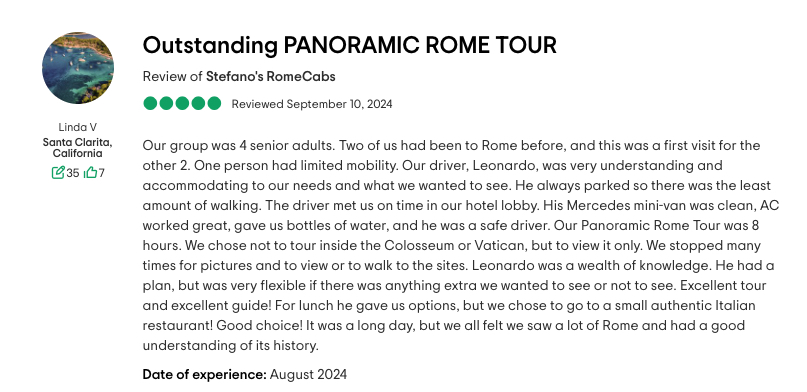
Linda V from Santa Clarita, California wrote:
Outstanding PANORAMIC ROME TOUR
Our group was 4 senior adults. Two of us had been to Rome before, and this was a first visit for the other 2. One person had limited mobility. Our driver, Leonardo, was very understanding and accommodating to our needs and what we wanted to see. He always parked so there was the least amount of walking. The driver met us on time in our hotel lobby. His Mercedes mini-van was clean, AC worked great, gave us bottles of water, and he was a safe driver. Our Panoramic Rome Tour was 8 hours. We chose not to tour inside the Colosseum or Vatican, but to view it only. We stopped many times for pictures and to view or to walk to the sites. Leonardo was a wealth of knowledge. He had a plan, but was very flexible if there was anything extra we wanted to see or not to see. Excellent tour and excellent guide! For lunch he gave us options, but we chose to go to a small authentic Italian restaurant! Good choice! It was a long day, but we all felt we saw a lot of Rome and had a good understanding of its history.
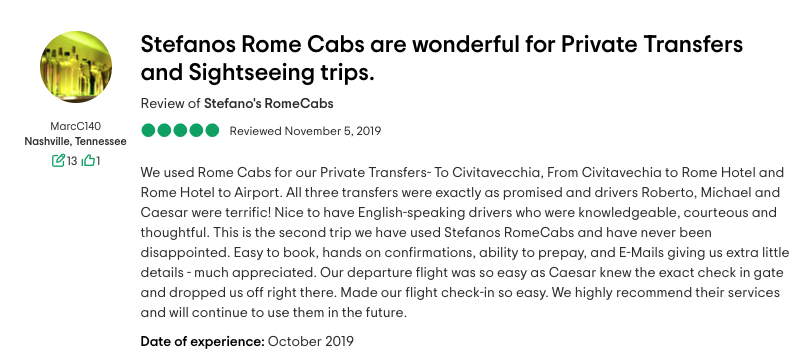
MarcC140 from Nashville, Tennessee wrote:
Stefanos Rome Cabs are wonderful for Private Transfers and Sightseeing trips.
We used Rome Cabs for our Private Transfers- To Civitavecchia, From Civitavechia to Rome Hotel and Rome Hotel to Airport. All three transfers were exactly as promised and drivers Roberto, Michael and Caesar were terrific! Nice to have English-speaking drivers who were knowledgeable, courteous and thoughtful. This is the second trip we have used Stefanos RomeCabs and have never been disappointed. Easy to book, hands on confirmations, ability to prepay, and E-Mails giving us extra little details – much appreciated. Our departure flight was so easy as Caesar knew the exact check in gate and dropped us off right there. Made our flight check-in so easy. We highly recommend their services and will continue to use them in the future.
RomeCabs doesn’t just get you from point A to point B—it offers a luxury travel experience, providing comfort, peace of mind, and personalized service every step of the way. Whether you’re in Rome for a few days or exploring multiple cities in Italy, RomeCabs makes sure your trip is as smooth and enjoyable as possible.
Book with RomeCabs today, and let us help you create lasting memories on your Italian adventure.
Find RomeCabs online also on:
- RomeCabs FACEBOOK
- RomeCabs TWITTER
- RomeCabs INSTAGRAM
- RomeCabs FLICKR Photo Gallery
- Romecabs Recommended on Cruise Critic
Discover more of Rome and Italy with RomeCabs travel blogs
A Day in a Medieval Village in Italy: Life in the 1200-1300s (Time Travel with RomeCabs)
Greetings and welcome to the RomeCabs Italy Travel Blog! With so many wonderfully preserved medieval towns across Italy, it’s natural to wonder what a day in a medieval village in Italy might have looked like during the 1200s and 1300s. Life in an Italian village was an intricate blend of routines and traditions, deeply tied to the rhythms of nature, the cycles of agriculture, and the feudal structures that defined society.
Villagers’ daily lives were centered around community, religious devotion, and their close connection to the land, which provided for all their essential needs. While life in a medieval Italian village was often harsh and labor-intensive, it was shaped by a sense of stability, purpose, and continuity passed down through generations.
Before we journey back in time to “spend a day in a medieval village in Italy in the 1200-1300s” here are some important aspects that characterized life during this period and the historical developments to better understand medieval village life:
What was Medieval Life like in the 1200s-1300s?
1. The Feudal System: Defining the Structure of Medieval Village Life
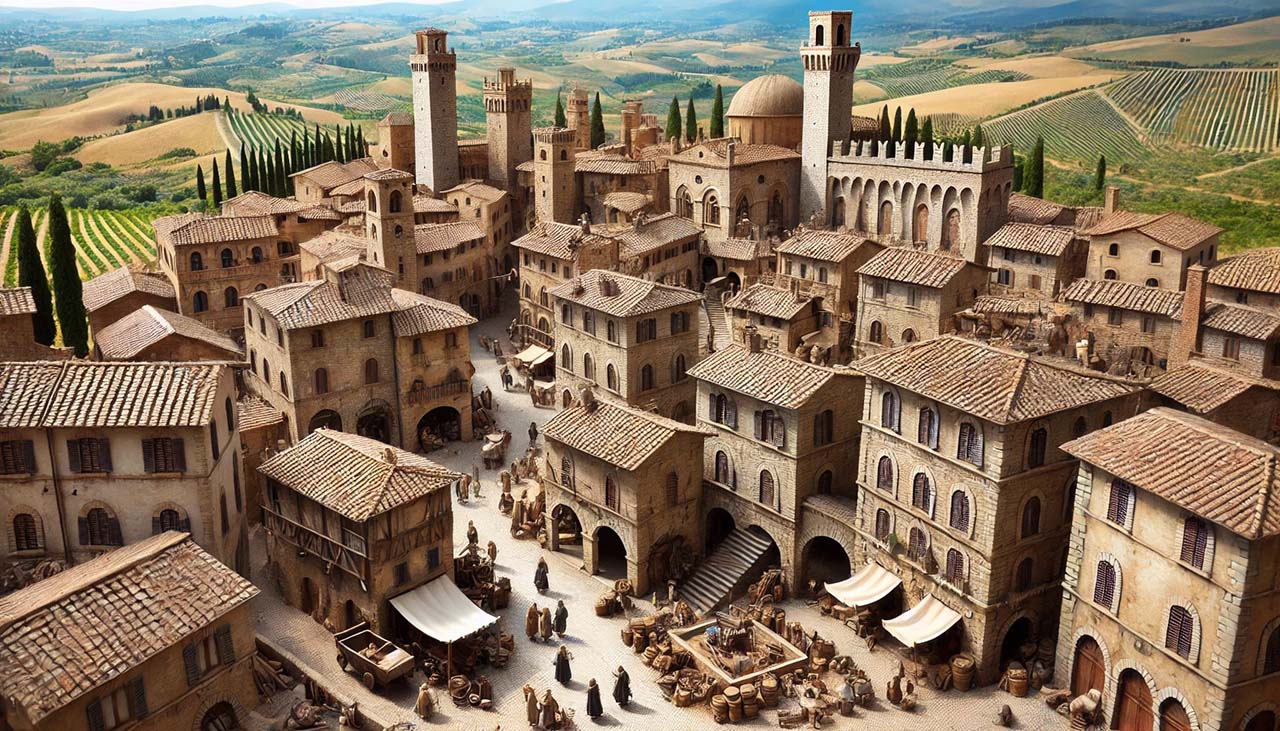
In the 1200s and 1300s, the feudal system was a defining feature of rural life in Italy and much of Europe. Villages were typically part of a larger manorial estate controlled by a local lord or noble. This system created a structured hierarchy where peasants, or serfs, were bound to the land and required to provide labor or produce in exchange for protection and the right to work their plots.
The feudal relationship deeply influenced daily activities, as most villagers focused on fulfilling their duties to the lord. From tending crops to maintaining the lord’s lands, their work was structured around obligations, which often left little room for personal pursuits. While this system was restrictive, it also provided a sense of security, as the lord offered protection against external threats and maintained order within the village.
2. Agricultural Developments: Increasing Yields and Stability
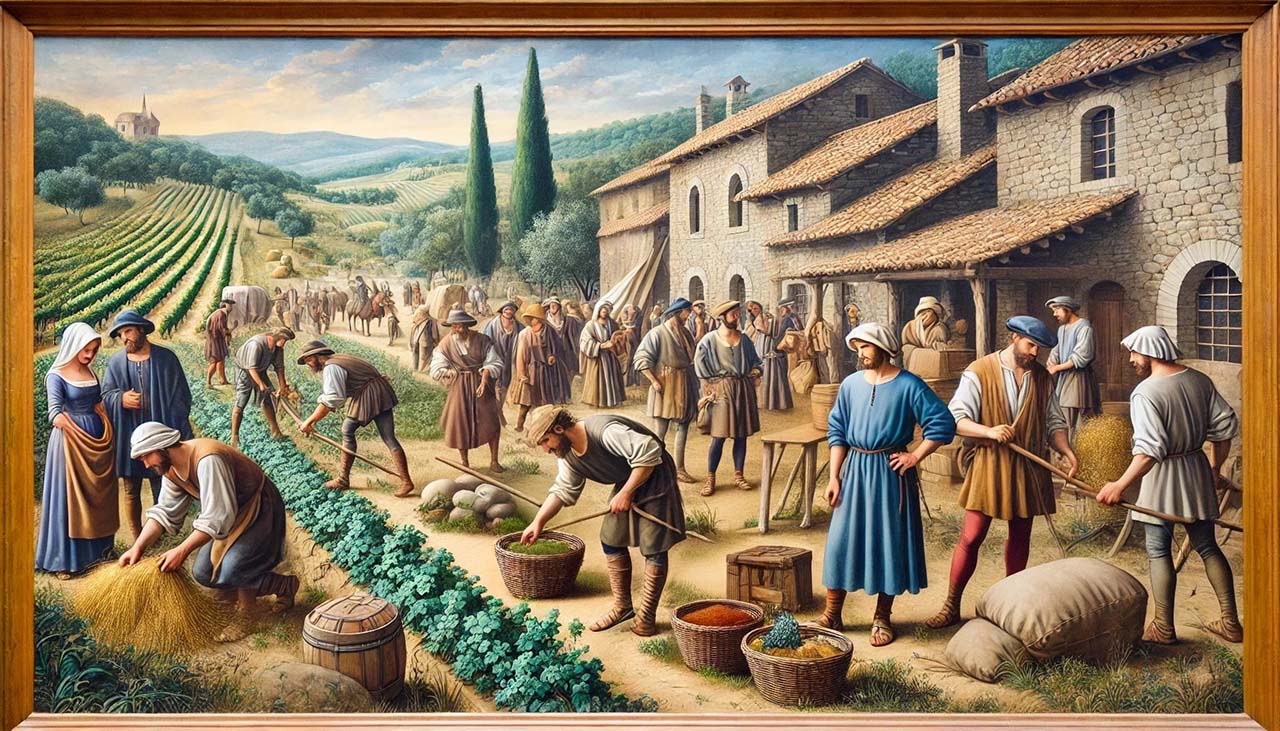
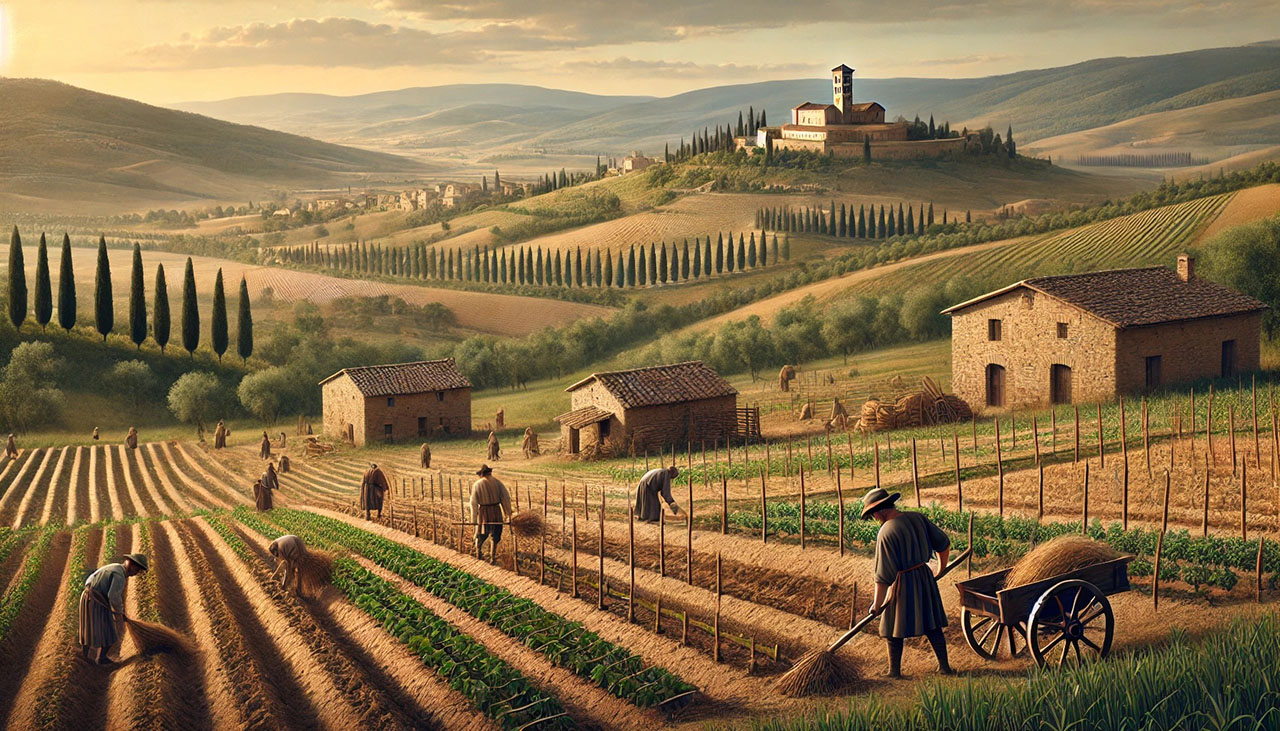
The 1200s and 1300s saw notable advancements in medieval agricultural practices, which significantly impacted village life. One of the most important innovations was the three-field system. In this system, land was divided into three parts: one planted in autumn, one planted in spring, and one left fallow to recover. This crop rotation method allowed for better soil fertility and increased yields, reducing the frequency of food shortages and allowing for modest population growth.
These agricultural improvements meant that villagers could produce more food and, in turn, have some surplus to sell or barter in local markets. This period also saw the development of more efficient farming tools, such as the heavy plow, which made it easier for farmers to till the soil and manage larger areas. As a result, agriculture began to support a more stable lifestyle, and the threat of famine decreased, leading to a gradual increase in the population and greater economic opportunities.
3. Religious Influence: The Spiritual Heart of the Village
Religion played a central role in medieval Italian villages, and the Church was the spiritual, moral, and social center of daily life. The local church, often the tallest and most substantial building in the village, was where villagers gathered for Mass, feast days, and religious celebrations. The Church calendar, filled with feast days, holy days, and periods of fasting, structured the villagers’ year and created a shared sense of community and devotion.
During the 1200s and 1300s, the rise of mendicant orders such as the Franciscans and Dominicans brought more active religious engagement to these villages. These monks and friars traveled through the countryside, preaching, providing aid, and encouraging villagers to lead virtuous lives. Their presence helped deepen the influence of the Church on daily life, offering spiritual guidance and moral teachings. Villagers looked to the Church not only for religious fulfillment but also for advice on social and moral matters.

4. Trade and Market Expansion: Connecting Villages to the Wider World
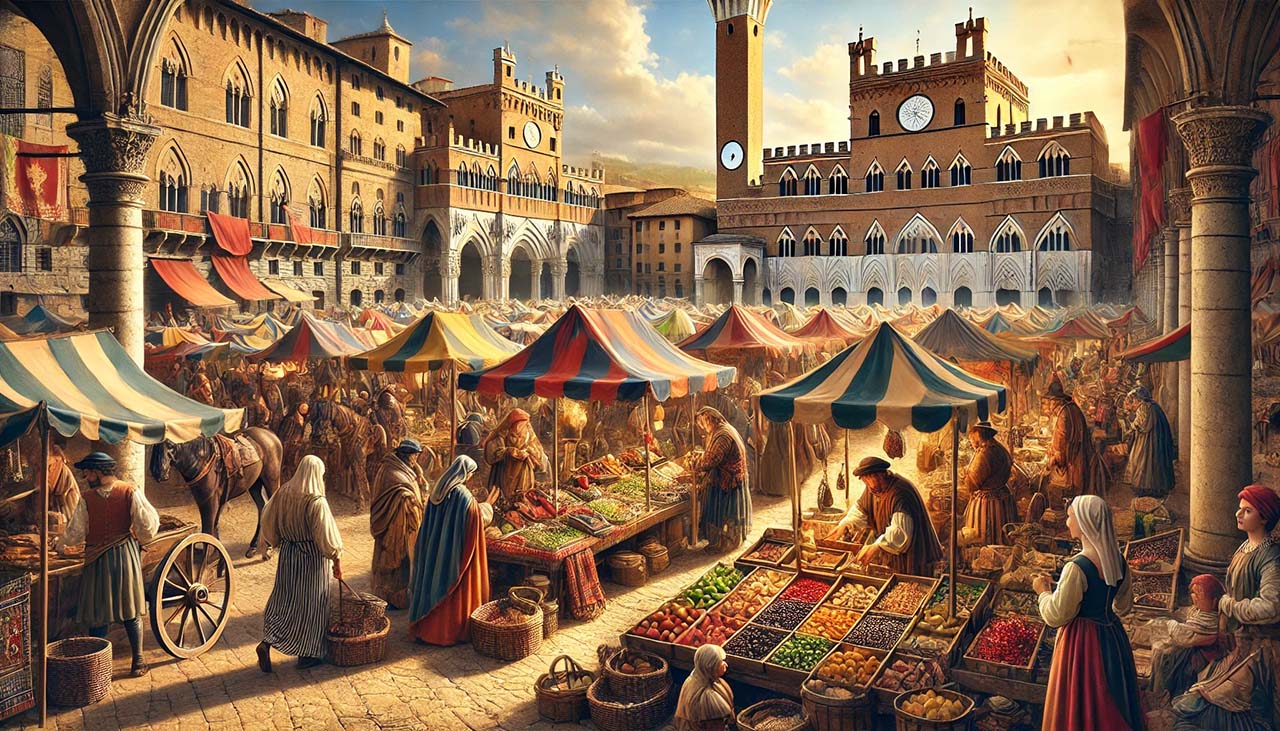
The 1200s and 1300s were a time of expanding trade and growing markets. Italian villages, especially those near bustling towns or along trade routes, began to sell surplus produce and artisanal goods in local and regional markets. This period saw the growth of fairs and markets, which brought traders from afar, enriching village life with new products, spices, and materials that were otherwise inaccessible.
Thanks to Italy’s geographic position, villages close to trade routes benefited from exposure to distant cultures. Traders brought luxury items such as silks, spices, and finely crafted tools, offering villagers a glimpse into goods and customs from beyond their borders. For many, these markets were a lively gathering place where they could sell their produce, buy necessities, and catch up on news from the outside world.
5. Social Structure and Changes: Shifting Opportunities for Villagers
While the social structure of a medieval village remained strictly hierarchical, the 1200s and 1300s saw the beginnings of social mobility for those who could accumulate wealth through trade or skilled work. The rise of a merchant class in towns provided new opportunities for some villagers who aspired to greater independence and a better quality of life.
In rare cases, skilled artisans or successful farmers might amass enough wealth to move to a nearby town, where social advancement was more attainable. This emerging class system allowed those with ambition and resources to dream of a life beyond the constraints of serfdom. However, such mobility was still limited and rare, and most villagers continued to live within the rigid boundaries of the feudal order.
6. Architecture and Village Layout: A Simple but Functional Design
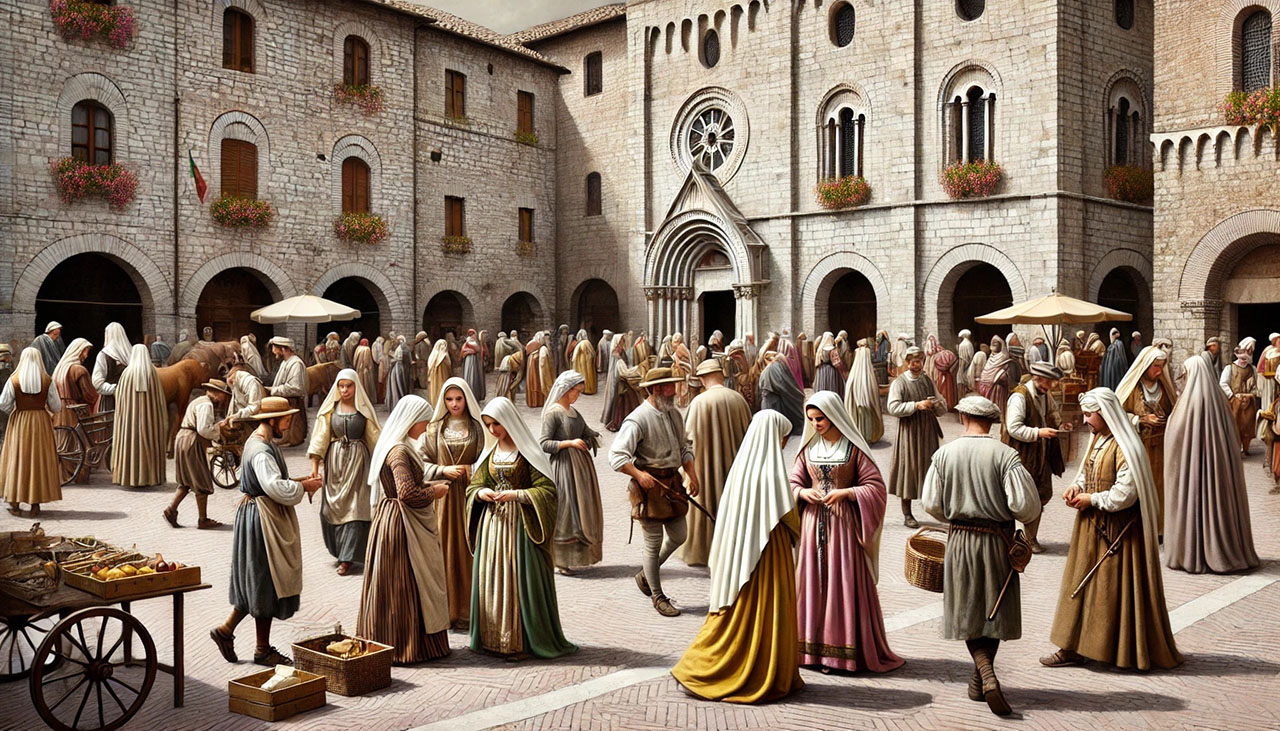
Medieval Italian villages in the 1200s and 1300s typically had a simple yet functional layout, with narrow, winding streets centered around a church, manor house, and common areas like the village square. Houses were typically small and built from local materials such as wood, stone, and thatch. Each home served multiple purposes, with family members, livestock, and stored crops all sharing space under one roof.
By the late 1200s, wealthier villages and those near prominent trade routes began to incorporate more substantial stone buildings, a sign of increasing prosperity and architectural development. This shift not only improved the durability of homes but also marked a visible distinction in social status, as wealthier families could afford these sturdy structures. The church, however, often remained the most architecturally significant building, reflecting its importance in the community.
7. The Constant Threat of War and Conflict: Villagers’ Lives on Edge
During the 1200s and 1300s, medieval Italy was frequently embroiled in conflict, from local feuds between noble families to broader territorial wars and incursions by foreign powers. Villagers lived with the constant threat of raids or forced conscription, and many times, they were required to flee their homes for safety. Fortifications, such as walls and towers, were sometimes added to villages, offering some protection but also a reminder of the volatility of the era.
The ever-present possibility of violence shaped the psychology of the village. Villagers often lived in a state of preparedness, learned basic defense, and were aware of nearby safe havens or escape routes. Despite the hardships of rural life, their sense of community and solidarity helped them endure these periods of uncertainty.
Let’s journey back to this period to explore what a typical day in such a village might have looked like, while also considering the broader historical context and developments of the time.

A Day in a Medieval Village in Italy: Life in the 1200-1300s
Dawn: The Village Awakens
In the stillness of the early morning, before the first light of dawn touches the horizon, a medieval village begins to stir. The village is small, nestled in a valley or perched on a hillside, surrounded by fields and forests that provide sustenance and protection.
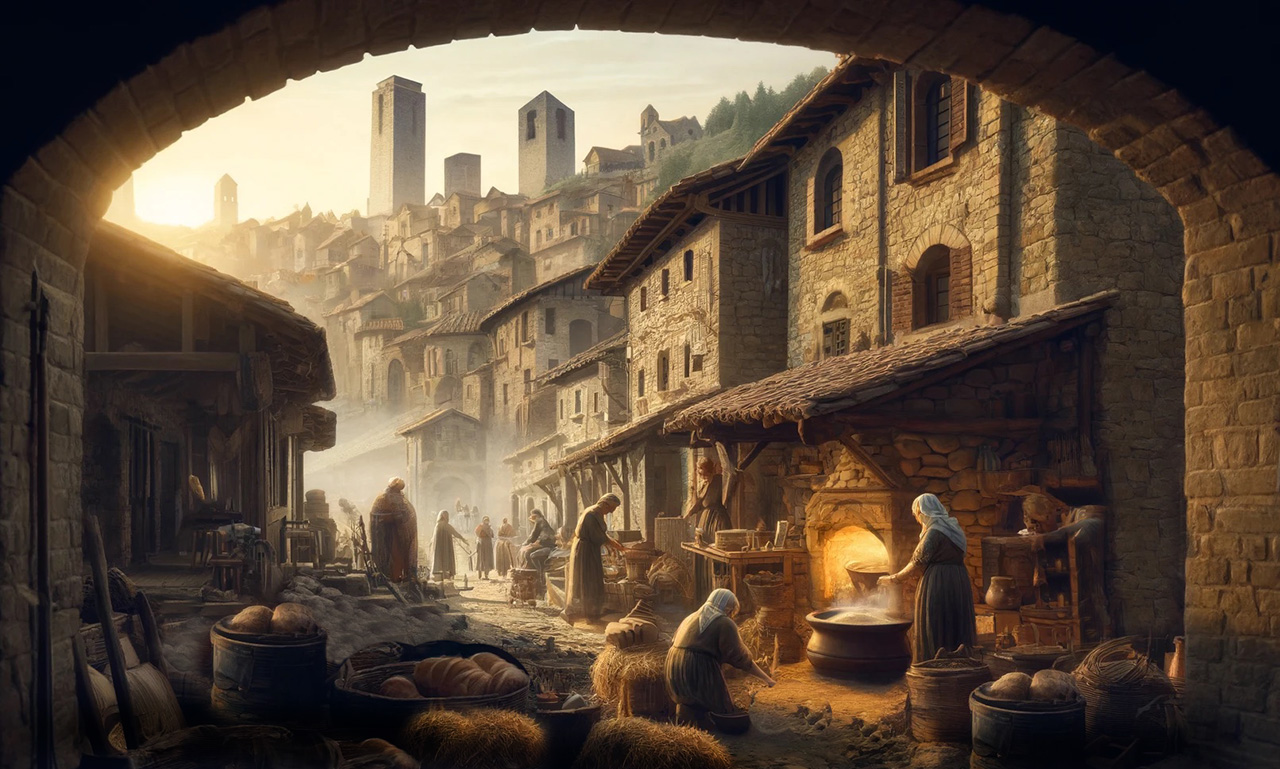
The homes, built from local materials like stone, wood, and thatch, are clustered together for warmth and security. Their small, thick-walled structures huddle around the village square, where the church bell tower rises above all else, serving as a constant reminder of the divine presence that governs their lives.
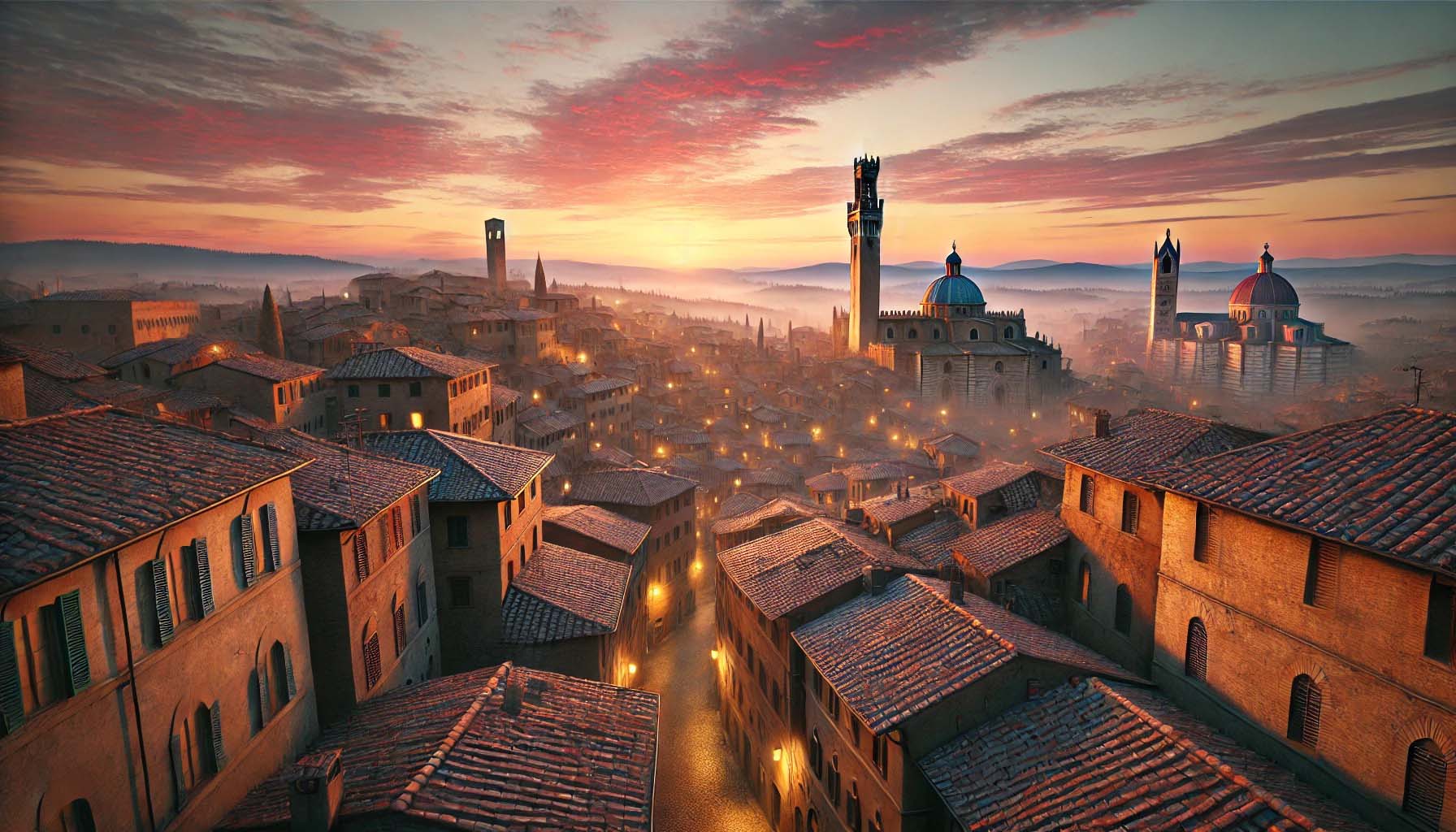
As the first rays of the sun break through, the roosters crow, and the day begins. The air is cool, the sky still tinged with the colors of night, but the village is already coming to life. Inside these modest homes, villagers rise from their simple straw mattresses, their breath visible in the cold morning air. The hearth, which has smoldered through the night, is stoked back to life, providing warmth and a place to cook the day’s first meal.
The church bell tolls, calling the villagers to early morning prayers. For many, this is how each day begins, with a visit to the church at the center of the village. The church, often the only stone building in the village besides the manor house, is not just a place of worship but the spiritual heart of the community. It is where the villagers are baptized, married, and ultimately, where they will have their final rites. The priest, a central figure in village life, leads the morning prayers, asking for blessings and protection for the day ahead.

Morning: The Village Buzzes with Work and Trade
After prayers, the village truly comes alive. The sun is now fully risen, casting long shadows across the fields and illuminating the dew-covered grass. The village is bustling with activity as each person goes about their daily tasks, all contributing to the communal life.
The majority of the villagers are peasants, and their lives are governed by the agricultural calendar. They work the land, growing crops like wheat, barley, and oats, or tending to vineyards and olive groves. The introduction of the three-field system during this period, where one-third of the land is left fallow each year to regain its fertility, has allowed for more efficient farming. This system, along with the use of more effective plows, has increased agricultural productivity, making famine less frequent and supporting modest population growth.
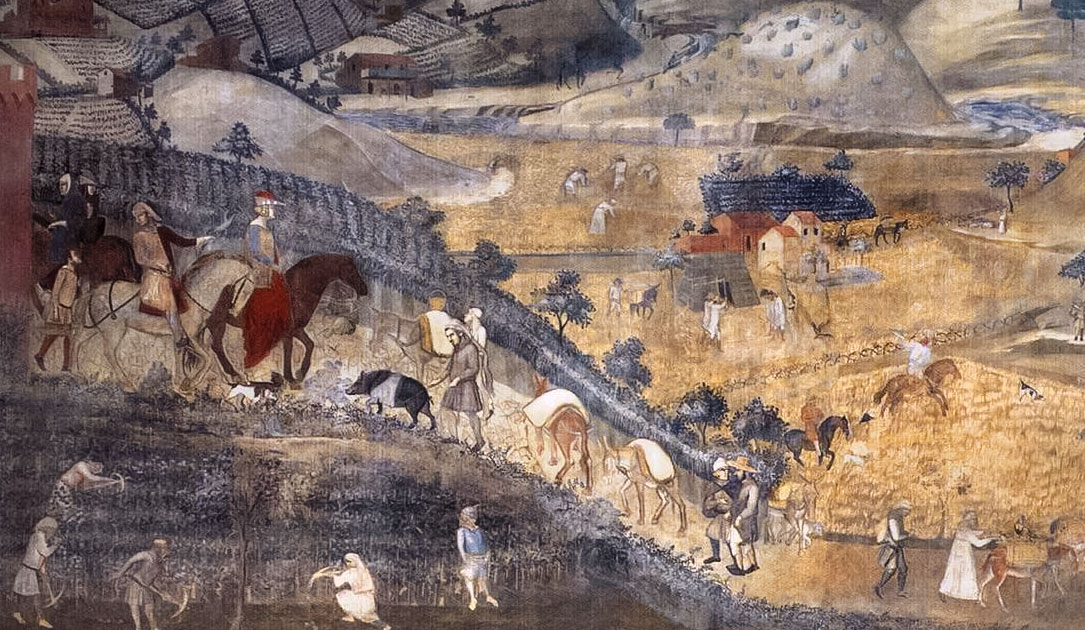
In the fields, men, women, and children work together. The men handle the heavier tasks, such as plowing and sowing, while the women help with planting, weeding, and tending the gardens. Children assist where they can, learning the skills they will need as adults. The work is hard, but the villagers understand that their survival depends on the land. The produce they harvest will not only feed their families but also fulfill their obligations to the local lord.
This is a feudal society, and the villagers are bound to the land they work. The local lord, who may live in a fortified manor house or nearby castle, owns the land and the villagers work it in exchange for protection and the right to live on it. They owe the lord a portion of their harvest, which is stored in the village granary or transported to the lord’s estate. These feudal obligations are central to the villagers’ lives, and failure to meet them can result in severe punishment.
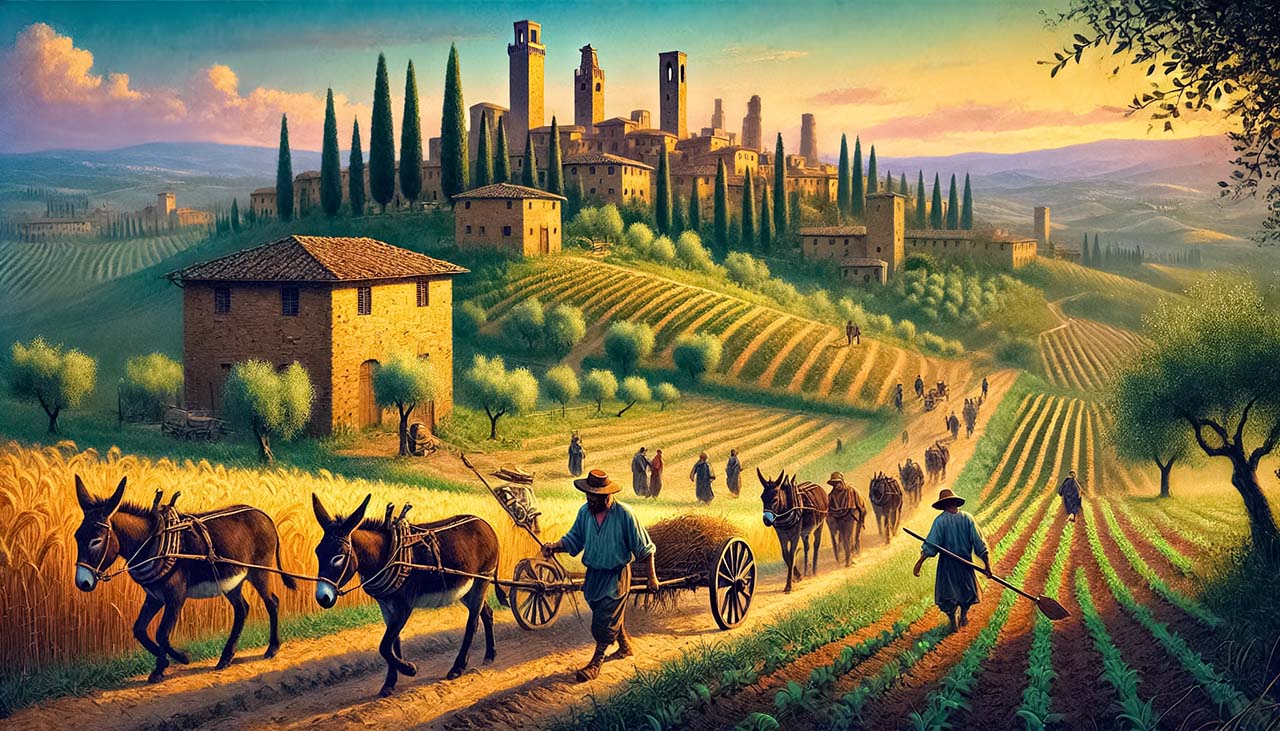
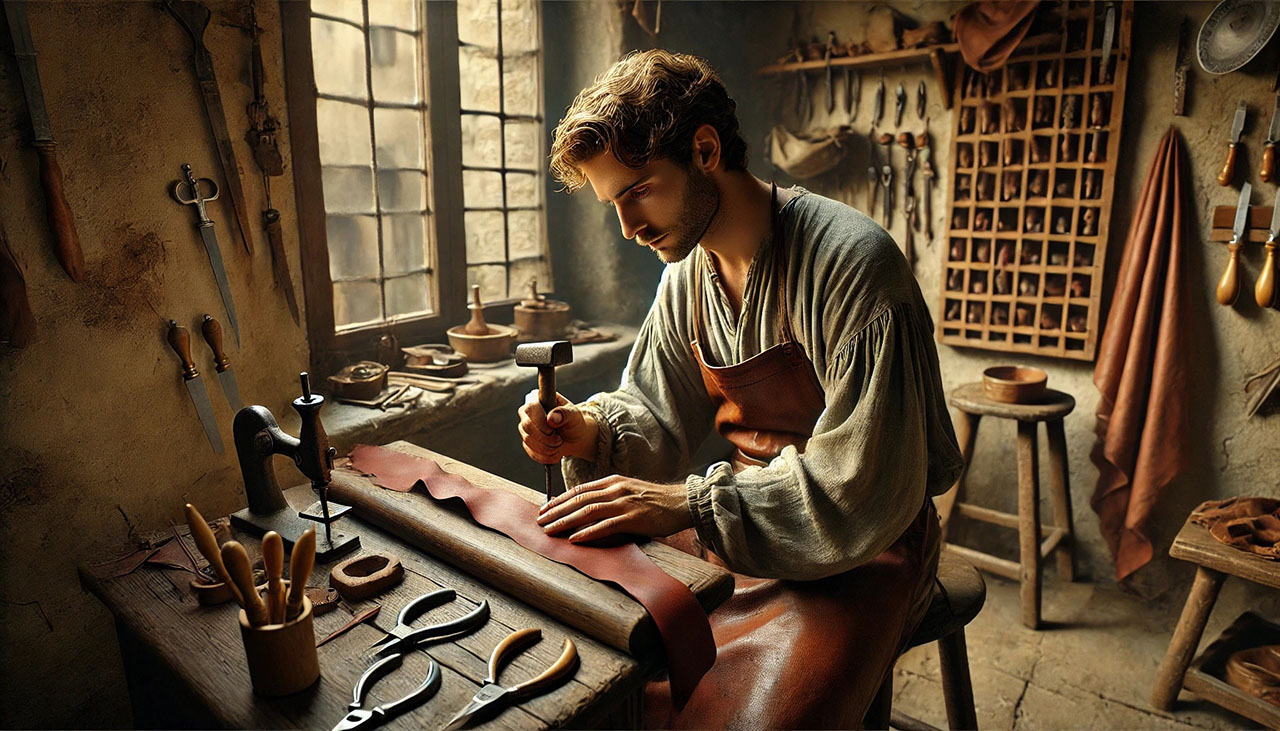
While the farmers toil in the fields, the artisans and tradespeople are busy in their workshops. The village blacksmith’s forge glows red-hot as he shapes iron into tools, horseshoes, and weapons. The carpenter’s workshop is filled with the scent of freshly cut wood as he crafts furniture, barrels, and carts.
Weavers work their looms, producing cloth from wool or flax, which will be sewn into garments by the village women. These artisans are essential to village life, providing the goods and tools necessary for daily survival.
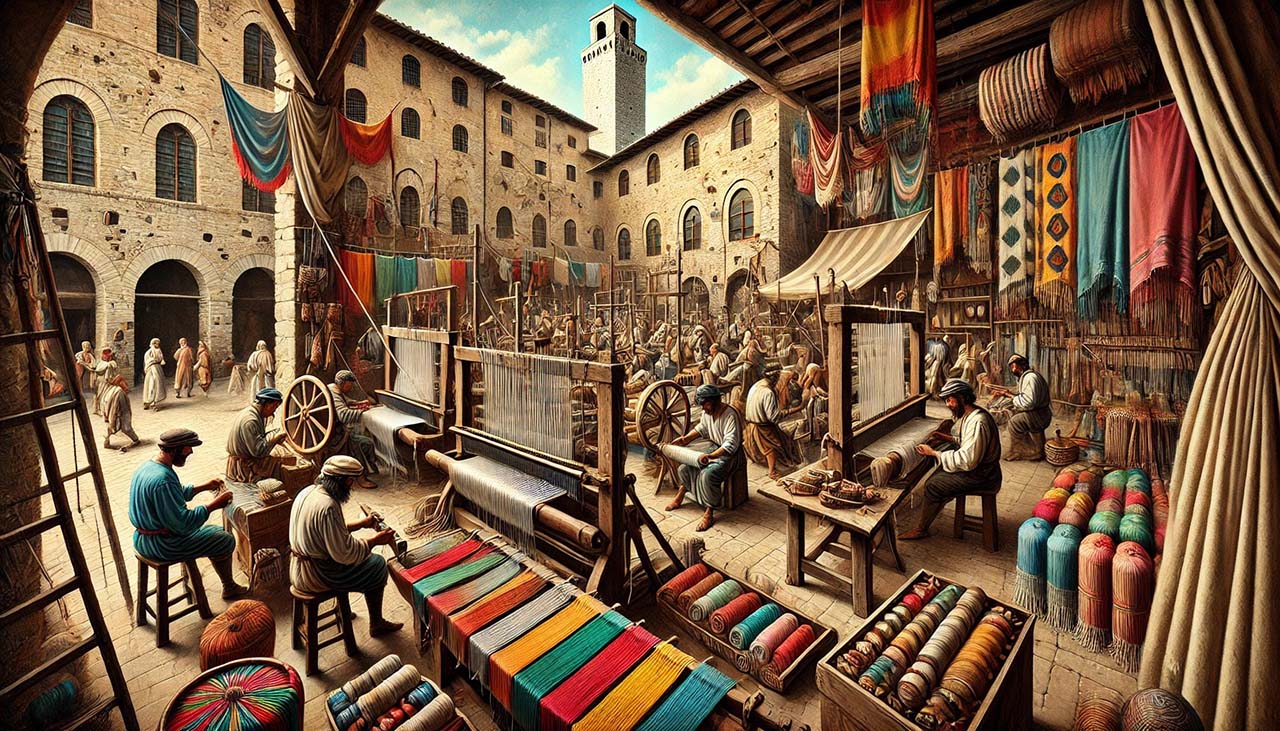
The village square, typically centered around a well or market cross, becomes a hub of activity as the morning progresses. Here, the village market takes place, where goods are traded and sold. Farmers bring their surplus produce, women offer eggs, cheese, and butter, and the local baker sells fresh bread.
The market is not just a place of commerce but a social gathering spot where villagers exchange news, gossip, and stories.
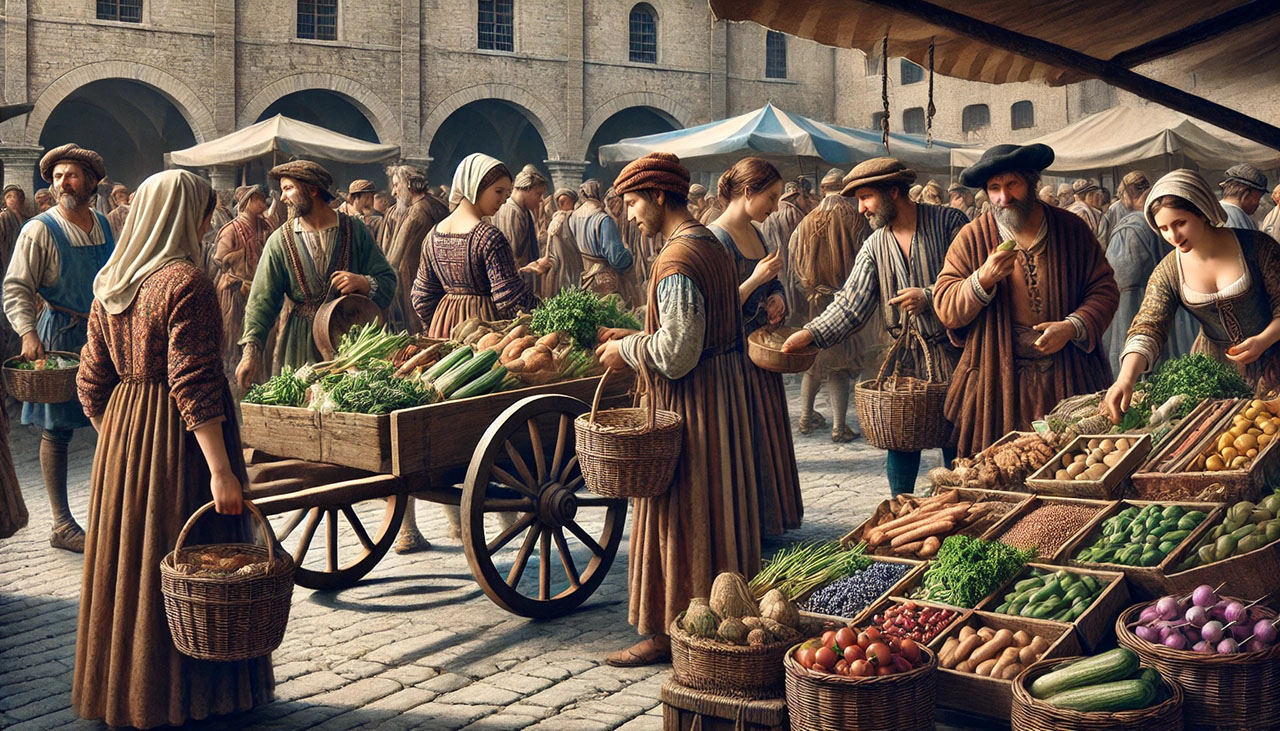
In this period, trade is expanding, especially with the growth of nearby towns and cities. Villages like this one benefit from this expansion, as they can sell their surplus produce or artisanal goods in local markets or to traveling merchants.
The rise of fairs and markets during the 1200s and 1300s brings traders and goods from afar, introducing villagers to new products and ideas. However, for most villagers, the market is where they procure their everyday needs and maintain the social fabric of their community.

Noon: A Time for Prayer and Rest
By midday, the sun is high, and the pace of work slows. The church bell rings once more, signaling the time for the Angelus, a prayer marking the Incarnation. Villagers pause their work to pray, whether in the fields, the market, or their homes. The Angelus is a moment of reflection, a brief respite in the busy day, and a reminder of the villagers’ deep religious faith.
Following the Angelus, it is time for the main meal of the day. In wealthier households, this meal might be more substantial, including bread, cheese, cured meats, and perhaps a stew made from vegetables, beans, and occasionally meat.
For most villagers, however, the meal is simple—bread, cheese, and a vegetable soup or porridge. Wine, often diluted with water, is the common drink, as it is safer than water alone. This is a time for families to gather, share food, and rest before returning to their tasks.
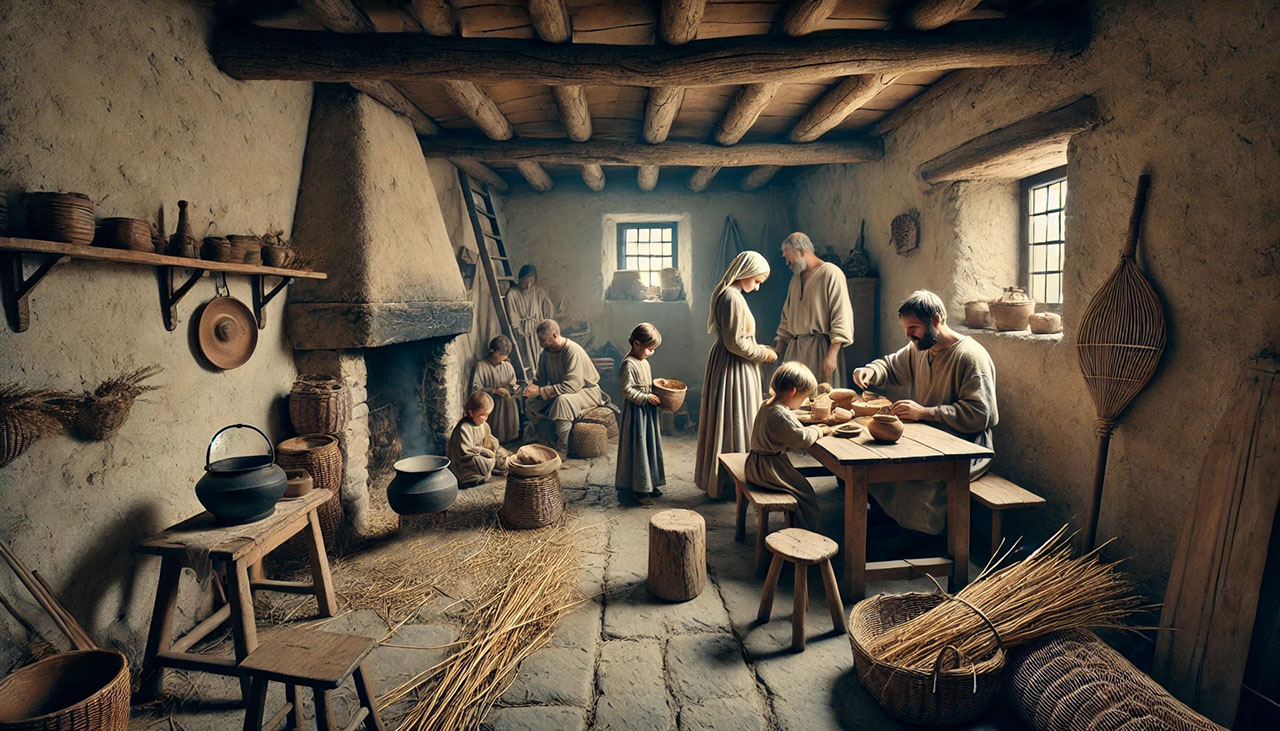
After the meal, there is a period of rest. The midday heat, especially in the summer, makes this a good time to stay indoors or seek the shade. Villagers might take a short nap, chat with neighbors, or simply relax before the afternoon’s work begins.
This break is an essential part of the day, offering a moment of peace in the otherwise demanding rhythm of village life.
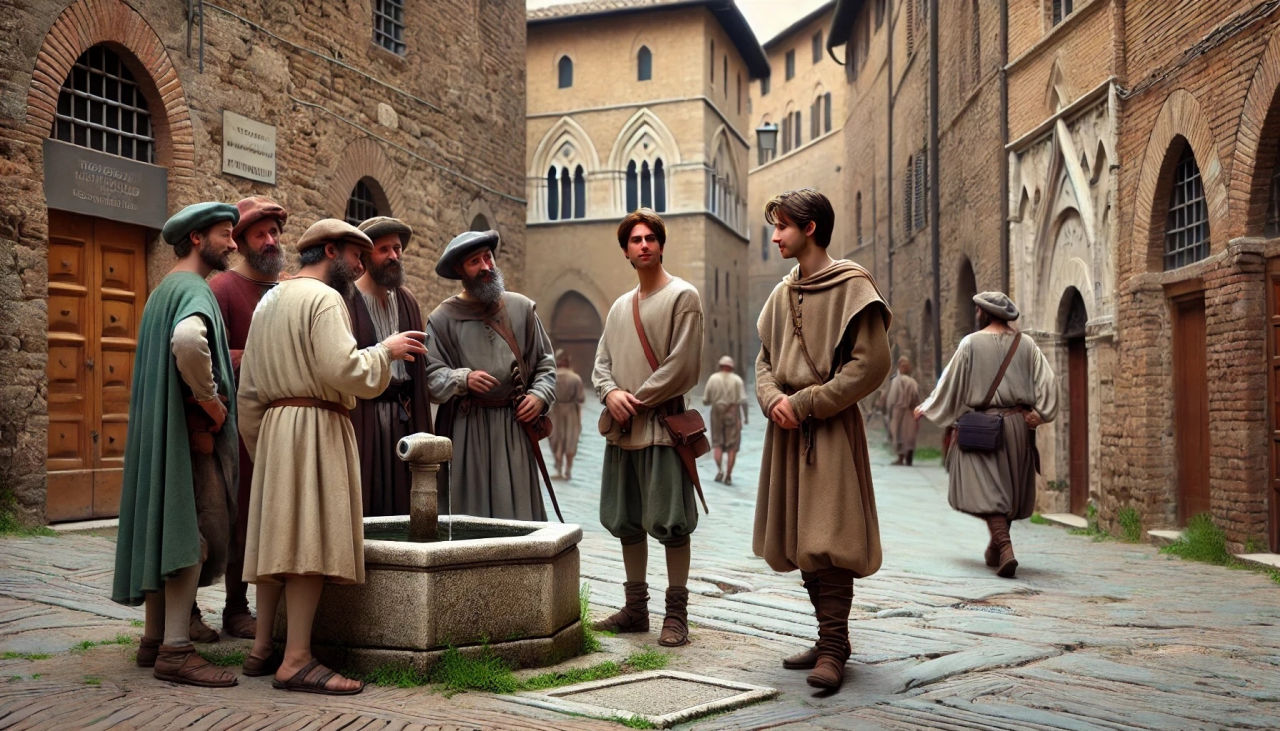
Afternoon: Villagers Head Back to Work
As the afternoon wears on, the village returns to its work. The farmers head back to the fields to finish the day’s tasks, while artisans continue their work in their workshops. The village is a hive of activity once more, with everyone contributing to the community’s well-being.
Children, too, have their roles. While they might spend part of the day playing with simple toys made from wood or cloth, they also help with household chores or tend to the animals. Education is informal, with children learning skills from their parents.
Boys often learn their father’s trade, whether it be farming, blacksmithing, or carpentry, while girls are taught domestic skills like cooking, weaving, and spinning by their mothers. Only a few children, usually from wealthier families, receive formal education, often provided by the local priest or a traveling tutor.
The village council, composed of elders or leading citizens, might meet during the afternoon in the council hall or a designated meeting place. These meetings are crucial for maintaining order and addressing communal concerns.
Disputes over land, resources, or feudal obligations are resolved, and decisions are made regarding the organization of the market, the distribution of common land, and other matters affecting the village. This self-governance is vital to the village’s stability, ensuring that the needs of the community are met and that justice is upheld.

While the village is generally peaceful, the period from 1200 to 1300 is also marked by frequent conflicts. Local lords might engage in territorial disputes, or the village could be threatened by raids from rival factions or foreign invaders.
The constant threat of war and conflict means that villagers must be prepared to defend themselves. Some villages are fortified with walls or towers, and the local lord might call upon the men of the village to serve as soldiers. This ever-present danger added uncertainty to daily life, reminding the villagers that their safety is never guaranteed.
Evening: The Day Winds Down

As the sun begins to set, the village gradually quiets down. Farmers return from the fields, artisans close their workshops, and the market winds down. The evening meal is simpler than the midday feast, often consisting of leftovers, porridge, or a thin soup. This is a time for families to come together, share stories of the day, and prepare for the night ahead.
Evenings in the village are a time for socializing and communal activities. Villagers might gather in the square or in each other’s homes, where storytellers recount tales of heroes, saints, and local legends. Music is a common form of entertainment, with villagers playing simple instruments like flutes, drums, or lutes. Dancing is another popular pastime, with everyone joining in to celebrate the end of another day’s work.
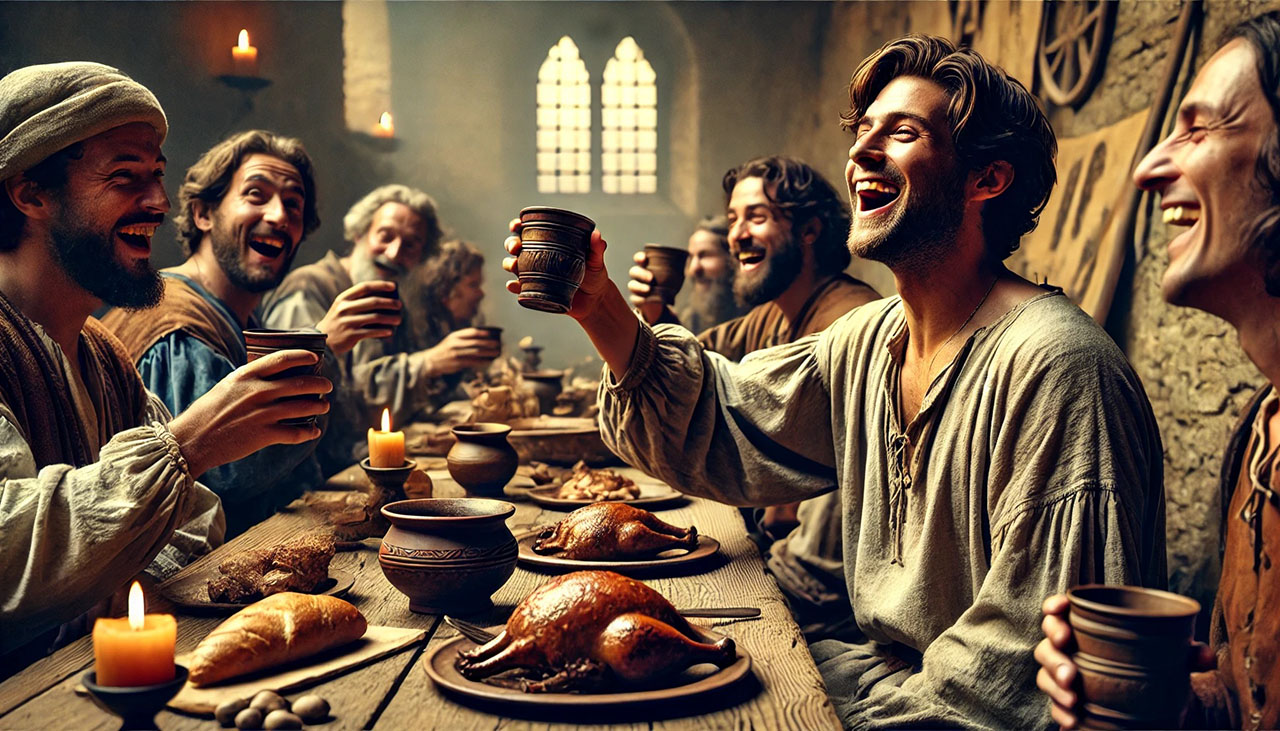
For the devout, the day ends as it began, with prayer. The church bell rings one last time, calling the villagers to evening prayers.
Those who do not attend might say their prayers at home, offering thanks for the day’s blessings and seeking protection through the night. Faith is a constant companion in their lives, providing comfort and a sense of order in a world that can be harsh and unpredictable.
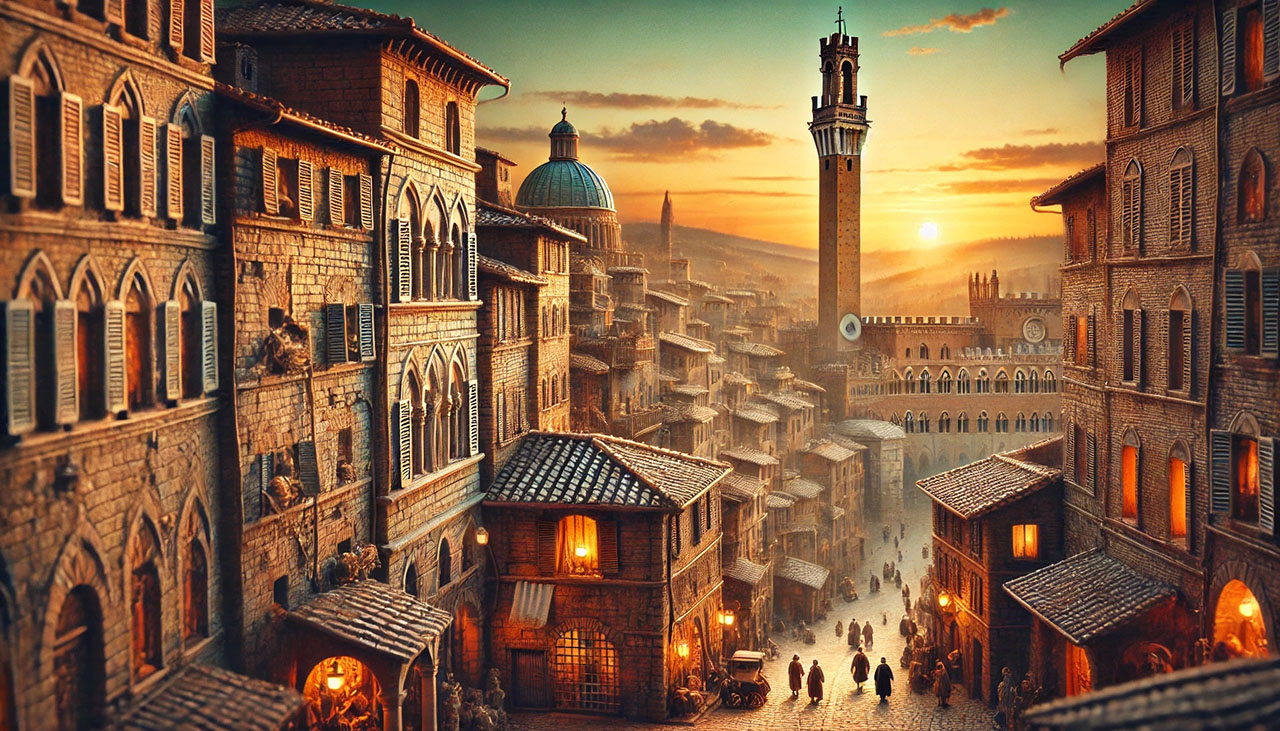
Night: The Village Sleeps
As darkness falls, the village settles into silence. The streets are deserted, and the only sounds are the occasional hoot of an owl or the rustling of the wind through the trees. Homes are secured for the night, with wooden shutters drawn and doors bolted. Families sleep close together, their homes providing a small but sturdy shelter against the outside world.
The village, though small and seemingly isolated, is a world unto itself. It is a place where life is governed by the rhythms of nature, the cycles of the seasons, and the traditions passed down through generations. Each day brings its challenges and rewards, but through hard work, faith, and the support of the community, the villagers find a sense of purpose and belonging in this medieval world.
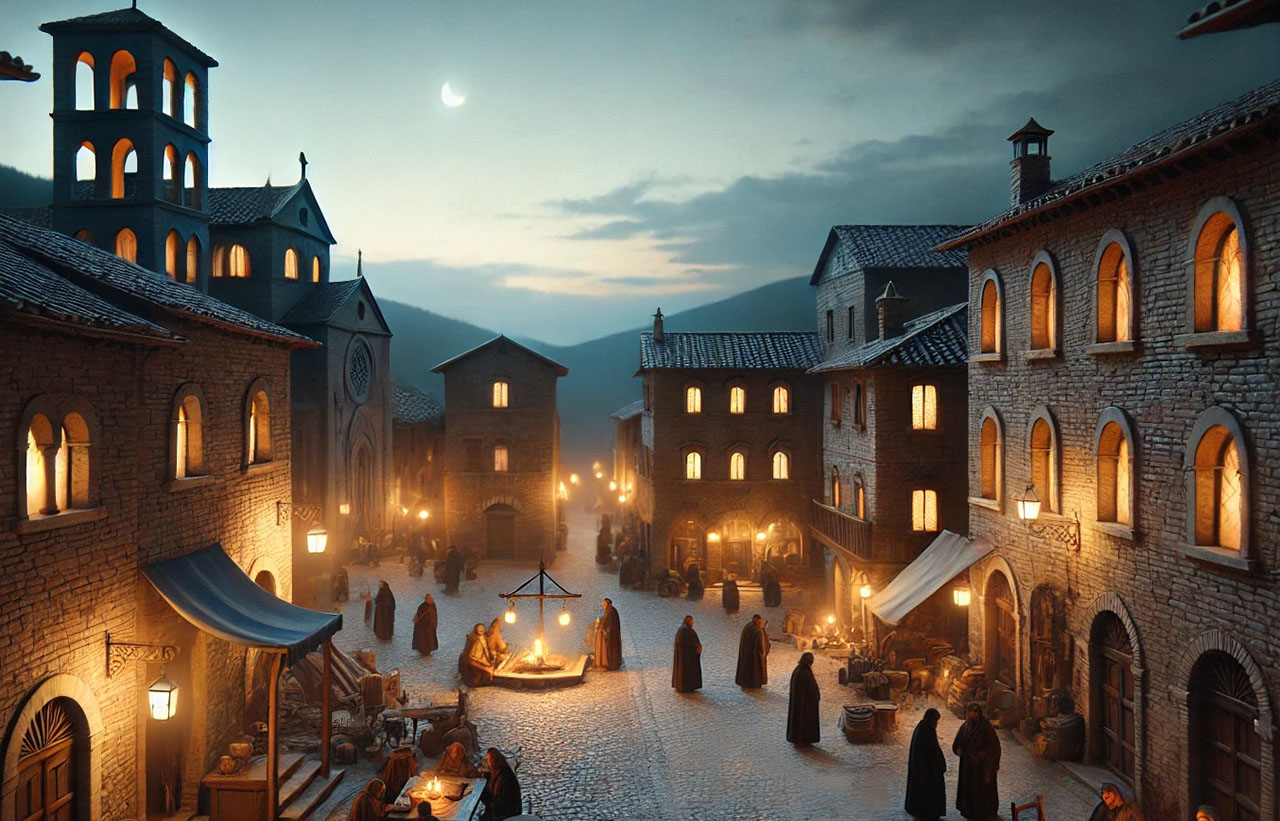
Though centuries have passed, the echoes of medieval village life still resonate in rural Italy today. The values of community, hard work, and a deep connection to the land continue to shape the lives of those who live in these ancient landscapes. The fields that once fed the villagers, the stone churches that stood as spiritual bastions, and the cobbled streets that echoed with the sounds of daily life all remain as silent witnesses to a way of life that, while long gone, still informs the character and culture of the Italian countryside.
In the villages of the 1200s and 1300s, life was a delicate balance of work, faith, and community, all under the ever-watchful eyes of nature and the divine. It was a life where each day was a testament to human resilience and the enduring power of tradition.
Find RomeCabs also online:
RomeCabs Facebook: https://www.facebook.com/RomeCabsToursAndTransfers
RomeCabs Pinterest: https://www.pinterest.it/romecabs
RomeCabs Twitter: https://twitter.com/RomeCabs
RomeCabs Instagram: https://www.instagram.com/romecabs/
RomeCabs Flickr Photo Gallery: https://www.flickr.com/photos/romecabs/
Discover MORE of Italy’s history with RomeCabs Travel blogs!
The Lake of Piazza Navona: A 200-Year Tradition You Never Imagined
Buongiorno and welcome to RomeCabs Rome Travel Blog! Today, Piazza Navona is known for its beautiful Baroque fountains, bustling cafés, and lively street performances. But did you know that this iconic square was once transformed into a lake during the summer months? Yes, the “Lago di Piazza Navona” ( Lake of Piazza Navona) was an extraordinary tradition that turned the square into a shallow lake where Romans of all social classes gathered to cool off, celebrate, and make memories.
This fascinating custom began in the 17th century under Pope Innocent X, who, along with his powerful sister-in-law Donna Olimpia Maidalchini, envisioned a revitalized Piazza Navona that could serve as a grand public space for both nobility and commoners. In the spirit of Roman creativity and celebration, Innocent X introduced a summer spectacle unlike any other in Europe.
How The Lake of Piazza Navona Began: A Pope’s Grand Vision
In the mid-1600s, Piazza Navona was a shadow of its former glory. Although it had once been the site of Emperor Domitian’s massive stadium for athletic games, by the Middle Ages, it had become a simple public space used mainly during Carnival. For the rest of the year, it was often neglected, littered with debris from the city’s markets.
Pope Innocent X, who had a family palace built nearby, saw an opportunity to turn Piazza Navona into a symbol of the Baroque splendor he envisioned for Rome. On June 23, 1652, he inaugurated the first “Lago di Piazza Navona” at the suggestion of his sister-in-law, Donna Olimpia, a formidable figure in Rome’s political and social circles. The idea was simple but brilliant: by blocking the drains of the square’s central fountain, the entire area could be flooded, transforming it into a shallow lake.
And so, each weekend in August, the heart of Rome became a “lake” where Romans would gather to enjoy music, cool off, and celebrate together—a perfect escape from the summer heat.
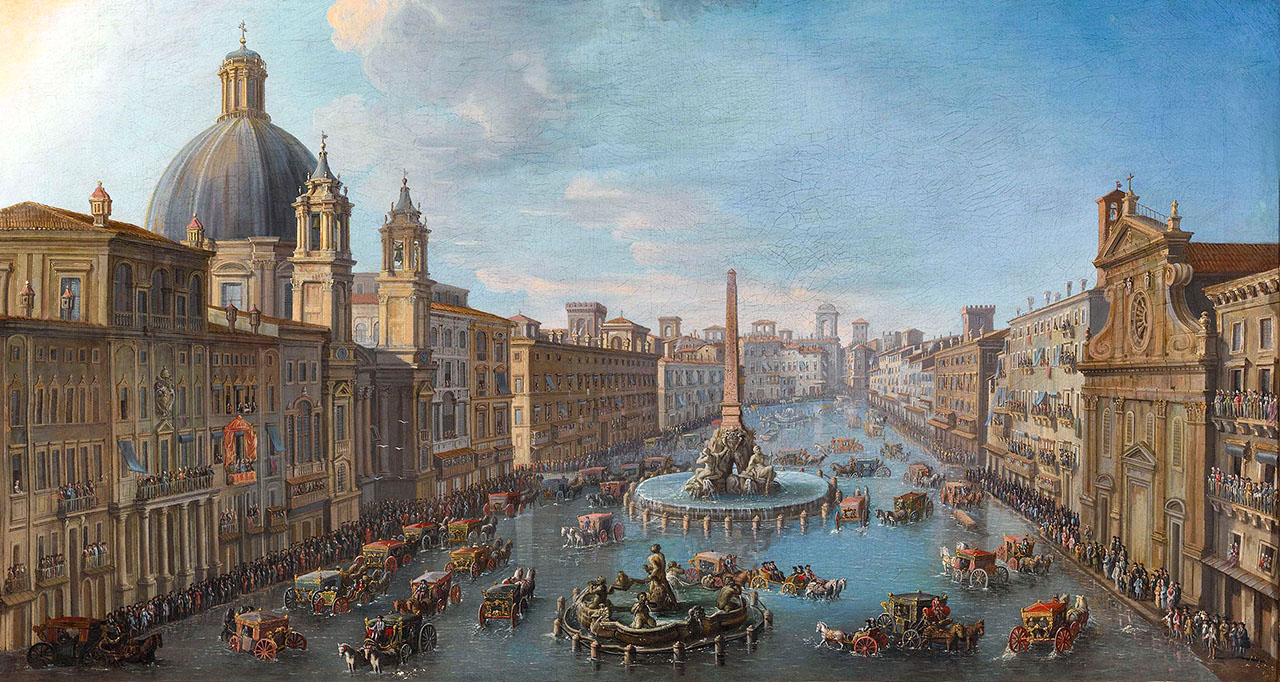
The Lake of Piazza Navona Comes to Life: A Roman Spectacle
On Saturdays and Sundays, Romans would flock to Piazza Navona to enjoy the artificial lake that transformed the square. The scene was lively and festive, with musical performances adding to the ambiance. Nobles arrived in grand carriages, while children splashed around, and families picnicked by the water’s edge.
But the Lake of Piazza Navona was more than just a place to cool off. It became a social and cultural event where the city’s aristocrats showcased their creativity. Some families went all out, commissioning elaborate carriages shaped like gondolas or ships made of wood and papier-mâché.
These vessels, complete with sails and rowers, sailed across the “lake” to the delight of spectators. Imagine the thrill of watching gondolas gliding through the heart of Rome—a scene that would be unimaginable today!
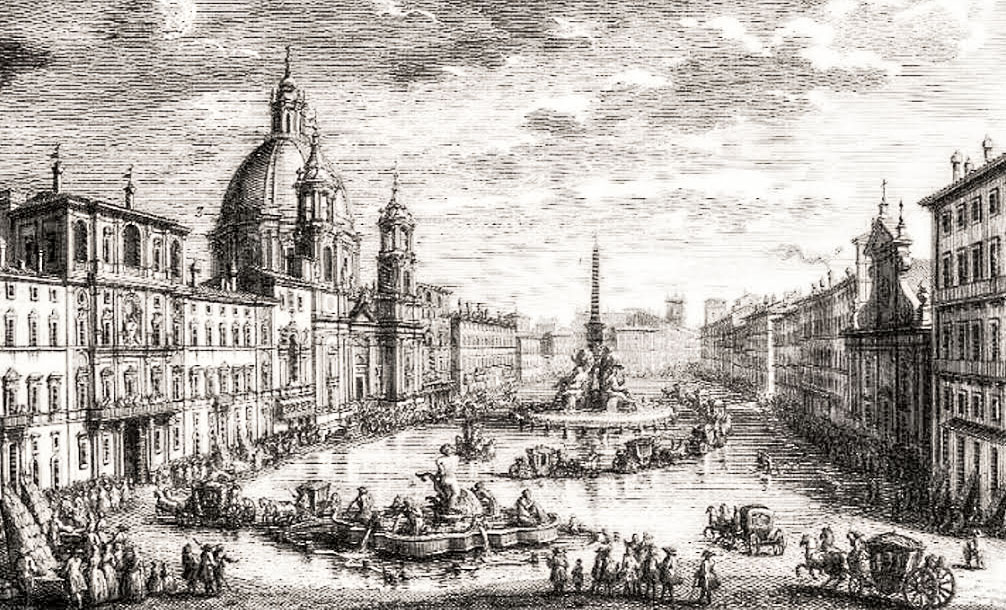
How Piazza Navona Kept Its Waters Under Control
One of the most fascinating aspects of the Lake of Piazza Navona was the engineering behind its containment. Despite filling an entire Roman piazza with water, organizers managed to keep the artificial lake within the boundaries of the square, preventing it from spilling into surrounding streets or homes. Here’s how they achieved this feat of water control in the heart of the city:
Utilized the square’s concave design: Piazza Navona’s original layout, inherited from the ancient Stadium of Domitian, played a crucial role. The piazza was constructed with a gentle concave shape, meaning its center was slightly lower than the edges. This natural dip acted as a basin, helping to contain the water safely within the confines of the square.
They blocked drainage points: To create the lake effect, event organizers would temporarily block the drainage outlets of the central fountains. Without an outlet, water slowly accumulated across the piazza, eventually creating a shallow “lake.” This method allowed them to flood the area to a controlled depth of around 50 centimeters (1.5 feet)—enough to cover the square’s surface without reaching the height needed to overflow.
Controlled depth limit: The water level was carefully monitored to avoid excessive depth. By keeping the water shallow, the organizers could create the lake effect while ensuring that water stayed comfortably within the edges of the square, preventing it from spilling out into the surrounding streets.
The Lake was temporary and supervised: The Lake of Piazza Navona was a brief summer event, taking place on certain weekends in August. Organizers closely supervised water levels, and once the festivities were over, the drains were unblocked, allowing the water to recede gradually. Within a short time, the piazza would return to its regular state, ready to welcome vendors, locals, and visitors again.
With these simple yet effective techniques, the Lake of Piazza Navona became a spectacular, controlled display that captured the public’s imagination and demonstrated the ingenuity behind Rome’s festive traditions.
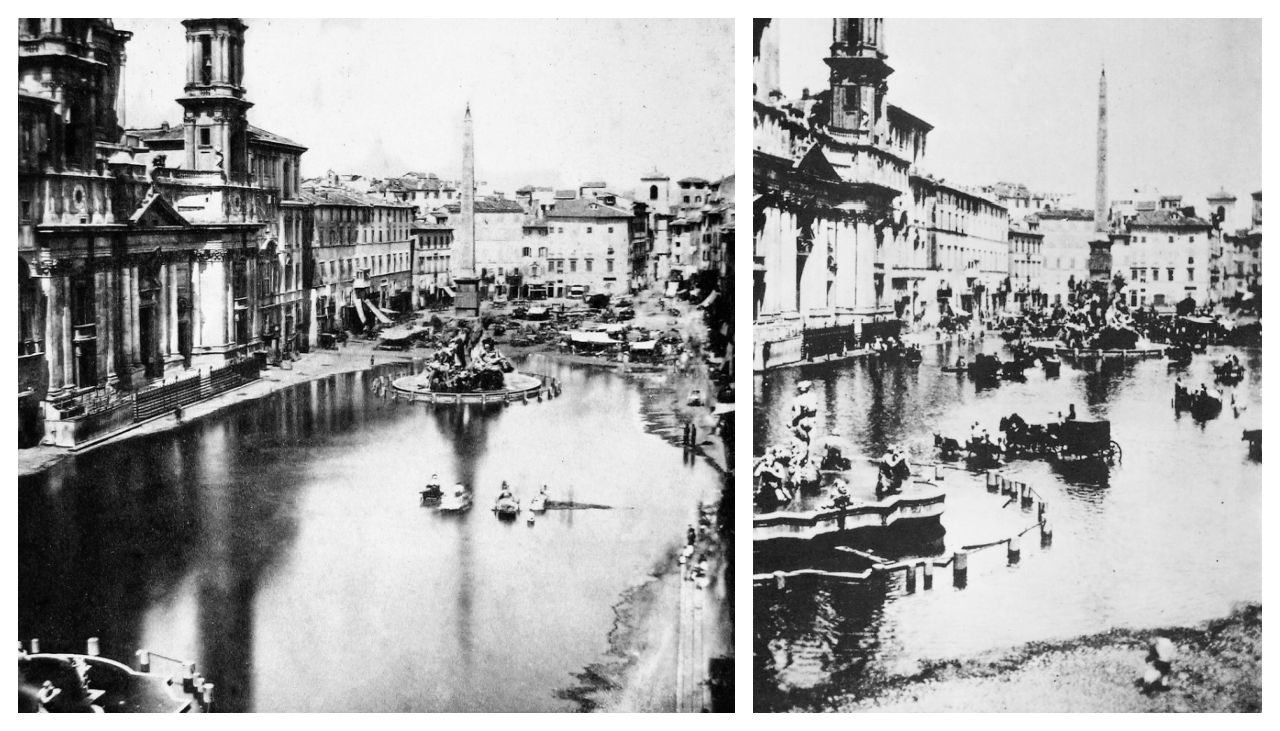
Fun and Follies of Lake of Piazza Navona
The Lake of Piazza Navona brought together people from all walks of life, creating an atmosphere of shared enjoyment and lighthearted mischief. Young men and women took the opportunity to mingle, court, and make memories in a setting as playful as it was picturesque. Even children and commoners joined in, splashing in the water, playing games, and pulling pranks.
Some legends have survived the centuries, adding to the lake’s mystique. One famous story tells of how, in 1717, several noblewomen, “perhaps heated by wine,” decided to shed their outer garments and take a spontaneous dip. Their merriment took a dangerous turn when they nearly drowned, saved only by bystanders who heroically dove in fully clothed to pull them to safety.
Another tale tells of a marquis whose horse accidentally drowned after one of its legs got stuck in a submerged hole. These stories, though likely exaggerated, captured the public’s imagination and added to the lake’s legendary status. Some accounts even claimed that the water reached a depth of over a meter, though historical evidence suggests it was likely no more than half a meter deep.

Health Concerns, Suspensions, and Revivals
Despite its popularity, the Lake of Piazza Navona was not without its controversies. In 1676, the tradition was temporarily halted due to fears that stagnant water in the square might lead to “bad air” or miasma, which was believed to cause illness. This concern wasn’t unusual; in the pre-modern world, stagnant water was often linked to poor health.
The lake was brought back in 1703 to honor Queen Maria Casimira of Poland, who was visiting Rome. At the time, the pope’s personal physician, Giovanni Maria Lancisi, assured Pope Clement XI that there were no health risks associated with the lake. That summer, Prince Giovanni Battista Pamphilj, a descendant of Innocent X, famously entered the water in a gilded gondola, adding even more splendor to the festivities.

The Lake’s Decline and Last Hurrah
By the 19th century, Rome was changing rapidly, and Piazza Navona’s days as a lake were numbered. When the city became the capital of the newly unified Kingdom of Italy, the square’s layout was modified, including the addition of sidewalks and raised areas. These changes made it more difficult to flood the piazza, and public attitudes shifted as well. The last recorded Lake of Piazza Navona event took place in 1865, marking the end of an era.
Though the lake tradition faded away, Piazza Navona continued to be a place of public gatherings and entertainment. In the early 20th century, another popular event, the “gioco della cuccagna”, took place here in May. Participants would attempt to climb a slippery pole with prizes at the top—a playful reminder of the square’s festive spirit.
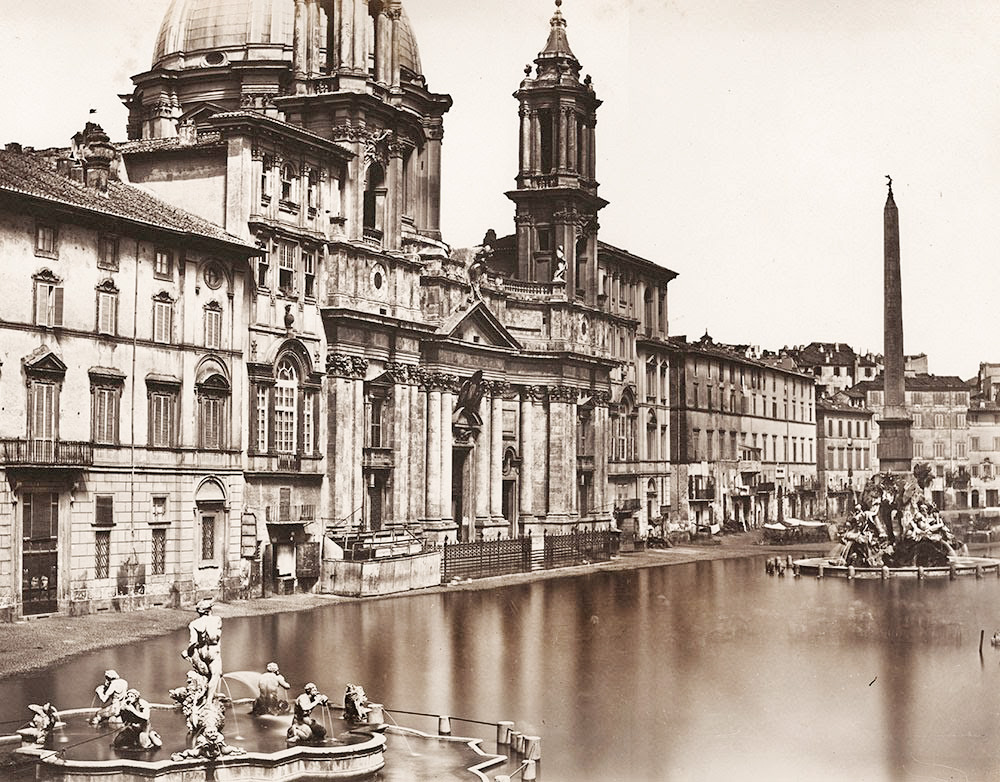
Piazza Navona: Still the Timeless Square in Rome
The Lake of Piazza Navona may be a thing of the past, but its legacy lives on in the joyful and communal spirit that still defines the square today. Now, visitors gather to admire the Fontana dei Quattro Fiumi (Fountain of the Four Rivers), enjoy a coffee at a nearby café, or watch street performers entertain the crowds. Though the lake is gone, Piazza Navona remains a cultural heart of Rome, where history, art, and daily life converge.
Imagine what it must have been like to see carriages shaped like gondolas floating in the middle of Rome, or children splashing around while music filled the air. Piazza Navona’s lake was more than an unusual event—it was a celebration of life, community, and creativity, qualities that still make Rome enchanting today.
So, next time you find yourself in Piazza Navona, take a moment to picture the lake that once filled this iconic square. While the water is gone, the magic of Rome’s “lost lake” remains, as vibrant as ever.
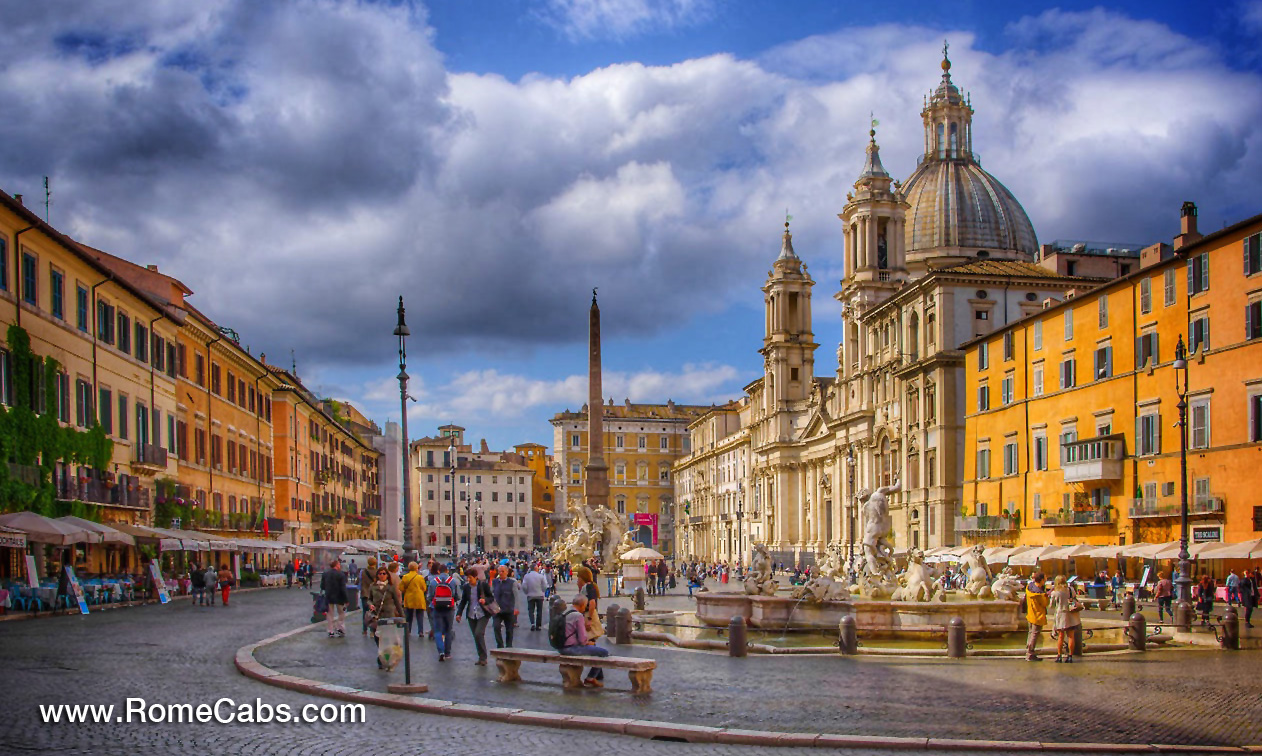
RomeCabs’ Rome Tours by Car & Shore Excursions from Civitavecchia
to Piazza Navona
Exploring Rome’s treasures, including the iconic Piazza Navona, is effortless with RomeCabs. RomeCabs’ Rome Tours by Car provide a comfortable and luxurious way to discover the Eternal City, complete with an English-speaking driver who ensures a seamless and informative experience. RomeCabs’ Rome tours by car are designed to help you make the most of your time in Rome.
For cruise passengers, RomeCabs’ Shore Excursions from Civitavecchia include a memorable visit to Piazza Navona. After enjoying the scenic drive from the port, you’ll have the opportunity to immerse yourself in the vibrant history and architecture of Rome including a stop to Rome’s most famous squares.
RomeCabs Customer Reviews from real customers:
Linda V from Santa Clarita, California wrote:
Outstanding PANORAMIC ROME TOUR
Our group was 4 senior adults. Two of us had been to Rome before, and this was a first visit for the other 2. One person had limited mobility. Our driver, Leonardo, was very understanding and accommodating to our needs and what we wanted to see. He always parked so there was the least amount of walking. The driver met us on time in our hotel lobby. His Mercedes mini-van was clean, AC worked great, gave us bottles of water, and he was a safe driver. Our Panoramic Rome Tour was 8 hours. We chose not to tour inside the Colosseum or Vatican, but to view it only. We stopped many times for pictures and to view or to walk to the sites. Leonardo was a wealth of knowledge. He had a plan, but was very flexible if there was anything extra we wanted to see or not to see. Excellent tour and excellent guide! For lunch he gave us options, but we chose to go to a small authentic Italian restaurant! Good choice! It was a long day, but we all felt we saw a lot of Rome and had a good understanding of its history.
Date of experience: August 2024
Robert S from Tennessee wrote:
Excellent does not begin to describe Romecabs
“Excellent” does not begin to describe the service provided by RomeCabs. We used them for three pickup/transfer/tour options and can not say enough good things about them. We first booked them to pick us up when we arrived at the Rome airport to include a 4 hour driving tour. Our guide first asked us what were were seeing while we were in Rome and then he proceeded to take us to places we would not get to see. The “driving tour” isn’t just a ride and see but included stopping and getting out to tour various places along the way. Next we booked the Rome hotel to cruise port transfer. Despite this only being a transfer, the driver spoke very good English and told us about various things/places as we drove to the port. Lastly, we booked the post cruise port pick up and country side tour. Again, excellent driver/guide, very accommodating, friendly, and professional. Before we booked our tours/pickups we compared prices from the top three companies in Rome. RomeCabs had the best reviews, best prices, and allowed us to pay for our bookings prior to arriving in Rome. Their competitors did not mention that option and wanted payment in Euros in person (we weren’t crazy with the idea of carrying that much money in cash). Also, the vans they picked us up in had plenty of room, were very clean, and comfortable. Definitely use RomeCabs when you are in Rome!!
* Find RomeCabs online also on:
- RomeCabs Facebook: https://www.facebook.com/RomeCabsToursAndTransfers
- RomeCabs Pinterest: https://www.pinterest.it/romecabs
- RomeCabs Twitter: https://twitter.com/RomeCabs
- RomeCabs Instagram: https://www.instagram.com/romecabs/
- RomeCabs Flickr Photos: https://www.flickr.com/photos/romecabs/
- RomeCabs Recommended on Cruise Critic
Tips for Civitavecchia Transfers, Rome Tours & MORE on RomeCabs Travel Blog

A Day in Assisi in the Middle Ages: The World of Saint Francis
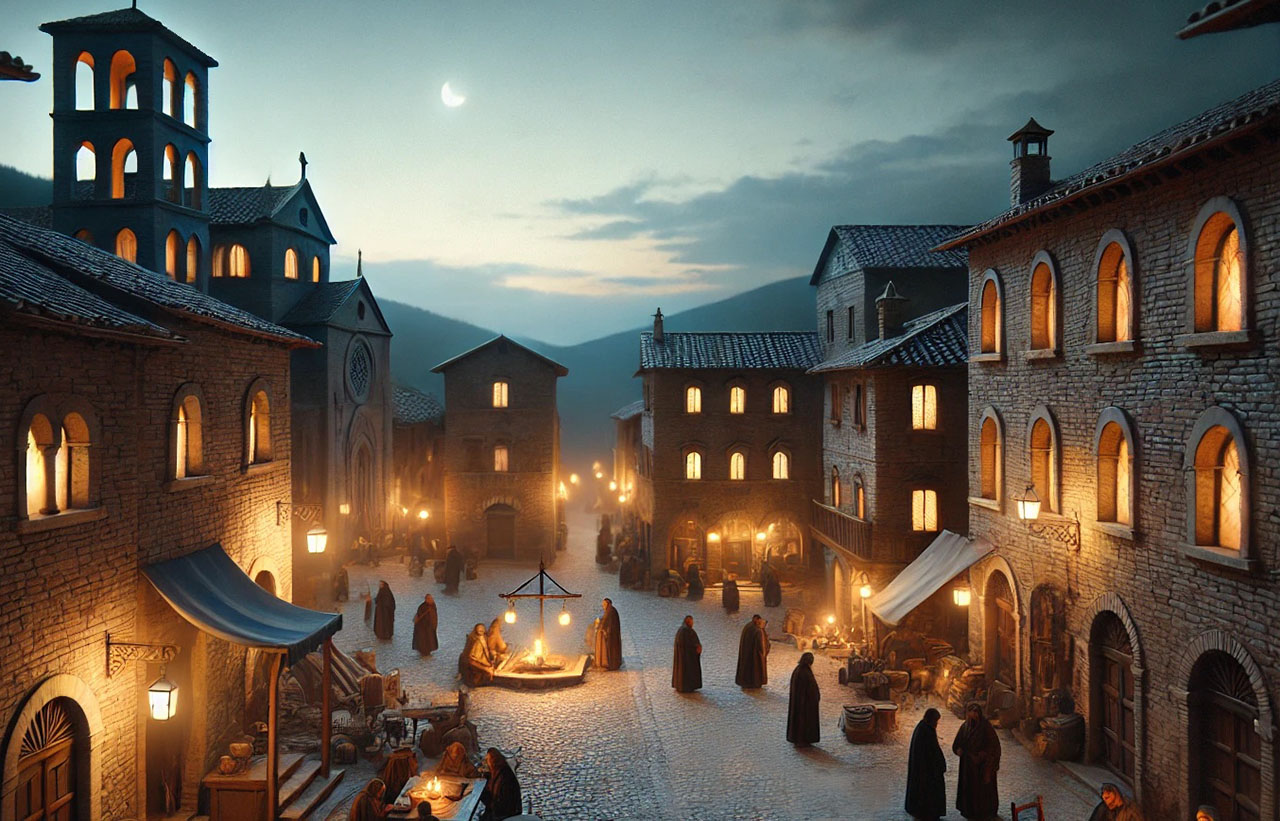
This imagined depiction of a day in Assisi in the Middle Ages and the words of Saint Francis is a creative interpretation based on historical context. While it aims to portray a day in Medieval Assisi during the early 1200s and Francis’s teachings, specific details and dialogues are reconstructed and may not reflect actual events or precise historical accuracy. Images are imagined sceneries for story-telling purposes and may not be historically accurate. This narrative is intended to illuminate a day in year 1210
The year is 1210, and the sun rises over the hills of Umbria, casting a golden light over the stone city of Assisi. High above the valley, the town clings to the slopes of Mount Subasio, its limestone buildings glowing softly in the morning air. Assisi is much smaller than the sprawling cities of today, but it is a bustling hub of medieval life. This is the home of Saint Francis, a man who has just begun to shake the foundations of society with his radical ideas of poverty, humility, and devotion.
This is a day in the life of Assisi during the Middle Ages, a time of transformation, faith, and simplicity.
Dawn in Assisi in the Middle Ages
As the first pale light of dawn begins to filter through the mist, Assisi awakens slowly, its streets still cloaked in the quiet of early morning. The soft hues of the town—gray and pink stone, rough and weathered—seem to glow faintly in the delicate light, as though the ancient city itself is stretching after a long night. The cobbled streets, worn smooth by the feet of countless generations, lie empty, their stillness broken only by the occasional echo of a distant rooster.
In the heart of the town, the Piazza del Comune stands silent, a place where history and daily life intersect. The towering Temple of Minerva, once a grand symbol of Rome’s glory, looms in the soft light, its six Corinthian pillars casting long shadows across the square. It feels ancient, watching over the town as it has for centuries, yet its purpose has changed. Now a church, dedicated to the Virgin Mary, it’s a testament to the way Assisi has embraced both the past and the present, melding pagan and Christian legacies into something new. But this morning, it stands empty, the marble cool to the touch, as if waiting for the day to begin.
A figure appears in the square—Pietro, a local craftsman, on his way to his workshop. His footsteps echo faintly as he walks, the cobblestones beneath his feet cool and damp from the morning dew.
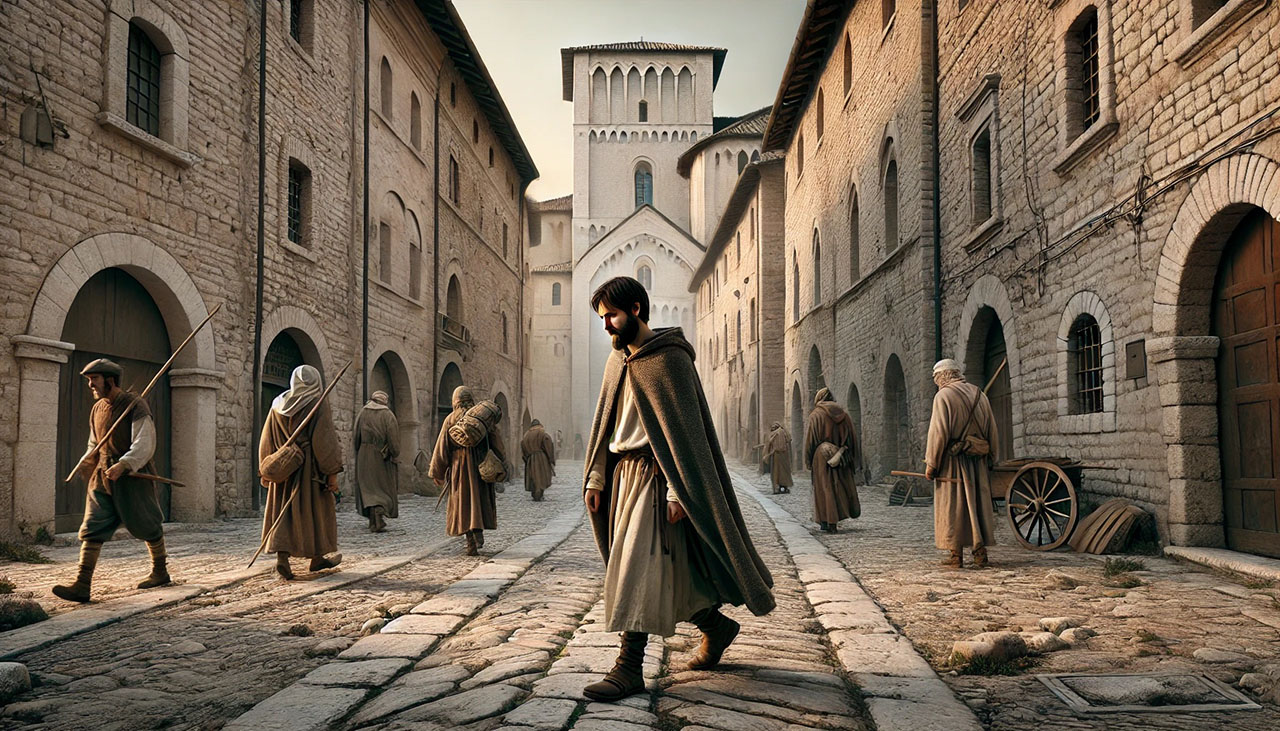
As he passes the temple, Pietro looks up, remembering how, just a decade ago, the town rose up and destroyed the Rocca Maggiore, the once-menacing fortress where Duke Corrado of Lutzen ruled with a heavy hand. The fortress had symbolized imperial power, oppressive and distant, until the townsfolk brought it down in a burst of rebellion. Now, with the communal government in place, there is a sense of self-determination, though the tension between the Guelphs and Ghibellines—supporters of the Pope and the Empire—simmers beneath the surface.
As Pietro walks on, the air is scented with the woodsmoke from nearby hearths. Around him, a few peasants are already up and about, moving quietly through the streets in their simple woolen cloaks. Their faces, lined and weathered, tell stories of long days in the fields, of harsh winters and brief summers. They walk with purpose, heading beyond the walls of the town to begin their day of labor, the tools slung over their shoulders clinking faintly as they pass.

The streets begin to stir as more townsfolk emerge from their homes. Women sweep doorways, sending faint clouds of dust into the cool morning air, while shopkeepers raise the shutters on their stalls, preparing for the day’s business. From a nearby alley, the low murmur of Benedictine monks can be heard, their chants drifting softly on the breeze as they begin their morning prayers in the chapel. Pietro glances toward the communal courthouse, housed in part of the ancient temple. Here, the Capitano del popolo will soon take his seat, overseeing the affairs of the town, and ensuring that the will of the people is carried out.
As Pietro nears the edge of the town, the Roman walls come into view, their stonework still standing firm after centuries. These walls, once the boundary of the town, now seem almost too small to contain the growing life of Assisi. Beyond them, the fields stretch out under the rising sun, waiting for the peasants and farmers to sow and harvest, just as their ancestors did.
Morning Mass at Cathedral of San Rufino
The golden light of dawn illuminated the cobblestones beneath his feet as he walked toward the Cathedral of San Rufino. Though Pietro had always been a man of habit, today felt different—an inexplicable sense of weight hung in the air. The morning was cool, with a faint breeze carrying the lingering smell of dew on stone and the earthy scent of the previous night’s rain.
Ahead of him, the cathedral stood, a silent sentinel to centuries of faith. Pietro joins the steady stream of townsfolk making their way toward the Cathedral of San Rufino. The air inside is rich with the mingling scents of beeswax candles and incense, the aroma weaving through the stone arches and ancient frescoes. The priest, clad in simple yet ornate vestments, begins the Latin prayers, his voice resonating softly through the cathedral. Pietro bows his head, joining in the collective devotion of the congregation.
The priest, clad in simple yet ornate vestments, leads the congregation in Latin prayers. His voice reverberates gently through the cathedral, merging with the murmurs of devotion from the gathered townspeople. Amid the sea of worshippers, a young man stands out with his humble appearance—dressed in a tattered robe cinched with a simple rope belt.
Despite his tattered attire, this figure exudes a profound serenity that seems to transcend the ordinary. As he kneels on the cold, uneven floor, his posture reflects deep reverence and devotion. His choice to live a life of voluntary poverty contrasts sharply with the more elaborately dressed congregation, underscoring his commitment to humility and service.
As the Mass concludes, the townsfolk slowly begin to disperse, their footsteps echoing softly through the cathedral’s sacred space. The cathedral, now emptying, returns to its tranquil state, a silent witness to the profound choices that shape the lives of those who enter its doors.
A Day in Medieval Assisi
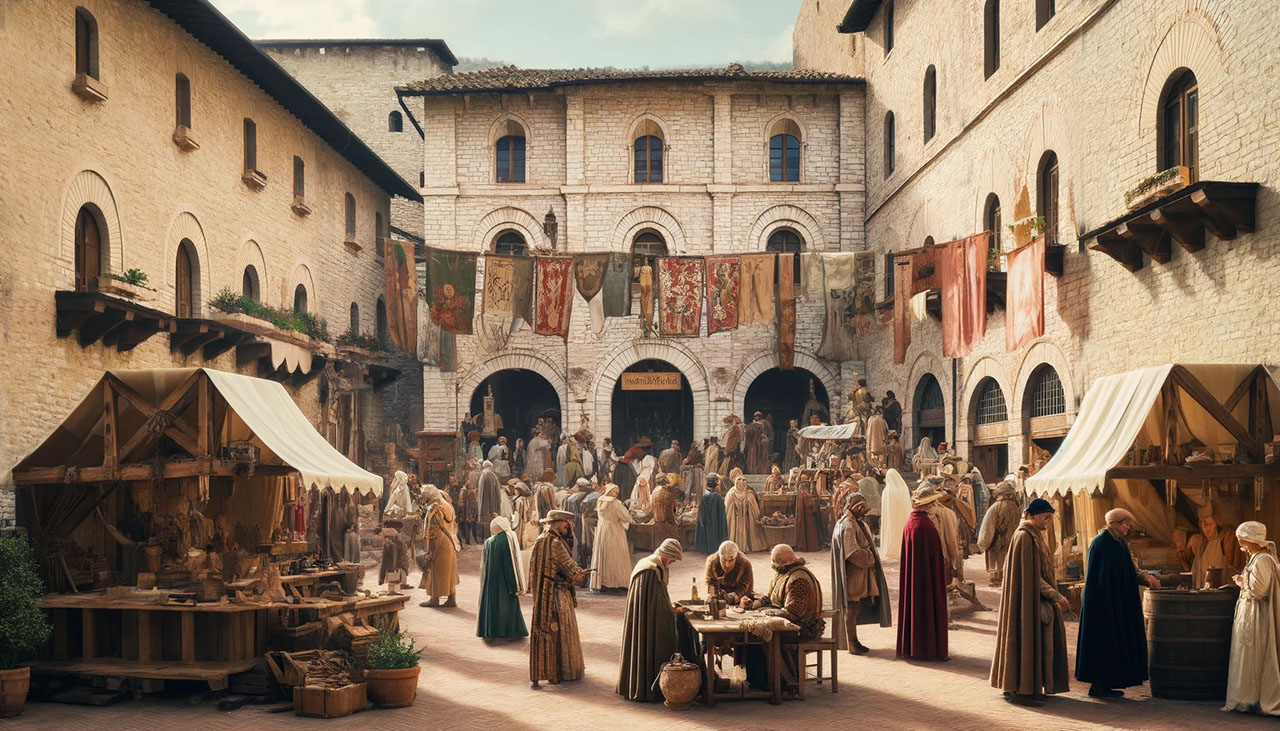
Pietro steps out of the church and makes his way to the nearby Piazza del Comune. The square, now fully awakened, is alive with the energy of the market. Merchants, their faces flushed with the effort of setting up, arrange their wares with practiced efficiency. The rhythmic clinking of coins and the spirited bartering of voices blend into a lively symphony, punctuated occasionally by the neighing of horses tethered to wooden posts.

The marketplace is a feast for the senses. The air is filled with the aroma of fresh bread baking, mingling with the sharp scents of cured meats and pungent cheeses. As he navigates the market, the earthy notes of basil and thyme from herb vendors blend seamlessly with the sweet fragrance of ripe, sun-kissed fruits.
The blacksmith’s forge, just a short walk away from the square, sends out rhythmic clangs that punctuate the market’s background hum. The heat and metallic scent of his work mingle in the nearby streets, a testament to the craftsmanship that supports the town’s daily life.
Similarly, the potter’s shop, a little off the main thoroughfare, showcases expertly crafted vessels. The soft thud of clay being shaped and the steady spin of the wheel create a rhythmic background to the potter’s art. Though not directly in the square, their presence is felt through the fine wares displayed by market vendors.
A Chance Encounter with Francis
After purchasing a loaf of freshly baked bread and a wheel of cheese from the market, Pietro tucks his purchases securely under his arm and begins making his way through the bustling streets of Assisi towards his workshop. The town is alive with activity, but amidst the clamor, Pietro’s attention is drawn to a figure who stands apart from the usual flurry of merchants and townsfolk.
Francis of Assisi, clad in a threadbare robe and walking barefoot, stands at the edge of a vegetable stall. His simplicity contrasts sharply with the richly dressed townsfolk moving about their business. Instead of commanding a raised platform, he engages with small, gathered groups, his voice rising gently above the din of the marketplace.
“Dear friends,” Francis’s voice carries a soothing warmth, “look around you at the wonders that surround us. Observe the olive trees, steadfast and enduring through the harshest winters. They weather the cold and storms, yet they yield their fruit when the season is right. Their resilience teaches us a sacred truth.”
Francis gestures toward the distant olive groves, their gnarled branches and vibrant leaves framed by the soft morning light. His message is delivered with a serene intensity that captivates those who pause to listen.
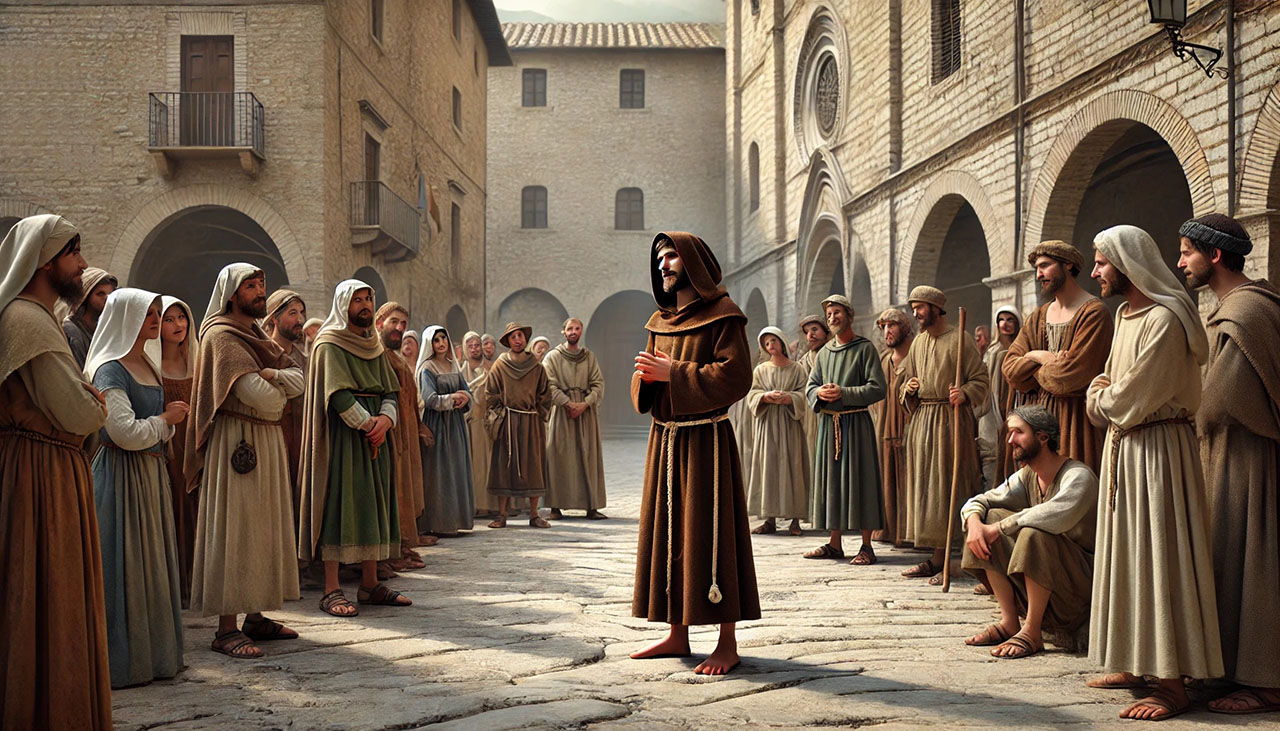
“Just as the olive tree stands firm, so must we remain steadfast in our love and service to one another. Life will present us with trials—famine, disease, and the bitter cold of hardship. Yet, if we root ourselves in love and compassion, we will bear fruit in the form of peace and joy, both for ourselves and for those around us.”
He continues, his tone gentle yet impassioned, “True contentment does not lie in the wealth of the world or in the splendor of our possessions. It is found in the simple acts of kindness we offer to each other. It is found in moments of gratitude for our blessings, however modest.”
Francis pauses, allowing his words to resonate. The crowd, a mixture of peasants, artisans, and traders, listens attentively, their usual concerns momentarily forgotten.
“Imagine,” Francis says softly, “a life where we measure our worth not by the riches we amass, but by the love we share. Envision a community where each person is valued and every act of kindness contributes to the whole. This is the life to which we are called—a life of humility and service. By embracing simplicity, finding joy in humble moments, and serving one another with open hearts, we serve Christ himself. In this simplicity, we draw closer to the essence of our faith.”
As Pietro observes, he sees the impact of Francis’s presence. The crowd’s faces reflect a deep contemplation, their usual preoccupations momentarily set aside. Francis’s simple, profound message transforms the atmosphere, offering a vision of a life imbued with purpose and grace.
With a renewed sense of reflection, Pietro continues his journey through the narrow, winding streets, leaving behind the market’s bustle. As he walks, he notes the grander buildings within the town walls. Constructed from finer stone, these structures contrast sharply with the modest homes of the peasants. Inside, he imagines the wealthier families enjoying luxuries and comforts not accessible to the poorer citizens whose labor sustains the town.

The disparity between the opulence of the wealthier families and the hardships of the peasants underscores the town’s social divide. Yet, it is the message of Francis—one of simplicity, service, and humility—that resonates deeply as Pietro heads towards his workshop. The sight of Assisi’s varied dwellings and the enduring spirit of its people weave together a rich tapestry of life in this medieval town.
A Workday of a Craftsman in Medieval Assisi
Entering his workshop, Pietro is greeted by the familiar sights and sounds of his trade. The space is filled with the earthy scent of freshly cut wood and the faint aroma of the leather he uses for crafting. His hands move deftly, shaping and refining the items for the day’s orders. The steady hum of his work blends with the occasional creak of the wooden floor and the distant clatter of horse-drawn carts on the cobblestones outside.
Throughout the day, Pietro’s workshop becomes a hive of activity. Local artisans drop by to discuss their needs, exchanging news and gossip with Pietro as they do so. The rhythmic clinking of tools and the soft murmur of conversations form a backdrop to his efforts. The sunlight filtering through the small window casts a warm glow over the room, making the intricate patterns of his work stand out with clarity.

As the sun climbs higher in the sky, the town’s bustle reaches its peak. Merchants call out their wares, children play in the streets, and the air is filled with the lively clamor of a vibrant community. Pietro takes a moment to step outside, savoring the fresh air and the sounds of the town. The marketplace remains a lively spectacle, with people haggling over goods, while the scent of freshly baked bread and rich cheeses continues to waft through the streets.
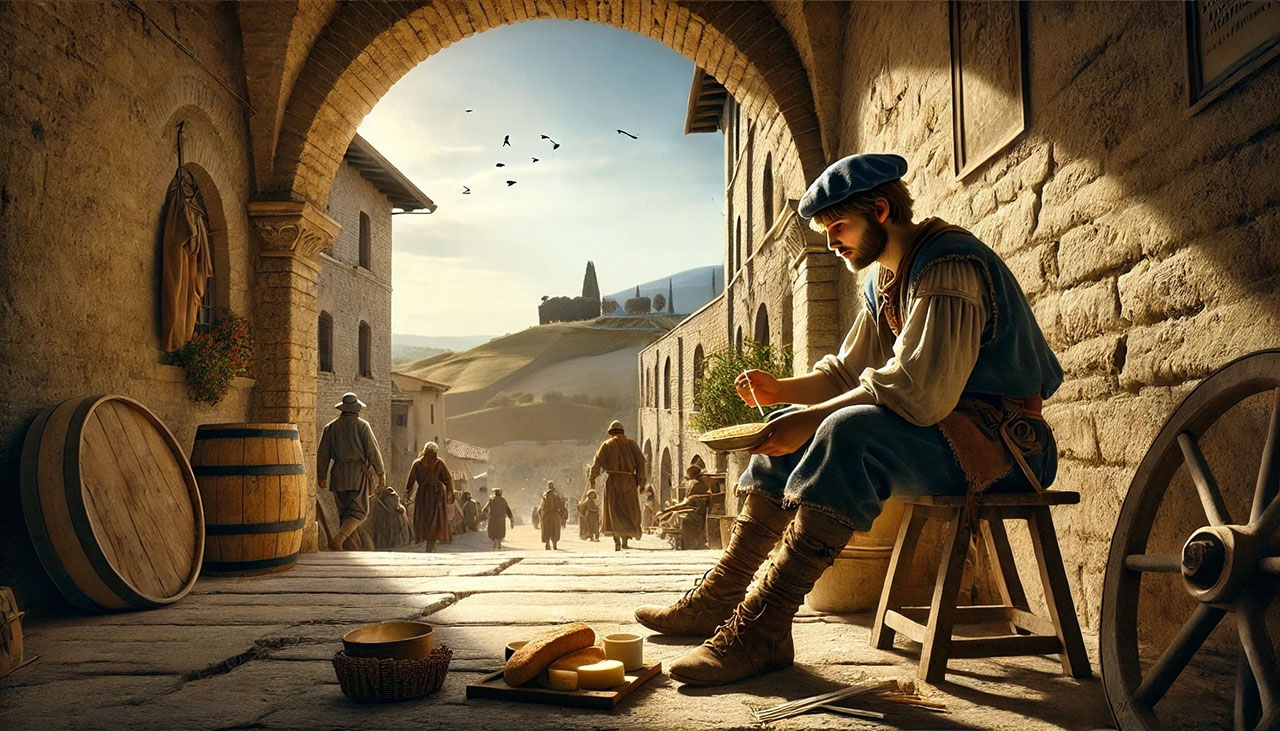
By midday, the sun is high, and Pietro takes a break to enjoy a simple meal. He finds a quiet spot in the shade of a nearby archway, savoring the bread and cheese he purchased earlier. As he eats, he watches the flow of life around him—the comings and goings of townsfolk, the distant toll of the church bells, and the constant movement that characterizes a thriving medieval town.
As afternoon wanes, the light softens, casting long shadows across the cobblestones. Pietro returns to his workshop, where he continues his work until the light begins to fade. With the approach of evening, the energy of the town gradually shifts from the bustle of daytime activity to a more subdued, reflective mood.
Nightfall in Medieval Assisi
As evening settles over Assisi, the once-busy streets now exude a calm stillness, illuminated softly by the glow of lanterns. The air is cooler, carrying the comforting scent of cooking fires from the homes that line the streets.
In the central square, the warm light of lanterns creates a cozy ambiance. A few families and friends gather in small groups, their voices mingling with the gentle strumming of lutes and the soothing melodies of songs from local musicians.
As night deepens, Assisi embraces a peaceful quiet. Lanterns flicker in the windows of the town’s stone buildings, their soft light dancing across the darkened streets. The occasional call of a watchman and the distant rustle of nighttime creatures punctuate the stillness, adding to the tranquility of the evening.
The townspeople find solace in their nightly routines. Many retreat to their homes, their thoughts turning to their faith and the promise of a new day. In the stillness of the night, the simple rhythms of life continue as families prepare for rest, their day’s work complete.
Amidst this tranquil darkness, Pietro falls asleep imagining what tomorrow will bring.
A Glimpse into the History of Assisi
Located on the side of Mount Subasius in Umbria, Assisi is a town steeped in rich history and vibrant cultural heritage. Its story unfolds over millennia, from its early Roman roots to its pivotal role in the medieval era and beyond.
Assisi’s origins trace back to the ancient Roman period. Originally a modest settlement, it grew under Roman rule, flourishing as a center of trade and culture. The town was encircled by Roman walls, remnants of which can still be seen today. The Temple of Minerva, with its imposing Corinthian columns, stands as a testament to the town’s Roman legacy. After the fall of the Roman Empire, Assisi, like many towns, transitioned into the medieval period, adapting to new political and social dynamics.

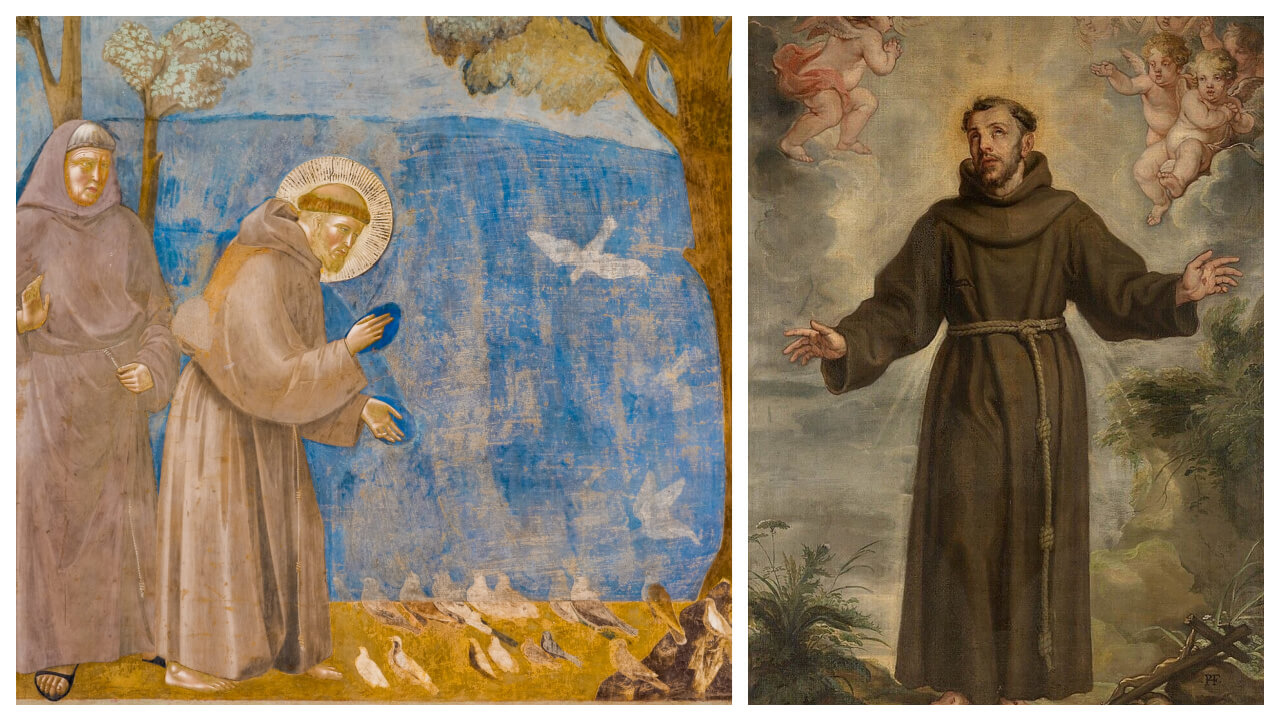
The medieval era marked a turning point for Assisi. By the early 13th century, the town had become a hub of religious and political activity. The rise of the Franciscan Order, founded by St. Francis of Assisi in 1209, brought significant change.
St. Francis, born Giovanni di Pietro di Bernardone, chose a life of poverty and service, profoundly influencing the town’s character and its role in the broader Christian world. His teachings and the Franciscans’ emphasis on humility and simplicity resonated deeply, shaping Assisi’s identity.
The Rise of the Commune and the Guelph-Ghibelline Rivalry in Assisi
The 12th and 13th centuries saw Assisi emerge as a free commune, a reflection of the broader Italian trend towards municipal independence. In 1198, the town experienced a popular uprising against the feudal authorities, leading to the demolition of the Rocca Maggiore, the fortress of Duke Corrado of Lutzen.
This was part of a larger struggle between the Guelphs, who supported the papacy, and the Ghibellines, who aligned with the Holy Roman Empire. Assisi, like many Italian towns, was embroiled in this factional conflict, which influenced its political and social landscape.

Assisi’s Religious and Artistic Legacy
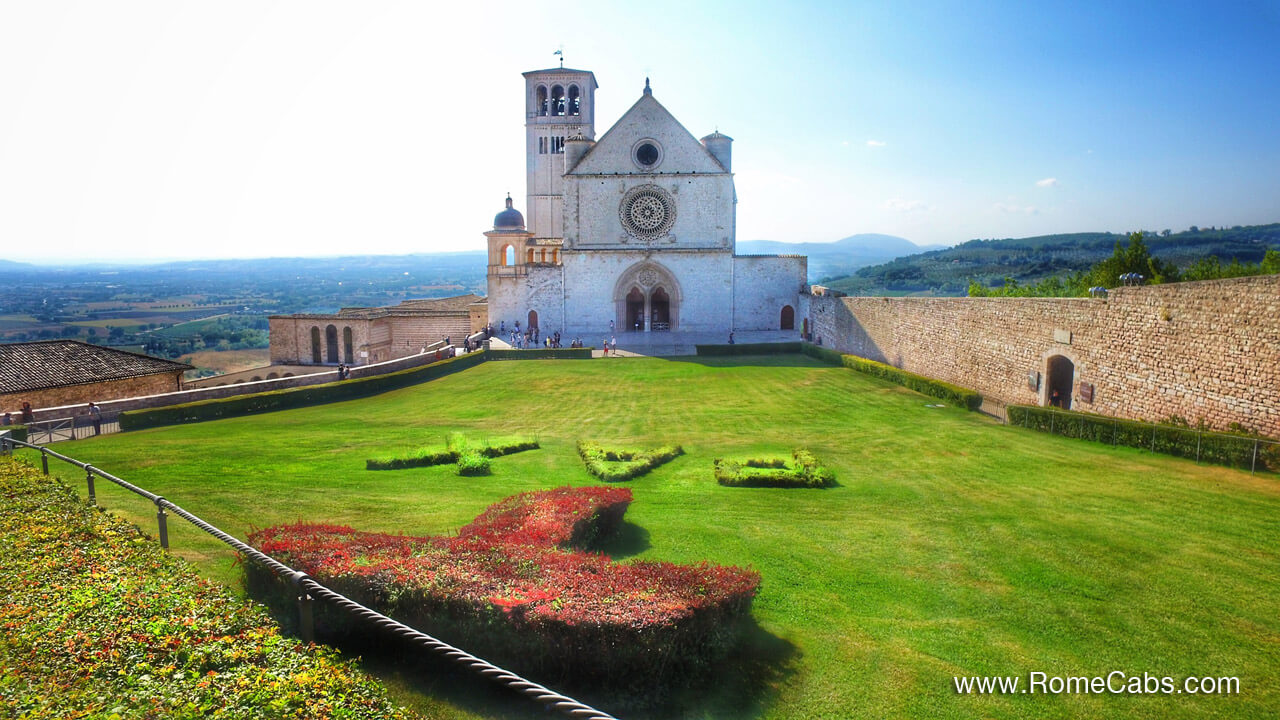
The influence of St. Francis extended beyond his lifetime, as the Franciscan Order grew to become a major force within the Catholic Church. Assisi became a pilgrimage site, attracting visitors from across Europe. The Basilica of San Francesco, with its stunning frescoes by Giotto and Cimabue, was constructed to honor St. Francis and remains one of the town’s most significant landmarks.
Throughout the Renaissance and beyond, Assisi continued to develop while preserving its historical essence. Its architecture, including medieval buildings and churches, reflects the town’s enduring legacy. Today, Assisi is celebrated for its well-preserved medieval character and its role in the history of Christianity.
Assisi Today
In modern times, Assisi remains a beacon of historical and spiritual significance. Visitors from around the world come to explore its ancient streets, fun festivals, and the enduring spirit of St. Francis. The town’s blend of historical depth, architectural beauty, and spiritual resonance makes it a unique destination, offering a window into the past and a continuing celebration of its rich heritage.
From its Roman origins through its medieval transformations to its present-day allure, Assisi’s history is a captivating story of change, continuity, and enduring faith.

Visiting Assisi from Rome
For those looking to experience Assisi firsthand, RomeCabs offers convenient day tours from Rome to Assisi, providing a private English-speaking driver at your service. You can also explore Assisi and Orvieto together, immersing yourself in the historical and cultural treasures of these remarkable destinations. Whether you’re drawn to the medieval charm of Assisi or the captivating beauty of Orvieto, these tours offer a seamless and enriching way to experience the heart of Italy’s historical landscape.
Day Tours from Rome to Assisi
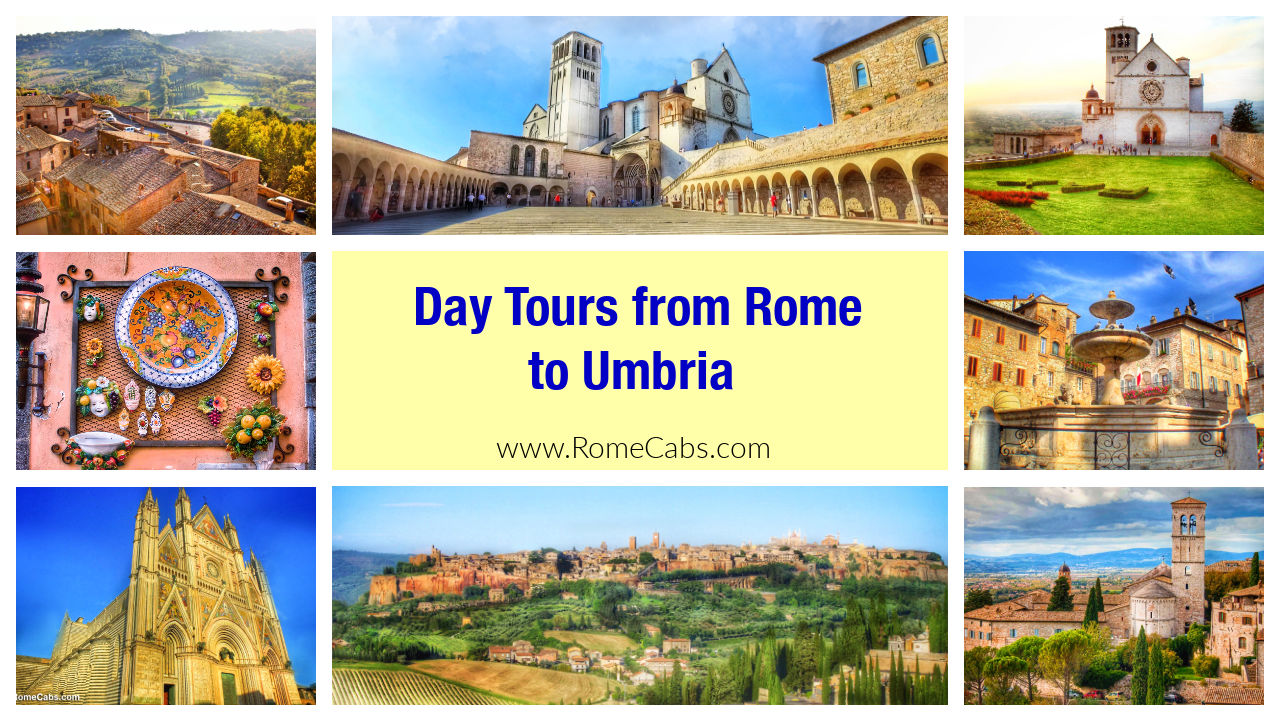
Embark on a journey to the enchanting medieval city of Assisi, the birthplace of Saint Francis, with our exclusive Day Tour from Rome. This tour offers a unique opportunity to delve into the rich history and spiritual legacy of Assisi while traveling in the comfort of a private, climate-controlled deluxe vehicle. With a personal English-speaking driver at your service, you’ll experience the serene beauty of Umbria and the charm of Assisi in a way that’s both luxurious and personalized.
Please note that you will Self Tour independently while away from the vehicle.
Assisi Tour from Rome Itinerary:
- Santa Maria degli Angeli Church: Begin your tour with a visit to this significant site, where you’ll see the Porziuncola, the humble chapel where the Franciscan movement began, and the Capella del Transito, the place where Saint Francis passed away.
- Basilica of St. Francis: Explore both the lower and upper basilicas dedicated to Saint Francis. Admire the stunning frescoes and architectural marvels that commemorate the life and teachings of this revered saint.
- Piazza del Comune: Stroll through the main square of Assisi, a vibrant hub surrounded by historical buildings and charming cafes.
- Santa Maria Sopra Minerva: Visit this church in the main square, originally a Roman temple, which reflects Assisi’s layered historical narrative.
- Basilica of Saint Clare: Discover the basilica dedicated to Saint Clare, a close companion of Saint Francis and founder of the Poor Clares.
- San Damiano Monastery: Wander through this serene monastery, surrounded by olive groves and offering breathtaking views of the landscape.
Jewels of Umbria – Assisi and Orvieto Tour from Rome
.
Uncover the hidden gems of Umbria with RomeCabs’ day tour from Rome to Assisi and Orvieto. This private tour provides an immersive experience of two of Umbria’s most captivating destinations, combining historical exploration with scenic beauty. RomeCabs’ private tours ensure optimal comfort and flexibility, with a dedicated English-speaking driver to enhance your experience. Enjoy the convenience of pick-up and drop-off at your hotel in Rome, making your exploration of Umbria both effortless and enjoyable.
Please note that you will Self Tour independently while away from the vehicle.
Jewels of Umbria Assisi and Orvieto Tour Itinerary:
Visit Assisi:
- Basilica of Saint Francis: Begin with a visit to this iconic basilica, home to extraordinary frescoes and a site of pilgrimage.
- Basilica of Saint Clare: Explore the basilica dedicated to Saint Clare, renowned for its spiritual significance and architectural beauty.
- Lunch and Stroll in the Town Square: Enjoy a delightful lunch at a local restaurant and take a leisurely stroll through the charming town square.
Visit Orvieto:
- Discover Orvieto, perched high on a volcanic rock, and explore its rich history and stunning architecture.
- Cathedral of Orvieto: Visit the magnificent cathedral, known for its striking facade and intricate frescoes.
- Free Time: Enjoy leisure time for sightseeing, shopping, wine tasting, or simply soaking in the town’s atmosphere.

.
Assisi offers a rare glimpse into Italy’s Medieval past, where the town’s rich history, spirituality, and centuries-old traditions are still palpable today. Much of its medieval architecture remains intact, allowing visitors to explore its storied streets, ancient churches, and historic squares much as they were centuries ago. From the majestic Basilica of Saint Francis to the humble San Damiano Monastery, Assisi preserves the essence of its medieval roots, offering a deeply immersive experience.
For modern travelers, this journey into history is made even more accessible through day tours, such as those offered by RomeCabs, where you can explore Assisi’s timeless beauty and culture in comfort, guided by an expert driver, ensuring a seamless and memorable experience.
.
* Find RomeCabs online also on:
- RomeCabs Facebook: https://www.facebook.com/RomeCabsToursAndTransfers
- RomeCabs Pinterest: https://www.pinterest.it/romecabs
- RomeCabs Twitter: https://twitter.com/RomeCabs
- RomeCabs Instagram: https://www.instagram.com/romecabs/
- RomeCabs Flickr Photos: https://www.flickr.com/photos/romecabs/
- RomeCabs Recommended on Cruise Critic
Step back in Time with RomeCabs travel blogs!

RomeCabs Customer Reviews: Real Experiences from Travelers
Buongiorno and welcome to RomeCabs Italy Travel Blog! When traveling through Rome and beyond, choosing the right transfer service can make all the difference in the world. RomeCabs has long been trusted by travelers seeking private transfers and luxury service throughout Italy. But why do so many choose RomeCabs, and what do they have to say about their experiences?
This post gathers real reviews and feedback from genuine RomeCabs customers who’ve shared their journeys. By categorizing reviews from popular routes to exclusive customizations, we’ll show you why RomeCabs has become a top choice for travelers who want comfort, professionalism, and flexibility.
Why Travelers Trust RomeCabs:
A Snapshot of RomeCabs Customer Reviews
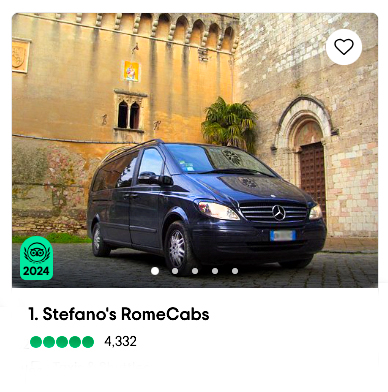
Many of our clients highlight the quality of service, the professionalism of our drivers, the ease of booking, and the option for custom itineraries as standout features. Whether it’s an airport transfer after a long flight, a sightseeing tour from Rome to Tuscany, or a transfer from the Civitavecchia Cruise Port, travelers find our services reliable, luxurious, and genuinely stress-free.
We’ve collected reviews from clients across various platforms, giving you a taste of what it’s like to travel with RomeCabs. Here’s what they’re saying about their journeys.
1. Civitavecchia Transfers: Trusted by Cruisers
For travelers arriving at Civitavecchia Cruise Port, RomeCabs offers private transfers that are designed to align perfectly with cruise schedules, ensuring a smooth, comfortable, and hassle-free journey into Rome or other destinations. Our Civitavecchia port transfers are tailored to meet the specific needs of cruise passengers, providing timely pickups, comfortable vehicles, and expert drivers who make the experience relaxing and enjoyable.
RomeCabs is a trusted name for Civitavecchia cruise transfers, especially popular among travelers looking for reliability, comfort, and local expertise. Our knowledgeable drivers are well-versed in Italian routes and are committed to punctuality, so cruisers can make the most of their shore excursions without any worry. Our private transfers from Civitavecchia to Rome are ideal for those who value a seamless, stress-free transfer experience, allowing you to arrive refreshed and ready to explore Rome’s top attractions.
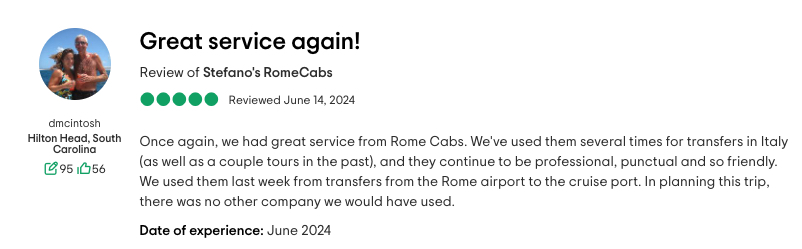
dmcintosh from Hilton Head, South Carolina wrote:
Great service again!
Once again, we had great service from Rome Cabs. We’ve used them several times for transfers in Italy (as well as a couple tours in the past), and they continue to be professional, punctual and so friendly. We used them last week from transfers from the Rome airport to the cruise port. In planning this trip, there was no other company we would have used.
Date of experience: June 2024
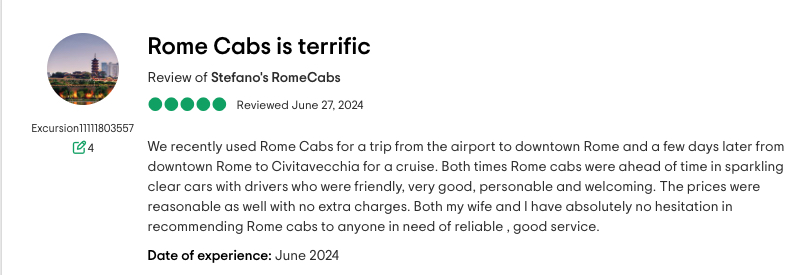
Excursion11111803557 wrote:
Rome Cabs is terrific
We recently used Rome Cabs for a trip from the airport to downtown Rome and a few days later from downtown Rome to Civitavecchia for a cruise. Both times Rome cabs were ahead of time in sparkling clear cars with drivers who were friendly, very good, personable and welcoming. The prices were reasonable as well with no extra charges. Both my wife and I have absolutely no hesitation in recommending Rome cabs to anyone in need of reliable , good service.
Date of Experience: Jun 2024 • Couples
3. Rome Airport Transfers: Reliable Arrivals with RomeCabs
A comfortable transfer from Fiumicino or Ciampino airports is the ideal way to start a trip to Rome. RomeCabs specializes in making airport transfers easy and enjoyable, providing travelers with professional, English-speaking drivers who are ready to greet them after a long flight.
MarcC140 from Nashville, Tennessee wrote:
Stefanos RomeCabs are wonderful for Private Transfers and Sightseeing Trips
We used Stefano’s RomeCabs for three trips: a transfer between Florence and Rome, with stops for wine tasting in Montepulciano and in Orvieto; a tour to see the catacombs and Roman aqueducts on the outskirts of Rome; and a transfer from Rome to FCO. All three drivers were excellent. In addition to being professional, friendly, and safe, each driver provided interesting commentary along the way as well as suggestions about other things we should see and do while in Rome. We highly recommend Stefano’s RomeCabs!
Date of experience: October 2019
More reviews speak to the peace of mind that comes with knowing RomeCabs will be there upon arrival:
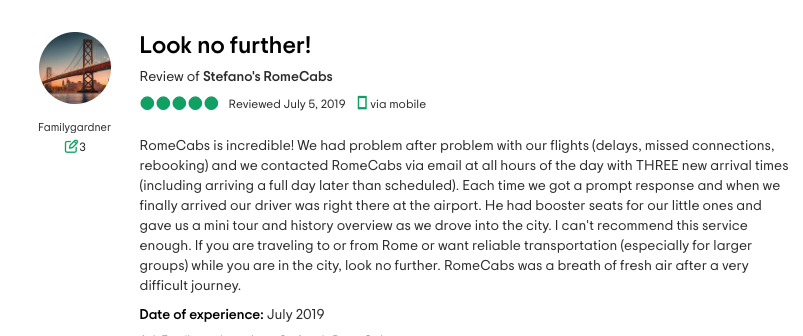
Familygardner wrote:
Look no further!
RomeCabs is incredible! We had problem after problem with our flights (delays, missed connections, rebooking) and we contacted RomeCabs via email at all hours of the day with THREE new arrival times (including arriving a full day later than scheduled). Each time we got a prompt response and when we finally arrived our driver was right there at the airport. He had booster seats for our little ones and gave us a mini tour and history overview as we drove into the city. I can’t recommend this service enough. If you are traveling to or from Rome or want reliable transportation (especially for larger groups) while you are in the city, look no further. RomeCabs was a breath of fresh air after a very difficult journey.
Date of experience: July 2019
For weary travelers, RomeCabs provides not only a safe and comfortable ride but also the assurance of reliable service upon arrival.
4. Long-Range Transfers from Rome to Other Cities in Italy
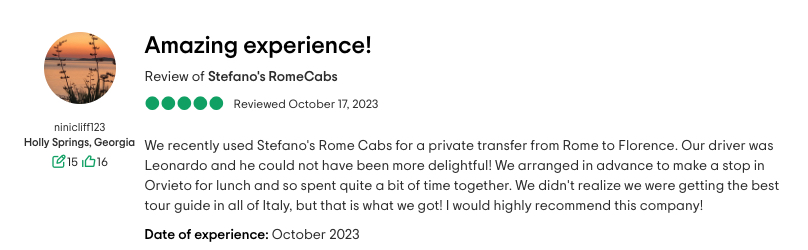
ninicliff123 from Holly Springs, Georgia wrote:
Amazing experience!
We recently used Stefano’s Rome Cabs for a private transfer from Rome to Florence. Our driver was Leonardo and he could not have been more delightful! We arranged in advance to make a stop in Orvieto for lunch and so spent quite a bit of time together. We didn’t realize we were getting the best tour guide in all of Italy, but that is what we got! I would highly recommend this company!
Date of experience: October 2023
5. Day Trips from Rome & Private Italy Sightseeing Transfers:
RomeCabs offers more than just transfers—many travelers rely on us for private day trips from Rome to explore Italy’s most iconic destinations, including the Amalfi Coast, Tuscany, and Umbria. With RomeCabs, you can travel in luxury and comfort, experiencing Italy’s beauty and culture without the limitations of group tour schedules.
Our day trips from Rome include popular destinations, allowing you to enjoy a scenic journey through Tuscan vineyards, explore the charming coastal towns of Positano and Sorrento, or visit historic sites in medieval towns like Bracciano and Tuscania. RomeCabs’ Italy sightseeing transfers provide a flexible way to travel at your own pace, stopping to appreciate each destination and capture the perfect photo along the way.
RomeCabs’ private tours are perfect for those looking for a luxurious Italy day trip experience. With experienced, knowledgeable drivers, comfortable vehicles, and scenic routes, we transform each transfer into an unforgettable journey across Italy’s picturesque landscapes and historic landmarks.
RomeCabs offers more than just standard transfers; we provide Private Italy Sightseeing Transfers that transform your journey into an enriching travel experience. Our services allow you to explore Italy’s iconic destinations such as the Amalfi Coast, Tuscany, and Umbria with the flexibility and comfort that group tours often lack.
Our Private Italy Sightseeing Transfers are designed to enhance your travel between cities by incorporating stops at notable sites along the way. For instance, when traveling from Rome to Florence, you can choose to visit historic towns like Orvieto or Assisi, turning a simple transfer into a memorable day trip. Similarly, a transfer from Rome to the Amalfi Coast can include a visit to the ancient ruins of Pompeii or the archaeological site of Herculaneum.
These services are ideal for travelers who wish to maximize their time in Italy by combining transportation with sightseeing. With RomeCabs, you have the opportunity to explore Italy’s rich history and breathtaking landscapes while traveling in the comfort of a private vehicle with an English-speaking driver
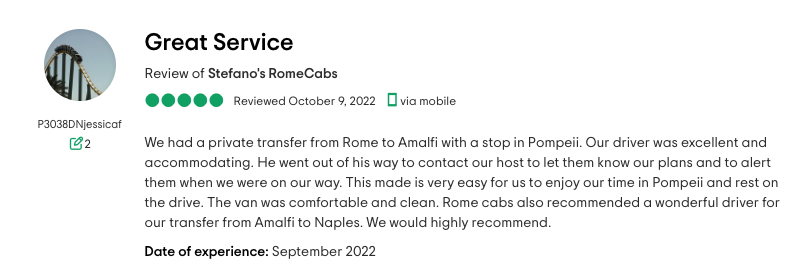
P3038DNjessicaf (Jessica F) wrote:
Great Service
We had a private transfer from Rome to Amalfi with a stop in Pompeii. Our driver was excellent and accommodating. He went out of his way to contact our host to let them know our plans and to alert them when we were on our way. This made is very easy for us to enjoy our time in Pompeii and rest on the drive. The van was comfortable and clean. Rome cabs also recommended a wonderful driver for our transfer from Amalfi to Naples. We would highly recommend.
Date of experience: September 2022
Additional testimonials highlight the diversity of RomeCabs’ tours:
Robert S from Tennessee wrote:
Excellent does not begin to describe Romecabs
“Excellent” does not begin to describe the service provided by RomeCabs. We used them for three pickup/transfer/tour options and can not say enough good things about them. We first booked them to pick us up when we arrived at the Rome airport to include a 4 hour driving tour. Our guide first asked us what were were seeing while we were in Rome and then he proceeded to take us to places we would not get to see.
The “driving tour” isn’t just a ride and see but included stopping and getting out to tour various places along the way. Next we booked the Rome hotel to cruise port transfer. Despite this only being a transfer, the driver spoke very good English and told us about various things/places as we drove to the port.
Lastly, we booked the post cruise port pick up and country side tour. Again, excellent driver/guide, very accommodating, friendly, and professional. Before we booked our tours/pickups we compared prices from the top three companies in Rome. RomeCabs had the best reviews, best prices, and allowed us to pay for our bookings prior to arriving in Rome.
Their competitors did not mention that option and wanted payment in Euros in person (we weren’t crazy with the idea of carrying that much money in cash). Also, the vans they picked us up in had plenty of room, were very clean, and comfortable. Definitely use RomeCabs when you are in Rome!!
Date of experience: September 2023
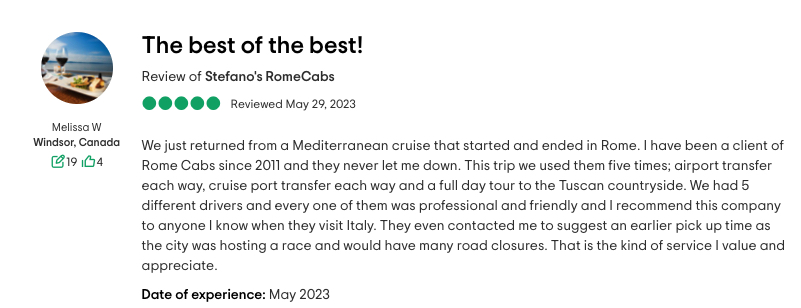
Melissa W from Windsor, Canada wrote:
The best of the best!
We just returned from a Mediterranean cruise that started and ended in Rome. I have been a client of Rome Cabs since 2011 and they never let me down. This trip we used them five times; airport transfer each way, cruise port transfer each way and a full day tour to the Tuscan countryside. We had 5 different drivers and every one of them was professional and friendly and I recommend this company to anyone I know when they visit Italy. They even contacted me to suggest an earlier pick up time as the city was hosting a race and would have many road closures. That is the kind of service I value and appreciate.
Date of experience: May 2023
These experiences underscore how RomeCabs goes above and beyond to make Italy’s highlights accessible, enjoyable, and tailored to individual preferences.
6. Customization and Personalization: Meeting Unique Travel Needs
One of the aspects of RomeCabs that travelers consistently highlight is the flexibility to tailor services to suit their needs. Our team is dedicated to creating custom itineraries and adapting services to meet each client’s preferences.
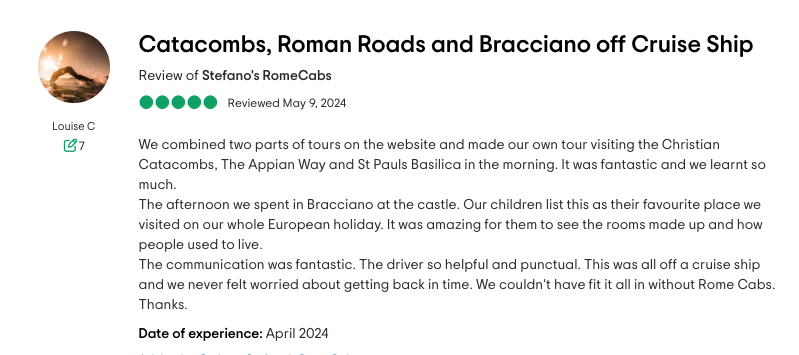
Louise C
Catacombs, Roman Roads and Bracciano off Cruise Ship
We combined two parts of tours on the website and made our own tour visiting the Christian Catacombs, The Appian Way and St Pauls Basilica in the morning. It was fantastic and we learnt so much.
The afternoon we spent in Bracciano at the castle. Our children list this as their favourite place we visited on our whole European holiday. It was amazing for them to see the rooms made up and how people used to live.
The communication was fantastic. The driver so helpful and punctual. This was all off a cruise ship and we never felt worried about getting back in time. We couldn’t have fit it all in without Rome Cabs. Thanks.
Date of experience: April 2024
SonjaWinston
Concord, Massachusetts
Great service from Stefano’s RomeCabs
We used Stefano’s RomeCabs for three trips: a transfer between Florence and Rome, with stops for wine tasting in Montepulciano and in Orvieto; a tour to see the catacombs and Roman aqueducts on the outskirts of Rome; and a transfer from Rome to FCO. All three drivers were excellent. In addition to being professional, friendly, and safe, each driver provided interesting commentary along the way as well as suggestions about other things we should see and do while in Rome. We highly recommend Stefano’s RomeCabs!
Date of experience: December 2022
Why RomeCabs Is the Preferred Choice for Private Transfers in Italy
When it comes to private transfers and luxury tours in Italy, RomeCabs stands out as the top choice among travelers, and customer reviews tell the story. With consistently high ratings, RomeCabs is praised for its exceptional standards across every part of the travel experience. Here’s what makes RomeCabs the preferred private transfer service in Italy:
RomeCabs Professionalism and Punctuality:
Travelers who choose RomeCabs consistently highlight the professionalism and reliability of our drivers. Each RomeCabs driver is committed to punctuality and going above and beyond to ensure your journey is smooth, timely, and enjoyable. With extensive local knowledge and a friendly demeanor, our drivers add an element of personalized care, which is why travelers trust RomeCabs over standard taxis or rideshares.
Comfort and Luxury with Every Transfer
RomeCabs is dedicated to providing premium vehicles that are modern, clean, and spacious. Our fleet includes well-maintained sedans, minivans, and luxury vehicles that cater to all group sizes. Travelers who book RomeCabs enjoy a level of comfort that transforms a simple transfer into a luxurious travel experience, whether it’s an airport pickup, a transfer from Rome to Florence, or a scenic drive along the Amalfi Coast.
Flexibility and Customization for Unique Experiences:
Unlike standard transfer options, RomeCabs offers a highly flexible service that accommodates unique travel needs and allows for personalized itineraries. From custom pick-up times and door-to-door service with transfers from Rome to Positano, Sorrento, Florence, or other top cities in Italy, to day trips from Rome to Tuscany or Amalfi Coast, RomeCabs provides the flexibility to make every journey special. It’s perfect for travelers seeking private transfers and tours in Italy that are as unique as they are memorable.
Ease of Booking with RomeCabs and Dedicated Customer Support:
RomeCabs makes the booking process seamless with an intuitive, user-friendly website and prompt customer support. Our team is ready to assist with any special requests or questions, ensuring a hassle-free booking experience from start to finish. Booking with RomeCabs means no guesswork or uncertainty, just reliable, professional service from the moment you book until the end of your journey.
Discover the Difference with RomeCabs for Your Italian Adventure
Whether you’re planning a trip to Rome, a sightseeing tour in Tuscany, or a day tour along the Amalfi Coast, RomeCabs offers a private, comfortable, and memorable way to explore Italy. Our commitment to providing a first-class travel experience has made us the go-to choice for private transfers, airport pickups, and exclusive tours across Italy.
Discover the difference for yourself—book with RomeCabs and experience Italian travel in comfort, style, and ease. Visit our website: https://www.romecabs.com/
* Find RomeCabs online also on:
- RomeCabs Facebook: https://www.facebook.com/RomeCabsToursAndTransfers
- RomeCabs Pinterest: https://www.pinterest.it/romecabs
- RomeCabs Twitter: https://twitter.com/RomeCabs
- RomeCabs Instagram: https://www.instagram.com/romecabs/
- RomeCabs Flickr Photos: https://www.flickr.com/photos/romecabs/
- RomeCabs Recommended on Cruise Critic
More Tips for Civitavecchia Transfers, Rome Tours & MORE on RomeCabs Travel Blog
A Day in a Medieval Village in Italy: San Gimignano in the 1300s
Buongiorno, and welcome to the RomeCabs Italy Travel Blog! Today, we invite you to experience a day in a medieval village in Italy by stepping back in time to San Gimignano in the 1300s. Located in the heart of Tuscany, this village is now famous for its medieval towers and enchanting atmosphere, drawing visitors from all over the world. However, in the 1300s, San Gimignano was a bustling hub of daily life, where the rhythms of work, faith, and community intertwined to create a vibrant tapestry of medieval existence.
Let’s explore what life was like in this remarkable village and imagine what a typical day in San Gimignano might have been like during this fascinating period in history.
What was Medieval San Gimignano like during the 1300s?
During the 1200s and 1300s, San Gimignano would have been a vibrant and bustling town, brimming with economic activity and cultural life. The presence of towers, walls, and narrow, winding streets would have created a sense of both security and communal living. The town’s residents, ranging from wealthy merchant families to skilled artisans, farmers, and tradespeople, contributed to a diverse and dynamic community.
The constant flow of pilgrims and traders ensured that San Gimignano was never entirely cut off from the broader currents of medieval European life, making it a unique and important location during this period.
In the 1200s to 1300s, San Gimignano was a bustling medieval town situated on a hill in the heart of Tuscany, Italy. It was strategically located along the Via Francigena, a major pilgrimage route connecting Northern Europe to Rome, which brought in a mix of travelers, traders, and pilgrims. The town’s layout and architecture were heavily influenced by its medieval roots, characterized by narrow, winding streets, fortified walls, and an abundance of tall stone towers that dominated the skyline.
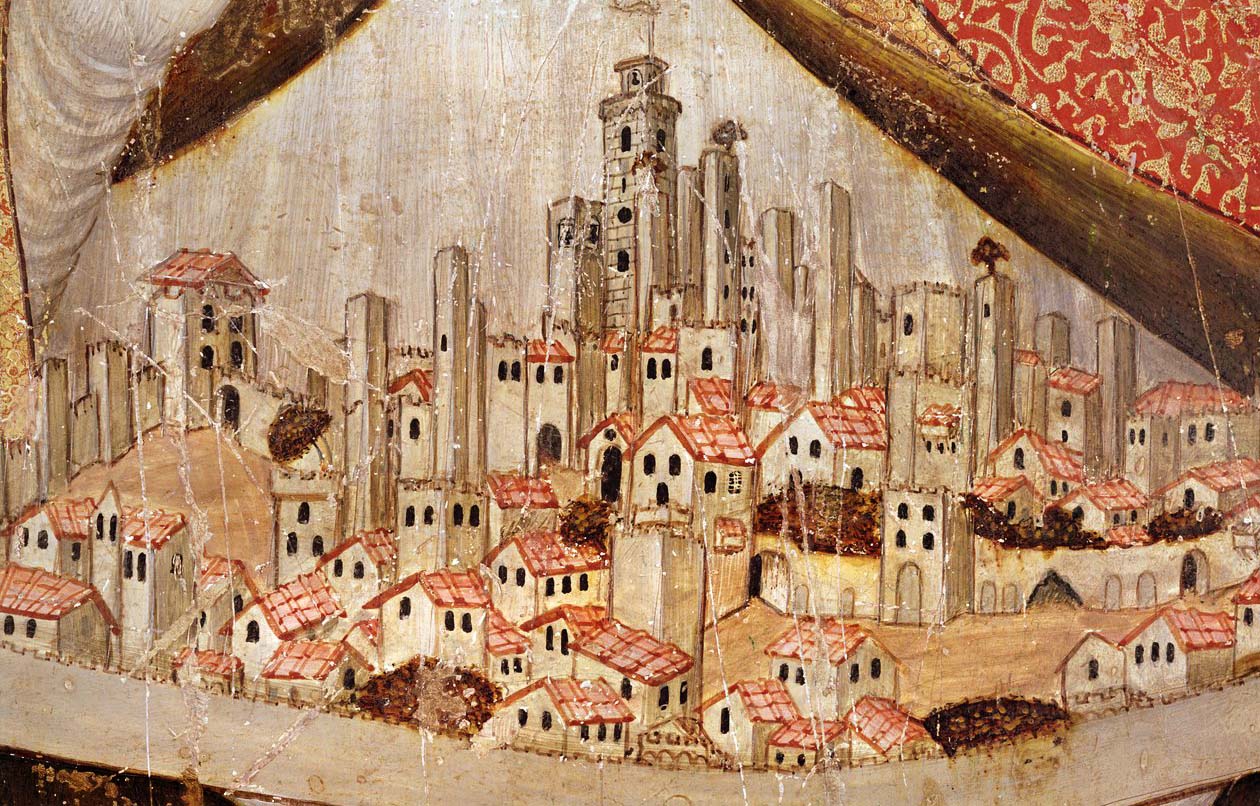
San Gimignano’s Medieval Walls and Towers
San Gimignano was most famous for its numerous tall towers, which gave it the nickname “Medieval Manhattan.” These towers were built by the wealthy merchant families as symbols of power, prestige, and wealth. In the 1200s, there were up to 72 towers, although today only 14 remain. The towers served both defensive purposes and were a clear indication of the intense rivalry between the town’s noble families, each competing to build a taller, more imposing tower.
The towers were constructed from stone, and they varied in height, with some reaching up to 50 meters (164 feet). They were square in shape, narrow, and built as freestanding structures next to family homes or palaces. Inside, they were often dark and sparse, with few windows to provide security against attacks.
.
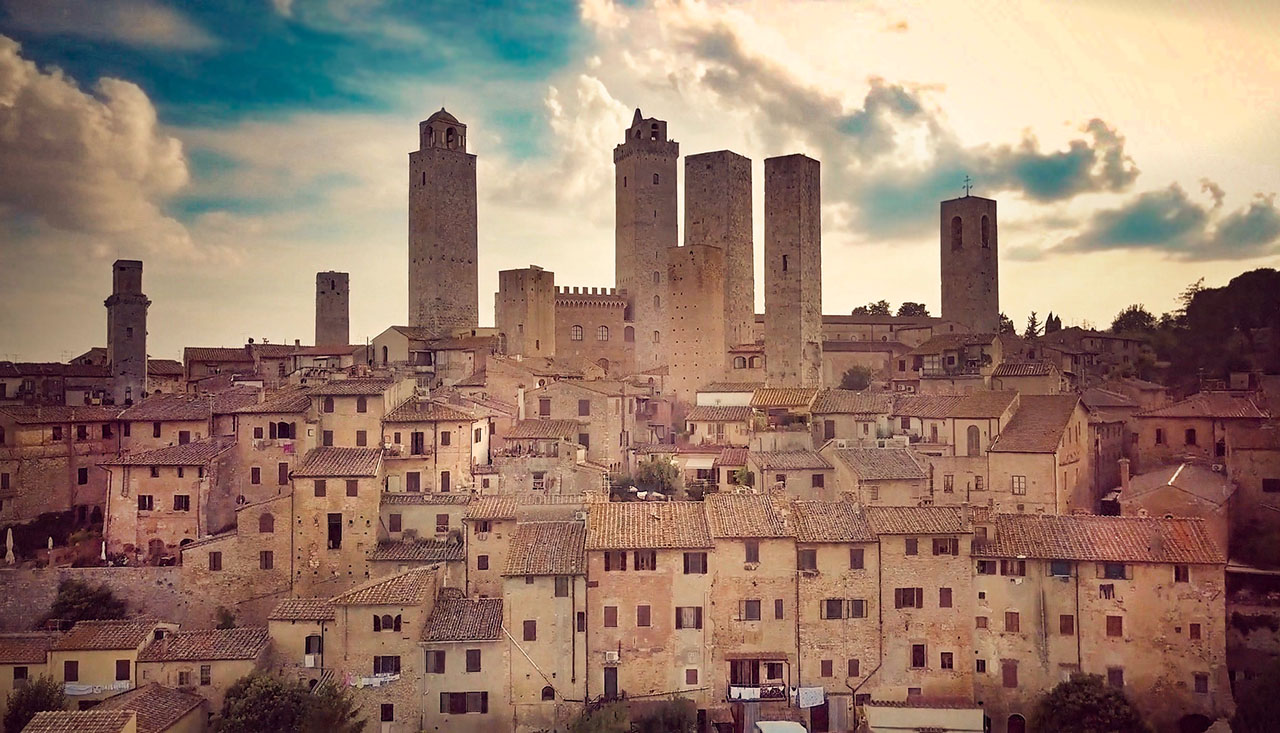
The town was enclosed by robust stone walls, built for defense against potential invaders and rival towns. The walls were punctuated with several fortified gates, such as the Porta San Giovanni and Porta San Matteo, which controlled access to the town. The gates were imposing structures, often reinforced with wooden doors and iron fittings, guarded by town watchmen who monitored the comings and goings of visitors and residents.
San Gimignano’s social and economic life revolved around its central piazzas. The Piazza della Cisterna and the Piazza del Duomo were the two main squares in the town.
San Gimignano housed several important civic buildings, reflecting its status as a prosperous and semi-autonomous medieval commune. The Palazzo Comunale (Town Hall), which housed the town’s governing council, was a significant building featuring a large council chamber, meeting rooms, and a tower from which announcements could be made. The Palazzo del Podestà was another key structure, serving as the residence of the town’s leading magistrate. It was a grand building, often used for receptions and official functions.

Dawn in San Gimignano in the 1300s: The Day Begins
As the first light of dawn breaks over the Tuscan hills, the village of San Gimignano, perched atop its hill, stirs to life. The village, known for its impressive stone towers reaching into the sky, begins the day in relative quiet. The air is crisp, and a thin mist clings to the fields and vineyards that surround the village walls. Inside the fortified town, cobblestone streets lie still, but this calm does not last long.
The bell of the Collegiate Church, standing proudly in the center of the village, tolls to signal the start of a new day. The sound resonates through the narrow streets and alleys, bouncing off the high walls of stone houses and echoing down into the valley below.
.

Morning Routines: Rising with the Bell
For the villagers, this is the cue to rise. They wake from their beds, which are often simple straw mattresses laid on wooden frames. The wealthy may have feather-filled mattresses and linen sheets, but most villagers sleep on straw or wool-stuffed sacks. In the dim light, families gather around the hearth, which has been kept smoldering throughout the night.
The fire is stoked back to life, providing much-needed warmth and a place to prepare a simple breakfast. This might consist of porridge made from grains or bread baked the previous day, sometimes flavored with herbs or a little honey if available.
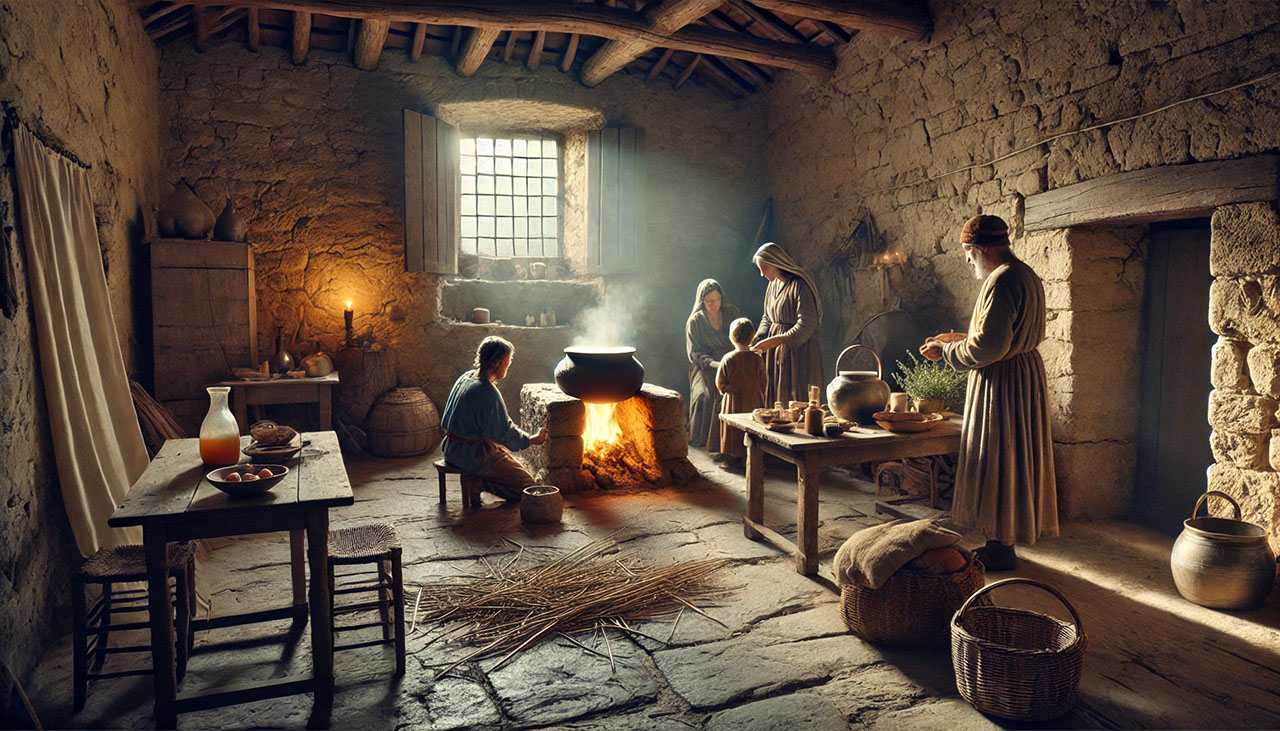
The Farmers’ Day of Tending to the Land
Farmers are among the first to rise and leave their homes. The land is the lifeblood of San Gimignano, and agriculture forms the backbone of the village economy. These early hours are crucial for work in the fields, where much depends on the season. In spring, they might be plowing and sowing the fields with wheat or barley, using heavy wooden plows drawn by oxen.
In the hot summer months, it’s time for weeding and tending to the growing crops, while autumn brings the harvest of grapes and olives, vital staples for both local consumption and trade.
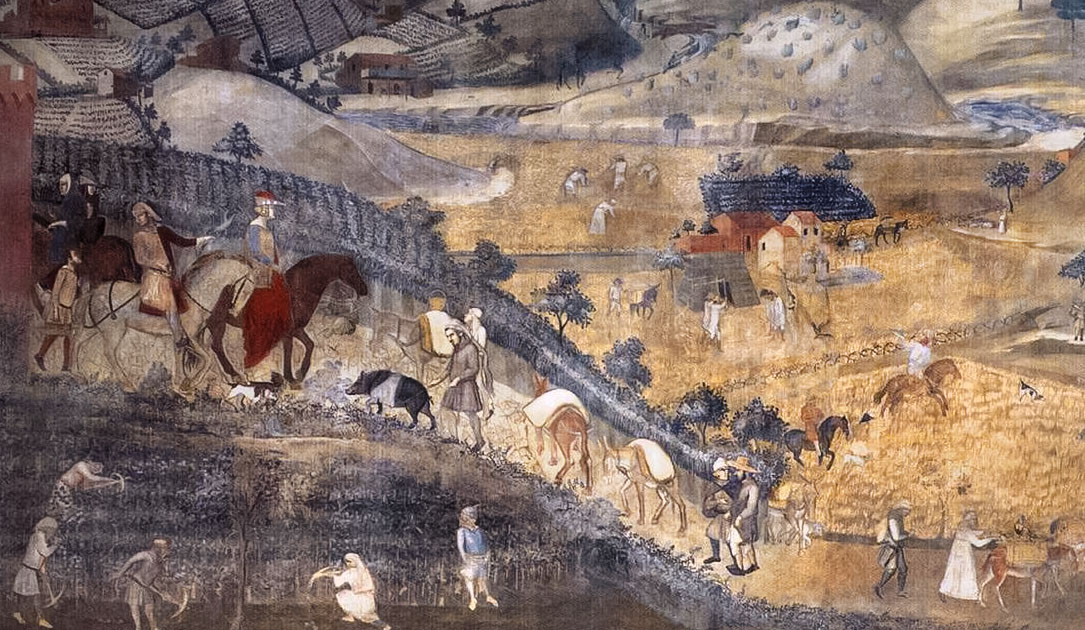
The farmers head to their fields outside the village walls. They walk along narrow dirt paths, leading donkeys laden with tools and baskets for gathering crops. Wheat, olives, and grapes are the primary crops cultivated here.
Wheat is ground into flour for bread, the essential food staple of the medieval diet. Olives are pressed for oil, used in cooking and as a source of light in simple oil lamps. Grapes, of course, are turned into wine, which is safer to drink than water and forms an essential part of both daily meals and religious ceremonies.
Women often accompany the men, particularly during the harvest season, working side by side to gather the crops that will sustain their families through the year.
Inside the Village Walls, The Artisans are at Work
Meanwhile, within the village walls, the artisans and tradespeople begin to open their workshops. Each street seems to have its specialty: one lined with the rhythmic clang of the blacksmith’s hammer striking iron, another filled with the scent of fresh bread wafting from the bakeries. The blacksmiths ignite their forges, using bellows to fan the flames and heat the metal until it glows red-hot.
They skillfully shape the iron into tools, horseshoes, and occasionally, weapons. Across the way, bakers knead dough for the day’s bread, shaping it into rounds and sliding it into large communal ovens. Bread is a daily staple, and the ovens are kept hot from before dawn until well after sunset.
Weavers set up their looms in small workshops or even in open doorways, spinning wool from sheep raised in the surrounding hills. They create cloth that is dyed in bright colors with natural dyes—reds, blues, and greens—that will be sewn into clothing. Tanners work with hides, soaking them in vats of urine and tannins to make leather for shoes, belts, and harnesses. The air is filled with the sounds and smells of industry as the village awakens.

The Morning Pulse of Commerce
As the sun climbs higher in the sky, the Piazza della Cisterna, the central square of the village, begins to hum with life. This square, named after the ancient stone well at its center, serves as the village’s bustling market hub. Merchants and vendors, both local and those who have traveled from neighboring towns, start setting up their stalls. They unfurl their colorful awnings, designed to shield them from the harsh sun or unexpected rain, and meticulously arrange their goods to attract the attention of passersby.
Vibrant Medieval Market in Medieval San Gimignano
The market stalls are a vibrant display of the village’s agricultural and artisanal bounty. Baskets overflow with fresh fruits and vegetables— leafy greens, and fruit glistening with morning dew. Stacks of aged cheeses, wheels of pecorino and rounds of fresh ricotta, sit alongside wooden crates filled with eggs, their surfaces speckled and earthy.

Coils of sturdy rope and bolts of hand-dyed cloth are neatly piled next to handcrafted tools and utensils, their wooden handles smooth from careful carving. Barrels of rich red wine and golden olive oil, the prized produce of the surrounding vineyards and groves, are lined up in neat rows, and slabs of salted meat hang from hooks, enticing shoppers with their savory aroma.
But the market is much more than a place of commerce; it is the social heart of the village. Here, villagers gather not only to buy and sell but to meet, converse, and catch up on the latest news. The market is a melting pot of voices and languages, where gossip and stories flow as freely as the goods being traded.
It’s where news from the outside world filters in, often brought by traveling merchants or pilgrims passing through on their way to Rome or Santiago de Compostela. These visitors bring tales of distant lands, rumors of wars and politics, and news of the latest fashions and customs, connecting the village to the broader currents of medieval life.
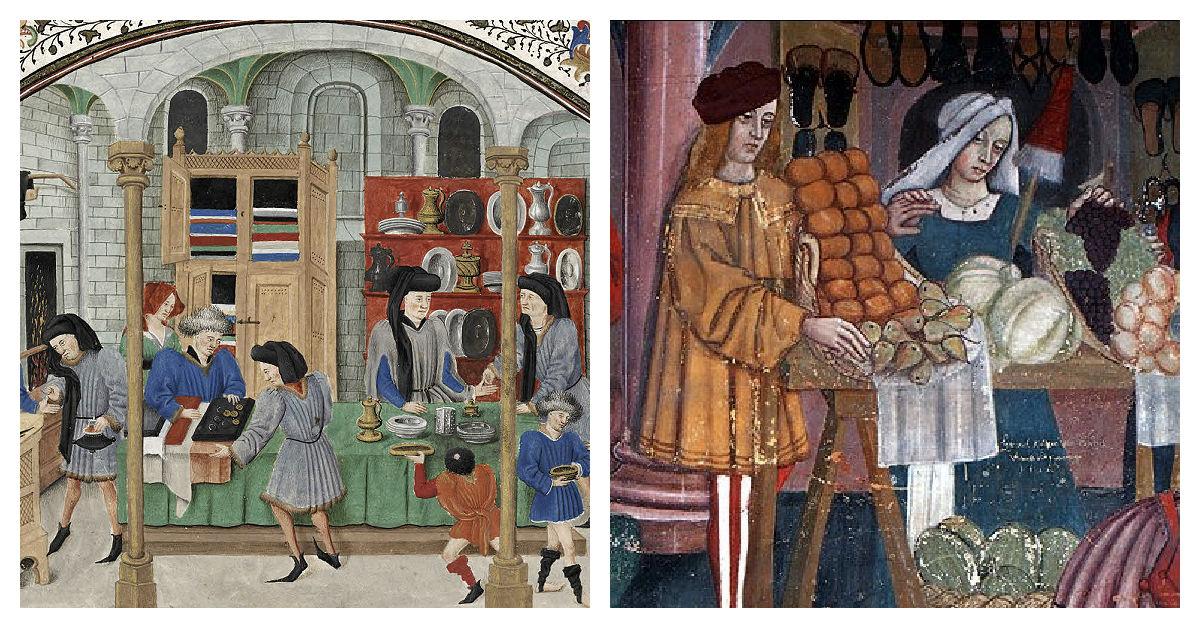
Mid-Morning Bustle of Trade and Bargaining
By mid-morning, San Gimignano is fully awake, and the market square is a hive of activity. Farmers from the surrounding countryside, having finished their early morning chores, arrive with carts laden with produce to sell. They barter and haggle over prices with the villagers, who inspect the goods with discerning eyes.
Women, often tasked with managing household supplies, are frequent visitors to the market, moving from stall to stall with woven baskets on their arms. They carefully select ingredients for the day’s meals, choosing fresh vegetables, herbs, grains, and occasionally, a cut of meat for a special occasion.

Craftsmanship and Textile Trade
Meanwhile, the skilled craftsmen of San Gimignano are hard at work in their nearby workshops, contributing to the village’s bustling economy. The village is renowned for its fine textiles, especially its high-quality wool, which is dyed using natural pigments to create vibrant hues of red, blue, green, and yellow.
The weavers, their looms clattering rhythmically, produce bolts of cloth that will be used to make clothing and other goods. These fabrics are a valuable commodity, not just within the village but also in neighboring towns and cities, traded for goods and services. The sound of the loom and the sharp, clear snaps of scissors cutting through cloth add a musical backdrop to the market’s buzz.
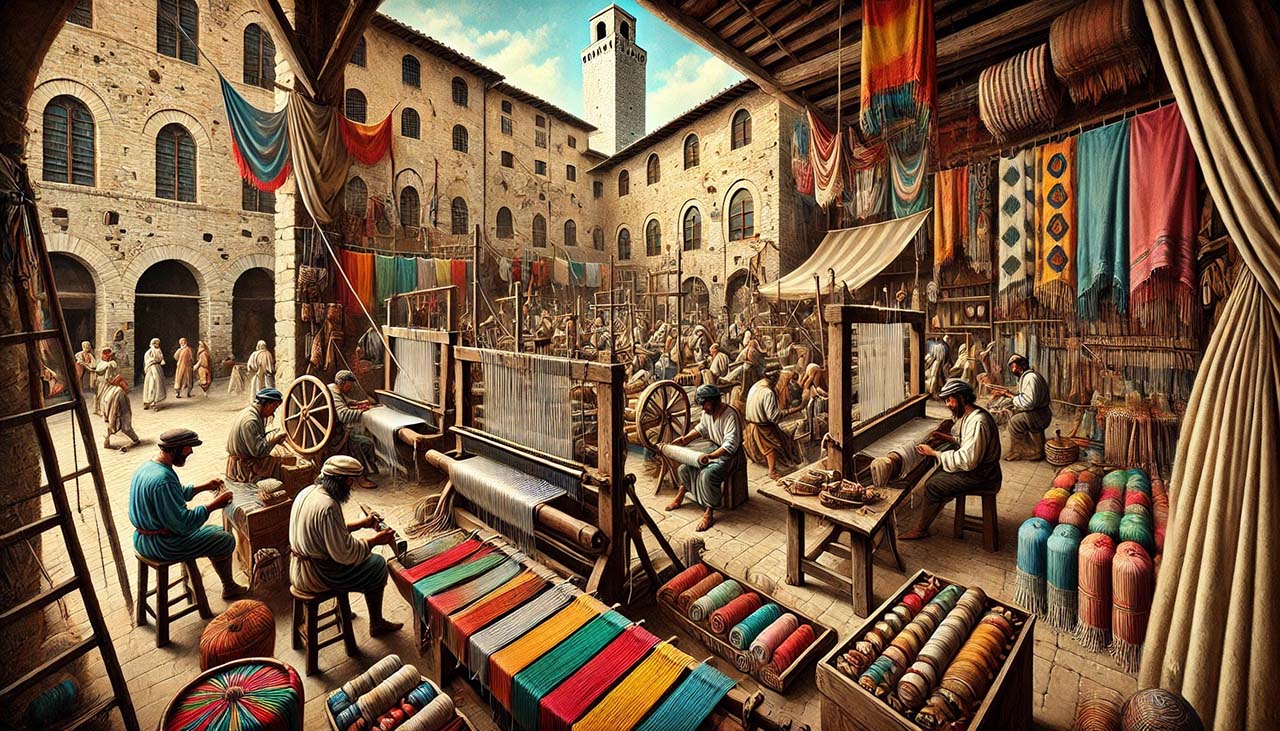
Trade Routes Bring Exotic Goods to San Gimignano
Trade is vital to San Gimignano’s prosperity and is deeply embedded in the village’s daily life. Positioned along the Via Francigena, a major pilgrimage and trade route that stretches from Northern Europe to Rome, the village attracts merchants from far and wide. These traders bring with them an array of exotic goods that are otherwise unheard of in this quiet corner of Italy.
Spices such as cinnamon and saffron, precious silks, and other luxury items from distant lands like Asia and the Middle East make their way to the market stalls, where they are eagerly snapped up by the wealthier citizens.
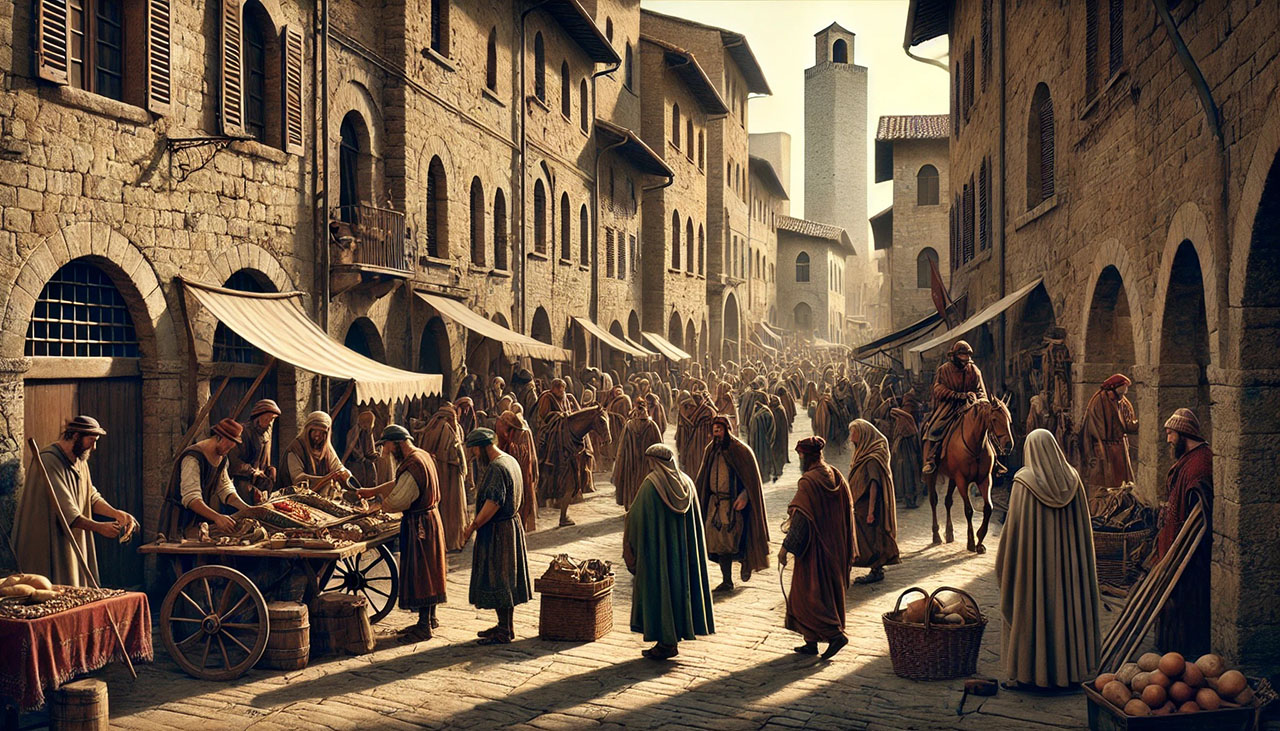
The wealth of San Gimignano is visible in the towering homes of its merchant families, who have grown rich through trade and commerce. These families, always eager to display their status, are frequent patrons of the market, purchasing luxury goods to adorn their homes or as gifts for friends and allies.
The high stone towers that rise above the village—symbols of wealth and power—serve as both defensive structures and status symbols, marking the skyline with the aspirations and rivalries of the merchant elite.
As the morning progresses, the market square remains the pulse of the village, a lively scene of commerce, conversation, and community, embodying the spirit and vitality of medieval life in San Gimignano.
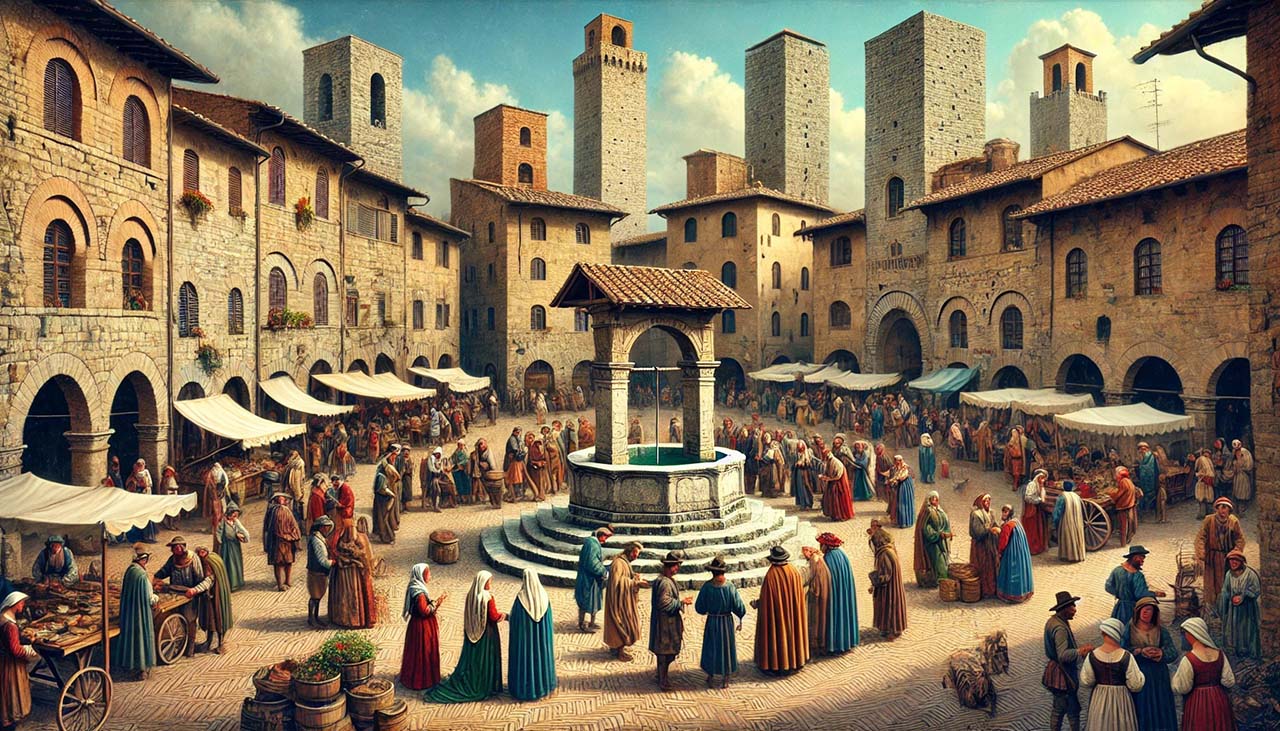
Noon: Pause for Prayer and Rest
By midday, the sun is directly overhead, and the village slows its pace. The church bell rings again, this time for the Angelus prayer, a call to remember the Annunciation and to give thanks. Villagers pause their work to offer a moment of prayer, whether they are in the fields, workshops, or homes. This pause is not just a religious obligation but also a much-needed break in the day’s labor.
Following the Angelus, families gather for the main meal of the day. This meal, typically the largest, is a communal affair, with extended families or groups of neighbors often eating together. The meal might include freshly baked bread, cheese made from goat or sheep’s milk, and a hearty stew made from vegetables, beans, and perhaps some meat if it is available.
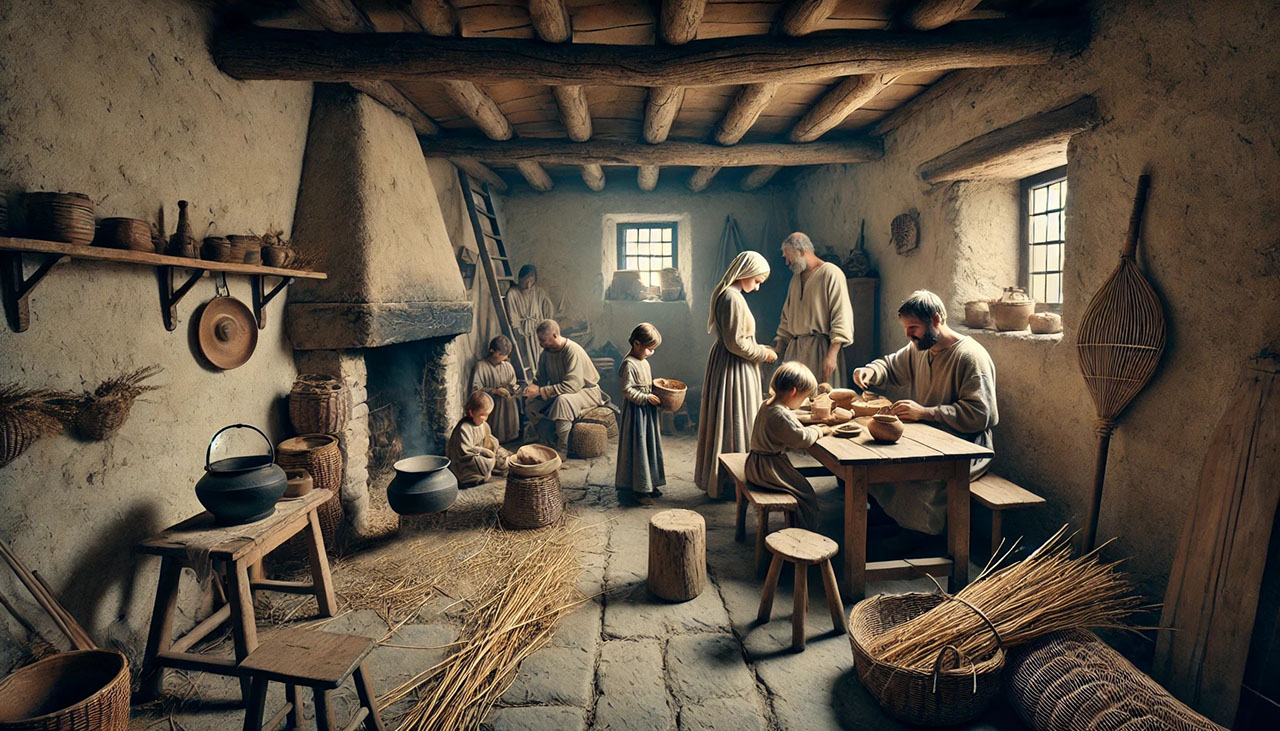
In wealthier households, the meal could be more elaborate, featuring roasted meats, pies, and fruit. Wine, often diluted with water, is a common beverage, consumed at every meal. It is not only a staple of the diet but is also considered safer to drink than water, which can be contaminated.
After the meal, there is a period of rest. The intense heat of the midday sun, especially in summer, makes this a good time to seek shade or stay indoors. Some might take a short nap, while others use the time to socialize or catch up on lighter tasks. This siesta is an integral part of daily life, providing a brief respite before the afternoon’s work begins again. For many, it is a time to reflect, pray, or simply enjoy the company of family and friends.
Afternoon in San Gimignano means Back to Work
As the heat of the day begins to wane, the village returns to its work. Farmers head back to the fields to continue their tasks—harvesting crops, repairing fences, or tending to livestock.
The blacksmith’s forge glows red-hot as he continues his work, while the carpenter shapes wood into tools, barrels, and furniture. In the market, traders continue to ply their goods, hoping to make a few last-minute sales before the day ends.
For many children, the afternoon is a time for learning and chores. Boys might learn their fathers’ trades, helping in the fields, workshops, or stalls, while girls assist their mothers with household tasks—cooking, spinning, weaving, and caring for younger siblings.
Education is informal and practical, centered around the skills needed for everyday life. A few children, often from wealthier families, might receive formal education from the village priest or a traveling tutor, learning to read and write Latin, the language of the Church and scholarly texts.

Meanwhile, the village council, composed of respected elders or local leaders, might meet to discuss matters of importance. These meetings, held in the open air or in a designated hall, are crucial for maintaining order and addressing communal concerns.
They might discuss disputes over land or resources, organize repairs to communal buildings or the village well, or plan for upcoming festivals or holy days. Decisions are often made by consensus, with each member having a voice in the proceedings. This self-governance is essential to the village’s stability, ensuring that the needs of the community are met and that justice is upheld.
Despite the relative peace, the period from 1200 to 1300 is also marked by frequent conflicts. Local lords might engage in territorial disputes, and the village could be threatened by raids from rival factions or foreign invaders.
The constant threat of war and conflict means that villagers must be prepared to defend themselves. Some villages, like San Gimignano, are fortified with walls and towers, and the local lord might call upon the men of the village to serve as soldiers or watchmen. This ever-present danger makes daily life uncertain, reminding the villagers that their safety is never guaranteed.
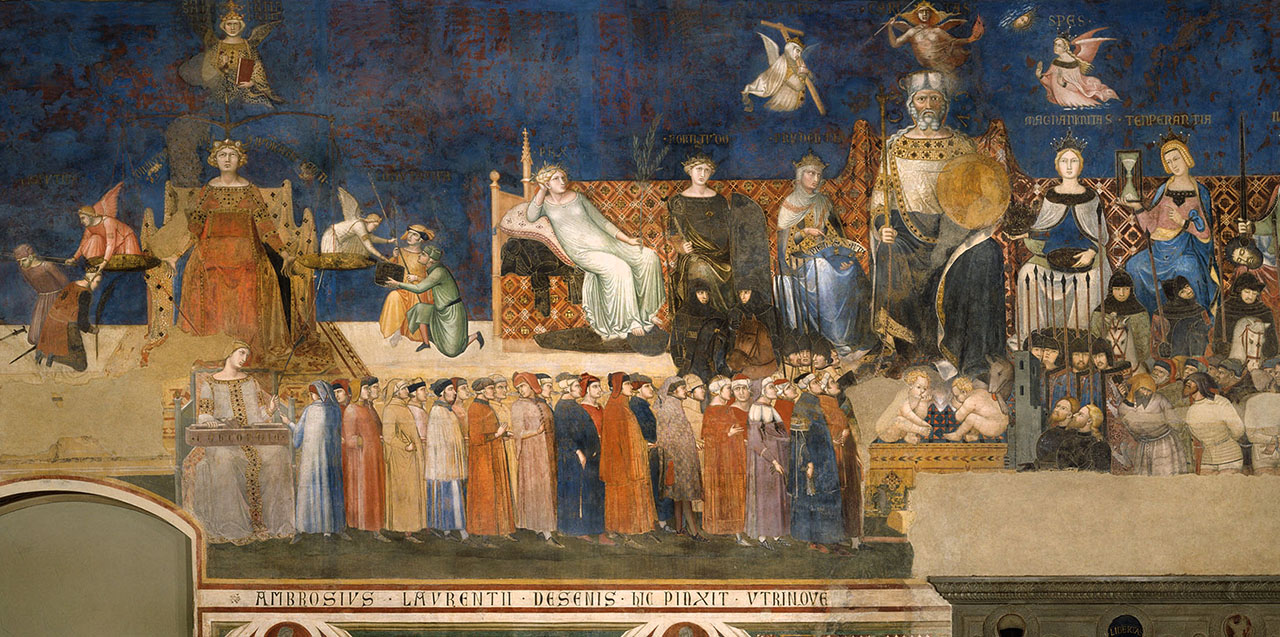
Evening: The Day Winds Down in San Gimignano
As the sun sets, casting long shadows over the hills and vineyards, the village begins to wind down. Farmers return from the fields, artisans close their workshops, and the market comes to a close.
The evening meal is simpler than the midday feast, often consisting of leftovers, bread, and a thin soup or porridge. Families gather around their hearths, sharing stories of the day, discussing plans for the future, and enjoying the rare moments of leisure. The evening is a time for relaxation, a brief respite from the demands of daily life.
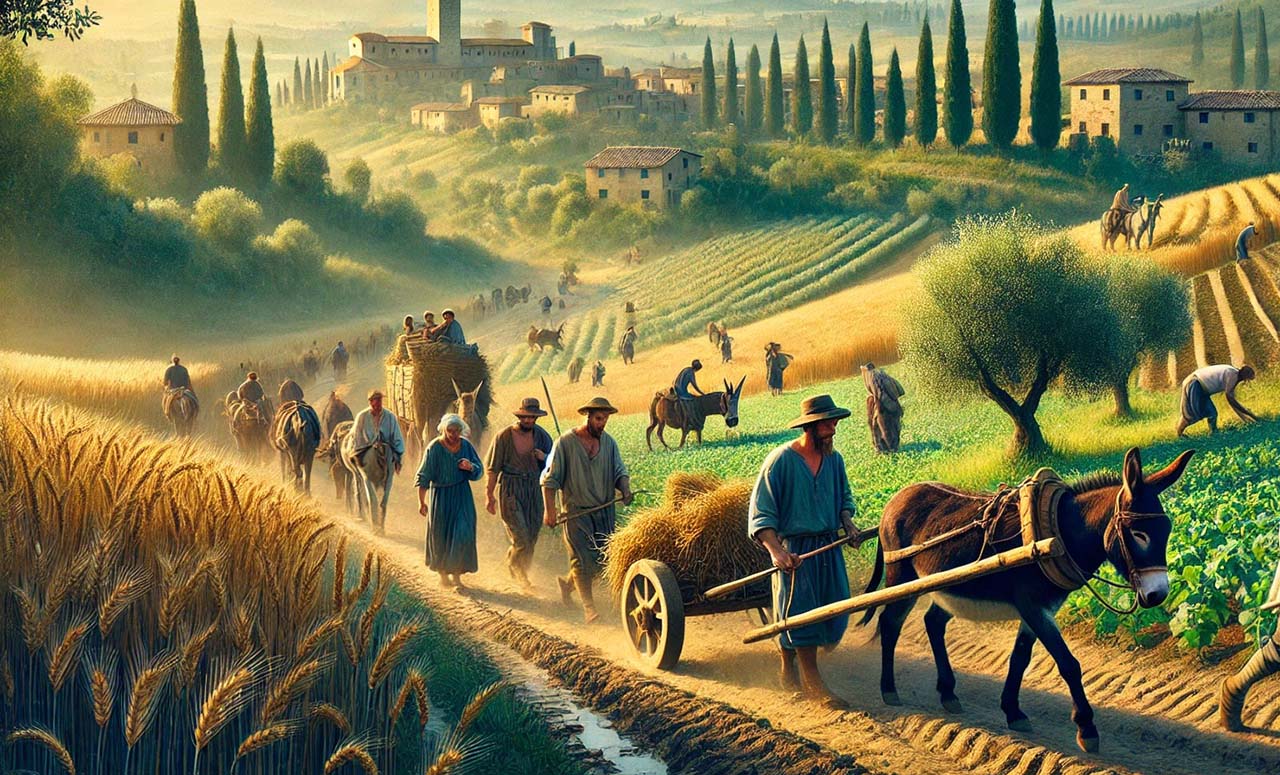
For many, the day ends as it began—with prayer. The church bell rings one last time, calling the villagers to evening prayers, the Compline, where they give thanks for the day’s blessings and seek protection through the night.
Faith is a constant companion in their lives, providing comfort and a sense of order in a world that can be harsh and unpredictable. The church, illuminated by candlelight, is filled with the soft murmur of prayers and hymns, a soothing end to a busy day.
After prayers, the village square comes alive with communal activities. Villagers gather to share news, tell stories, and enjoy music and dance. Young men and women flirt and court, children play games, and the elders share tales of the past.
This social time is crucial for maintaining the bonds of community, and reinforcing friendships, alliances, and family ties. Music is a common form of entertainment, with villagers playing simple instruments like flutes, drums, or lutes. Dancing is another popular pastime, with everyone joining in to celebrate the end of another day’s work.
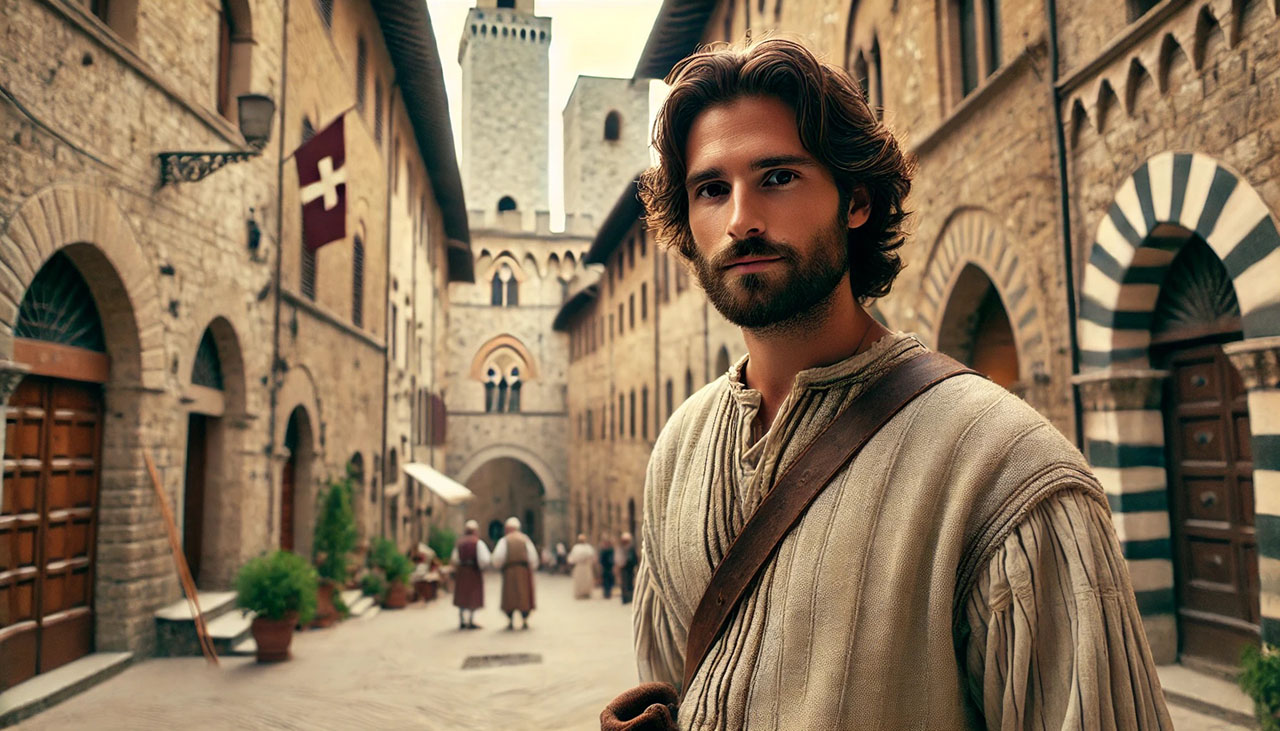
Night: The Medieval Village of San Gimignano Sleeps
As darkness falls, the village settles into silence. The streets are deserted, and the only sounds are the occasional hoot of an owl or the rustling of the wind through the trees. Homes are secured for the night, with wooden shutters drawn and doors bolted.
Families sleep close together, their homes providing a small but sturdy shelter against the outside world. Inside, the hearth burns low, casting a warm glow on the rough stone walls. The village, though small and seemingly isolated, is a world unto itself.
It is a place where life is governed by the rhythms of nature, the cycles of the seasons, and the traditions passed down through generations. Each day brings its challenges and rewards, but through hard work, faith, and the support of the community, the villagers find a sense of purpose and belonging in this medieval world.
They sleep knowing that tomorrow will bring more of the same—the familiar, unending cycle of work and rest, hardship and joy, life and death.

Life in a medieval village like San Gimignano during the 1200s and 1300s was a delicate balance of work, faith, and community, shaped by the natural world and the rigid structures of feudal society.
Despite the hardships and uncertainties, the villagers of San Gimignano found meaning and fulfillment in their daily routines, their faith, and their communal bonds. Their lives were a testament to human resilience and the enduring power of tradition, qualities that continue to define rural life in Tuscany today.
Though centuries have passed, the echoes of medieval village life still resonate in the Italian countryside. The fields that once fed the villagers, the stone towers that stood as silent sentinels, and the cobbled streets that echoed with the sounds of daily life all remain as silent witnesses to a way of life that, while long gone, still informs the character and culture of this beautiful region.
* Find RomeCabs online also on:
- RomeCabs Facebook: https://www.facebook.com/RomeCabsToursAndTransfers
- RomeCabs Pinterest: https://www.pinterest.it/romecabs
- RomeCabs Twitter: https://twitter.com/RomeCabs
- RomeCabs Instagram: https://www.instagram.com/romecabs/
- RomeCabs Flickr Photos: https://www.flickr.com/photos/romecabs/
- RomeCabs Recommended on Cruise Critic
Travel Back in Time with RomeCabs Italy Travel Blogs
Why You Should Visit Rome, Italy in the Off-Season
Buongiorno and welcome to Rome Cabs Rome Travel Blog! When envisioning a trip to the Eternal City, many travelers picture sunny skies, vibrant piazzas filled with life, and iconic landmarks like the Colosseum and the Vatican bustling with energy. However, consider the allure of visiting Rome during the off-season—fall and winter—when the city transforms into a tranquil haven, revealing a different, yet equally captivating side.
In this quieter time of year, you can stroll through charming cobblestone streets, explore historical sites without the usual crowds, and immerse yourself in the rich culture and authentic experiences that only the off-season can provide. If you’re seeking a more leisurely adventure that allows for deep exploration and a genuine connection to the city, then Rome in the off-season is not just a choice; it’s the perfect escape.
What is Off-Season Travel in Rome?
Off-season travel refers to visiting a destination during its quieter months, when tourism is at a low point. For Rome, the off-season typically spans from November through March, in contrast to the peak season that runs from May through October. While the summer months attract hordes of tourists eager to soak up the sun and explore famous landmarks, the off-season offers a more serene and authentic experience of the Eternal City.
Visiting Rome during the off-season presents numerous advantages for savvy travelers looking to avoid the hustle and bustle. During these quieter months, the city’s top attractions are less crowded, accommodations are more readily available, and the weather is milder, making it ideal for sightseeing without the summer heat. This period, which includes the late fall, winter, and early spring, allows visitors to see Rome in a more intimate, relaxed light.
Peak Season vs. Off-Season in Rome, Italy
The peak season in Rome, running from May through October, sees the city flooded with tourists from all corners of the globe. These months are the most popular for visitors, with warm weather, long daylight hours, and events like summer festivals driving tourism numbers up. This period also coincides with the European vacation season, further increasing the influx of travelers. Additionally, Rome becomes a hotspot for cruisers arriving from Civitavecchia, Rome’s nearby port, making the city even more crowded during the warmer months.
While summer is vibrant and full of life, it also means longer lines, crowded streets, and higher prices for tours, accommodations, and dining. Travelers must book hotels and tours well in advance to secure a spot at the city’s top attractions, and even then, the experience can feel rushed due to the sheer number of people vying for the same spots.
On the other hand, the off-season, from November through March, is a hidden gem for those looking to experience Rome more authentically. These months see far fewer tourists, allowing for a calmer and more relaxed exploration of the city’s history, culture, and culinary delights. While some may shy away from visiting Rome in the winter due to cooler weather, savvy travelers know that this is one of the best times to enjoy the city without the overwhelming crowds and inflated prices that characterize the peak season.
Tourism Trends During Rome’s Off-Season
In the off-season, Rome’s tourist numbers drop significantly. This makes it easier to access the most popular sites, such as the Colosseum, St. Peter’s Basilica, and the Vatican Museums, without spending hours in line. With fewer people visiting during the cooler months, travelers can enjoy a more leisurely pace while taking in the city’s rich history and beautiful architecture.
Moreover, off-season travel allows visitors to explore a side of Rome often hidden in the chaos of the busy season. Travelers have more opportunities to discover Rome’s quieter neighborhoods, enjoy seasonal local foods, and attend events that are geared more toward locals than tourists. This time of year offers a more authentic taste of life in Rome, where you can stroll the streets without being jostled by large crowds or waiting in line at every attraction.
Weather Differences: What to Expect in Rome During the Off-Season
Rome in the off-season offers a completely different weather experience compared to the peak summer months. From May to October, temperatures often climb into the high 80s and 90s (Fahrenheit), making sightseeing under the blazing sun a challenge. In contrast, November through March brings cooler, more comfortable weather, with daytime temperatures averaging between 50 and 60°F (10 to 15°C), perfect for walking and exploring without overheating.
Though winter in Rome is mild compared to many other parts of Europe, it’s wise to pack for a range of weather conditions. November and December see occasional rain showers, while January and February bring chilly but manageable temperatures, perfect for cozying up in a trattoria after a day of sightseeing. By March, the city begins to warm up, signaling the arrival of spring, though the crowds remain sparse.
Visiting in the off-season also offers the charm of seeing Rome under a different atmosphere. Imagine strolling through ancient ruins in the crisp winter air, or visiting churches and museums to escape the occasional rain. With fewer people, Rome takes on a more tranquil, almost magical ambiance during the colder months. For those seeking a unique experience, visiting during this time can provide moments of solitude in otherwise crowded places like the Spanish Steps or the Pantheon.
Why You Should Visit Rome, Italy in the Off-Season (November to March)
A More Relaxed Sightseeing Experience in Rome with Fewer Crowds
One of the standout advantages of visiting Rome during the off-season is the opportunity for a more leisurely sightseeing experience. With a significant decrease in tourist traffic from November through March, you can immerse yourself in the city’s stunning architecture and rich history without the usual hustle and bustle.
As you meander through Rome’s ancient streets, you’ll find it easier to appreciate the beauty of its famed landmarks. The tranquility of the off-season allows for more unhurried exploration, letting you discover hidden gems, cozy local cafés, and charming shops that might otherwise be overshadowed by larger crowds. This quieter atmosphere also fosters opportunities for meaningful interactions with locals, offering you a more authentic glimpse into Roman life and culture.
Overall, the serene environment enhances your sightseeing experience and provides you with a deeper appreciation of Rome’s artistic and historical treasures. Whether you’re visiting renowned sites or enjoying a peaceful stroll along the Tiber River, off-season travel is a refreshing escape from the frantic pace of peak tourist months.
Easier Access to Ticketed Attractions
In addition to the general tranquility, off-season travel also significantly improves your access to ticketed attractions such as the Colosseum, Vatican Museums, and Pantheon. During peak travel seasons, obtaining tickets to these popular sites can often be a logistical challenge, requiring advance reservations that may sell out quickly due to high demand.
However, visiting Rome from November to March alleviates that pressure. With fewer visitors competing for entry, securing tickets for these must-see attractions becomes a much smoother process. This not only allows you to bypass the long lines typically associated with peak season but also enables you to spend more time truly immersing yourself in the art and history housed within these remarkable sites.
Whether you’re captivated by the stunning frescoes in the Sistine Chapel or exploring the ancient ruins of the Colosseum, the off-season provides a more relaxed and enjoyable setting to experience these wonders, enriching your overall visit to Rome.
Impact of Traveling to Rome “Off-Season” during Jubilee 2025
If you’re planning to visit during a Jubilee Year, it’s important to note that off-season travel might not be as quiet as usual.
The Jubilee—a special event in the Catholic Church held every 25 years—draws millions of pilgrims and visitors from around the world. During a Jubilee Year, such as the upcoming Holy Year 2025, Rome experiences a substantial increase in visitors, which can lead to peak-season-level crowds even in the winter months.
If you’re considering off-season travel during a Jubilee, it’s wise to book accommodations well in advance, as hotels will fill up quickly, and prices may not follow the usual off-season trend of being lower.
2. Greater Availability & Lower Prices for Accommodations in Rome Off-Season
One of the major advantages of visiting Rome in the off-season is the increased availability of accommodations, along with lower prices. From May through October, the city is teeming with both land-based tourists and thousands of cruisers disembarking from Civitavecchia, Rome’s busy port.
The surge in visitors during peak season makes it difficult to secure accommodations, especially in highly sought-after areas like the Trevi Fountain, Piazza Navona, and the Spanish Steps. Travelers often need to book months in advance to guarantee a room in these prime locations.
During the off-season, however, this high demand drops, meaning there’s much greater availability for accommodations. Whether you’re looking for a luxurious hotel, a charming boutique stay, or a vacation rental, you’ll find it easier to secure the perfect room that suits your preferences and budget. Plus, with fewer tourists vying for rooms, there’s no need to rush into early bookings, giving you more flexibility in choosing your ideal location and timeframe.

Another perk of traveling to Rome in the off-season is that many hotels and accommodations reduce their prices, making it more affordable to stay in the city’s most coveted neighborhoods. While prices may still spike around holiday periods like Christmas and New Year, and perhaps also around Easter if falls in March, you can generally find better deals on lodging from November to March. This means you could stay just steps away from Rome’s top attractions without breaking the bank, all while enjoying a more relaxed and authentic Roman experience.
In short, off-season travel to Rome not only ensures more availability in desirable accommodations but also allows you to enjoy lower prices, adding significant value to your trip.
JUBILEE YEAR – Keep in mind through that during major extended events like Jubilee, off season travel may be as busy as peak season if many pilgrims or travelers travel to Rome for the Jubilee.
3. Enjoy Cooler, More Comfortable Weather for Sightseeing
One of the biggest advantages of visiting Rome in the off-season is escaping the oppressive summer heat. During the summer, temperatures can soar into the 90s°F (32-38°C), making outdoor activities and sightseeing a sweaty, exhausting challenge. By contrast, the off-season from November to March offers cooler, more pleasant temperatures, ideal for both leisurely strolls and more active exploration.
In the fall, Rome enjoys mild, sunny days that are perfect for exploring the city’s open-air wonders, like the Roman Forum, Palatine Hill, or Piazza Navona, without the need to constantly seek shade. Winter brings crisp, cool air, which not only makes walking between landmarks more enjoyable but also adds a certain charm to the city’s ancient streets, especially when you have iconic sites like the Colosseum or the Pantheon practically to yourself.
If you prefer sightseeing without the stifling heat and crowds, the off-season offers a serene alternative.

4. Festive Charm During the Holidays
If your off-season travel to Rome happens to fall during the holiday season, you’ll experience the city at its most magical. From late November through early January, Rome transforms into a winter wonderland of festive lights, charming Christmas markets, and time-honored traditions. Piazza Navona, with its festive market stalls, becomes the heart of Christmas celebrations, offering everything from handmade ornaments to local sweets like panettone and torrone. Even though Rome doesn’t often see snow, the holiday decor, bustling market squares, and illuminated streets more than compensate for the lack of a white Christmas.
One of the most iconic holiday experiences in Rome is found in St. Peter’s Square, where the Vatican unveils one of the world’s most elaborate and breathtaking nativity scenes, accompanied by a grand Christmas tree. This scene draws visitors from all over the world, offering a unique moment of reflection and admiration in the heart of Christendom. Visitors can also attend the Vatican’s midnight mass on Christmas Eve, an unforgettable spiritual experience for Catholics and non-Catholics alike.

For those looking to immerse themselves in local traditions, attending special holiday masses at historic churches throughout Rome can be a meaningful experience. Iconic basilicas such as Santa Maria Maggiore or San Giovanni in Laterano offer beautiful holiday services that blend art, history, and religious heritage in a truly captivating way.
While hotel prices may spike briefly around Christmas and New Year’s, visiting Rome during the holidays ensures you experience a side of the city that few travelers get to see. From the magical lights to the warmth of Roman hospitality during the holidays, this is an ideal time to embrace Rome’s festive spirit and create lasting memories.
5. Capture Instagram-Worthy Photos with Fewer Crowds
If you’re dreaming of taking stunning photos of Rome’s iconic squares, monuments, and landmarks—but without the throngs of tourists blocking the view—then off-season travel is the perfect solution. In the winter months, the city still sees visitors, but the crowds are much thinner compared to the bustling peak season. While attractions won’t be completely tourist-free, the reduced foot traffic makes it significantly easier and more pleasant to explore and photograph these historic sites.
Whether it’s the Spanish Steps, Trevi Fountain, or St. Peter’s Basilica, you’ll have a better chance of capturing those Instagram-worthy shots with fewer people in the background. Winter’s shorter days also bring beautiful early sunsets, adding a magical golden light to Rome’s ancient architecture, making it an ideal time for photography enthusiasts to snap unforgettable images.

6. More Availability for Rome Tours and Transfers Off-Season
Traveling to Rome during the off-season also means better availability for Rome tours and private transfers. From May through October, peak tourist season brings an influx of visitors, including cruisers from Civitavecchia. This leads to increased demand for Rome tours, Rome transfers, as well as Civitavecchia Transfers and Shore Excursions from Civitavecchia, making it more challenging to secure a Rome private tour by car or even a transfer from Civitavecchia to the city.
In the off-season, you’ll find that Rome’s top tour providers, like RomeCabs, have more booking availability. With fewer tourists, you have greater flexibility in scheduling your tours, ensuring that you can enjoy a personalized and relaxed experience without the crowds. Whether you’re interested in a day tour of Rome or shore excursions from the port, traveling during the off-season offers a more stress-free and enjoyable way to explore the Eternal City.
Why Choose RomeCabs for Private Tours of Rome Off-Season?
When it comes to making the most of your off-season visit to Rome, booking a private tour with RomeCabs is the ultimate way to ensure a seamless and memorable experience. As the top-rated provider of Rome private tours and transfers, RomeCabs specializes in creating personalized itineraries that allow you to explore Rome’s most famous sites—and hidden gems—at your own pace.
Whether you’re visiting Rome for a few days or looking for Rome day tours to nearby cities, RomeCabs offers a range of options that cater to every interest. From the best tours of Rome to Rome excursions from Civitavecchia, RomeCabs provides top-notch service and expert local guides to make your trip unforgettable.
Book Your Rome Adventure with RomeCabs Today!
Visiting Rome in the off-season offers a unique and rewarding experience for travelers seeking a quieter, more relaxed, and authentic side of the Eternal City. Whether you’re planning a fall getaway or a winter escape, now is the perfect time to book your Rome tours with RomeCabs and discover why the off-season is the best time to visit Rome.
For more information or to book your off-season tour, contact RomeCabs today and let us make your Roman holiday one to remember!
Find RomeCabs also online:
RomeCabs Facebook: https://www.facebook.com/RomeCabsToursAndTransfers
RomeCabs Pinterest: https://www.pinterest.it/romecabs
RomeCabs Twitter: https://twitter.com/RomeCabs
RomeCabs Instagram: https://www.instagram.com/romecabs/
RomeCabs Flickr Photo Gallery: https://www.flickr.com/photos/romecabs/
.
.
.
.
.
.
The Oculus of the Pantheon: A Window to the Heavens
Buongiorno and welcome to RomeCabs Rome Travel blog. The Pantheon in Rome is one of the most awe-inspiring architectural feats in human history and in this blog, we will focus on the oculus of the Pantheon, a window into the heavens that has captivated visitors for almost two millennia.
Though many are familiar with the striking dome that crowns the Pantheon, the oculus remains its most symbolic and functional feature, offering more than just a way to let light and air into the structure. From its perfect proportions to its symbolic ties to Roman religion and culture, the oculus serves as a literal and metaphorical window to the heavens.
In this blog, we will explore the engineering, symbolism, and lasting legacy of the oculus of the Pantheon from time of the Ancient Rome to the present.
.
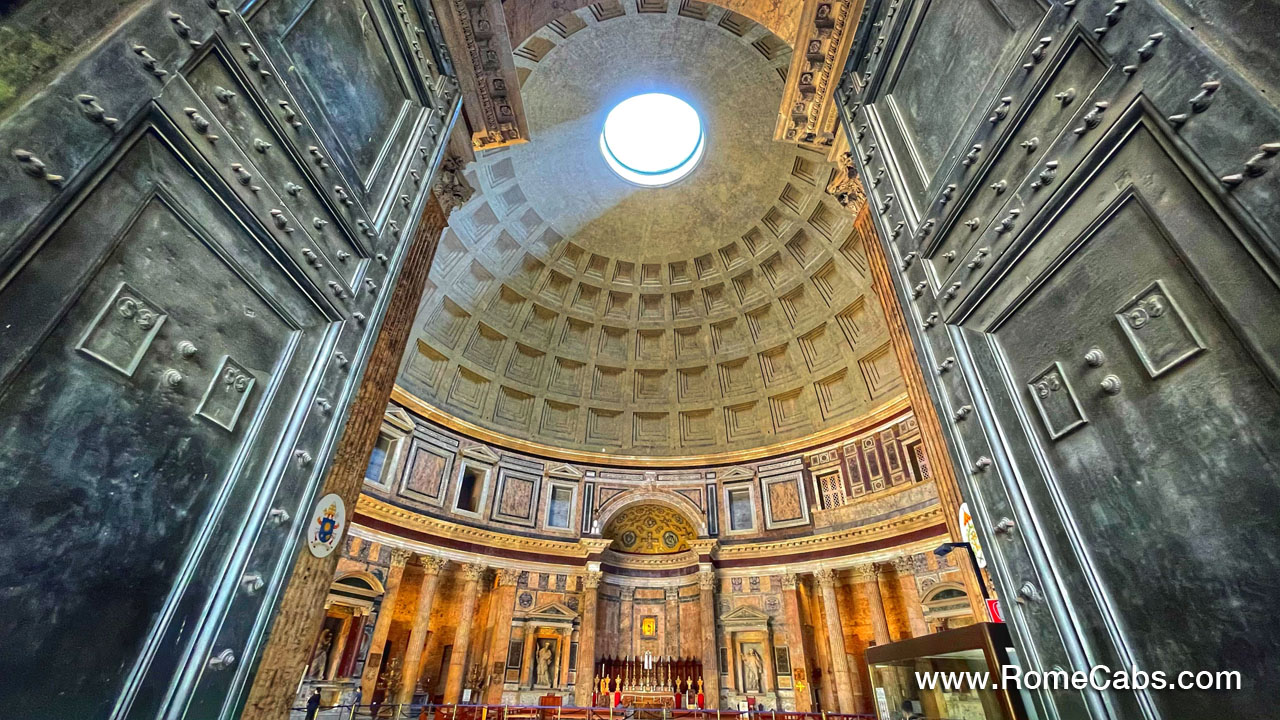
.
.
.
Pantheon: A Monumental Engineering Achievement
.
Upon stepping into the Pantheon, visitors are greeted by an enormous circular room covered by a dome, the height of which is exactly equal to the building’s diameter: 43.3 meters (142 feet). This symmetry and scale make the Pantheon feel perfectly balanced, as though one is standing within a massive sphere.
At the peak of this dome, the oculus—measuring about 9 meters (30 feet) in diameter—appears as the architectural crown jewel. The oculus is both a simple and dramatic feature: it is nothing more than an open hole, yet it is one of the most sophisticated elements of Roman design.
The Pantheon was originally constructed under Marcus Agrippa around 27 BC but was later rebuilt by Emperor Hadrian between 118 and 125 AD after a fire destroyed much of the original structure.
.
.
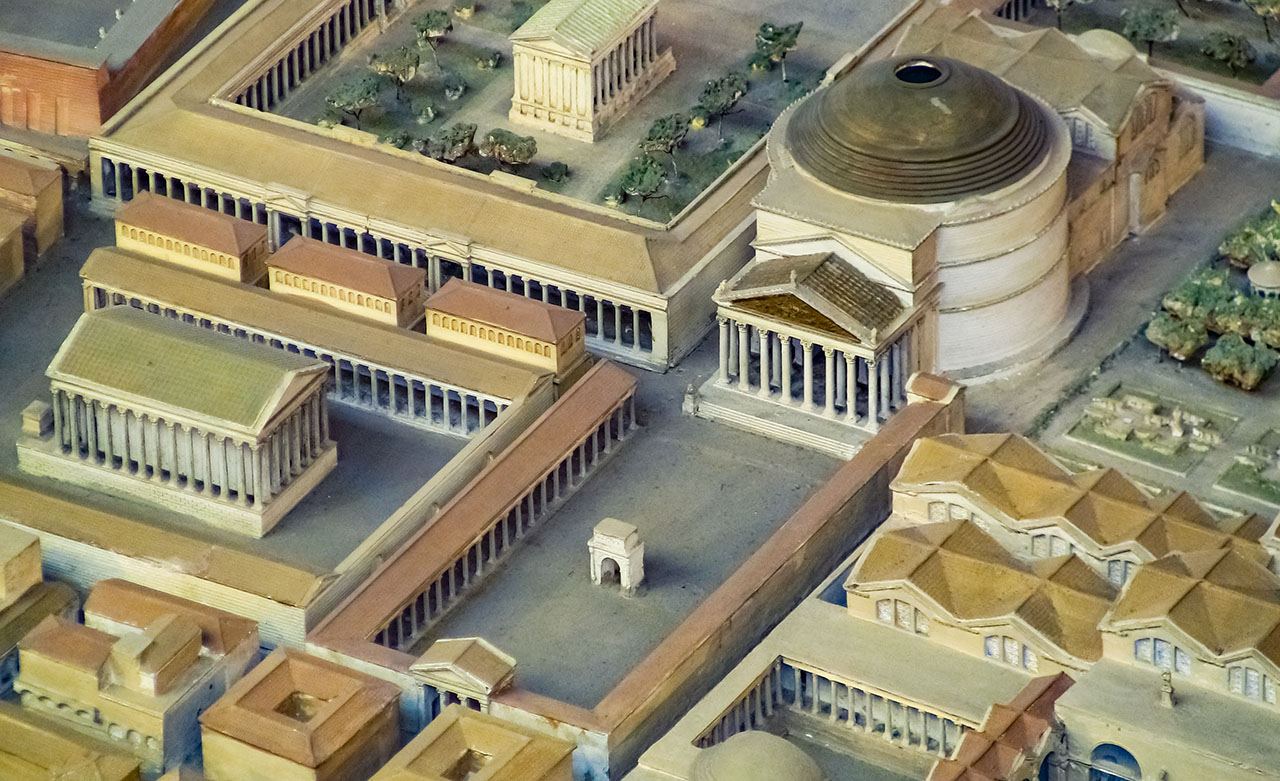
.
.
The Pantheon’s design and construction are often attributed to Hadrian, though it is possible that the architect Apollodorus of Damascus played a significant role as well. Regardless of its authorship, the Pantheon stands as the best-preserved structure of ancient Rome, largely due to the sophisticated engineering techniques employed in its construction.
One of the most remarkable aspects of the Pantheon is its dome, the largest unreinforced concrete dome in the world. This record remains unbroken, even in an era where reinforced concrete allows for far greater feats of engineering.
The dome’s construction involves a brilliant layering technique: the lower portions of the dome are made of heavier materials like travertine and tufa, while the upper parts are composed of lighter pumice and brick. This reduces the weight pressing down on the walls as the dome curves upwards, a necessary innovation that has allowed the Pantheon to survive for centuries without structural reinforcements.
.
.
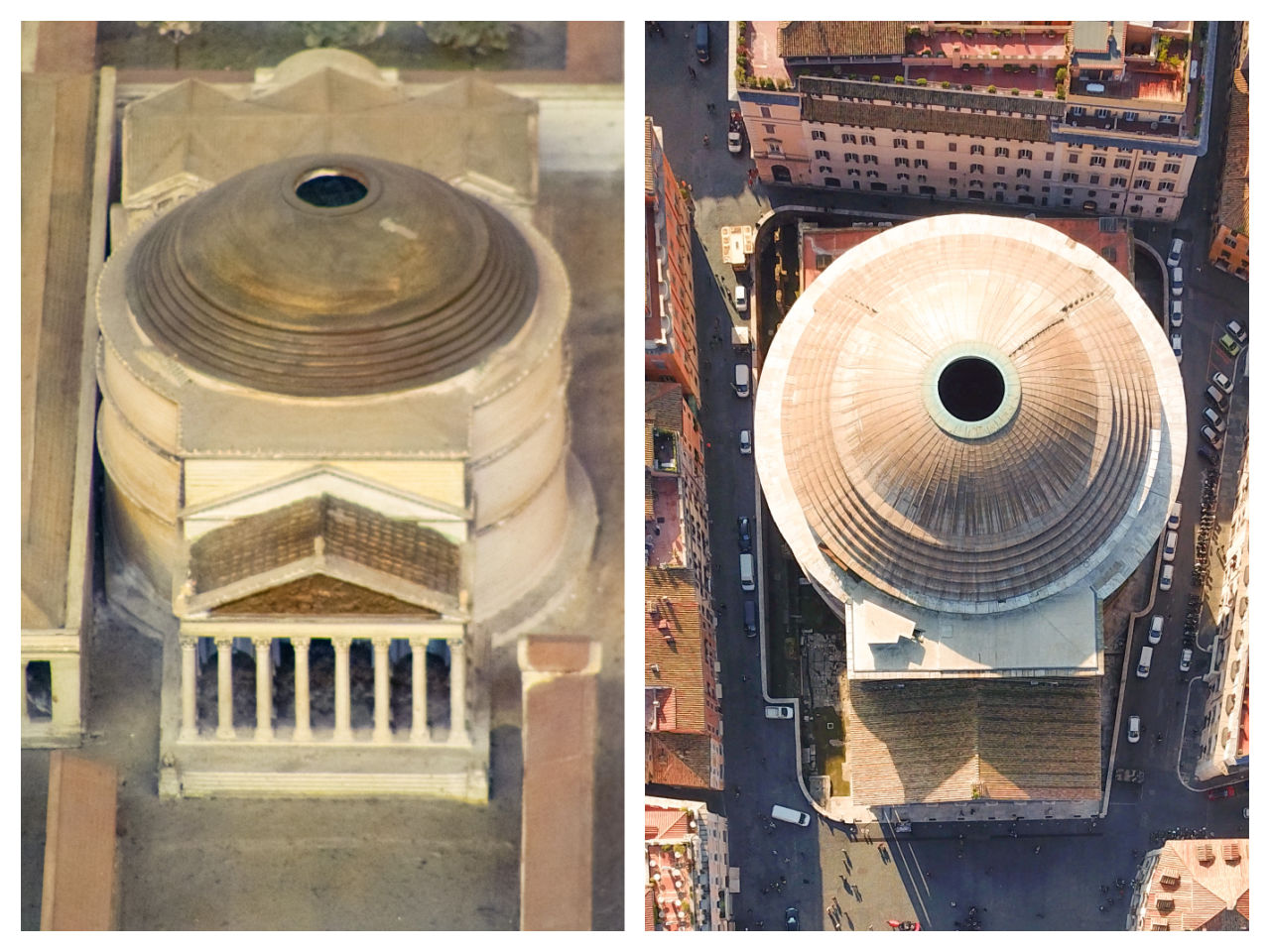
.
.
The oculus plays a key role in maintaining this balance. It reduces the weight at the dome’s apex, eliminating the need for additional support that could have compromised the building’s open, airy design. The ancient engineers knew that a solid dome this large would be too heavy to support itself, so the oculus was both an architectural necessity and a stroke of artistic genius.
.
.
The Purpose and Symbolism of the Oculus
.
Though the oculus is an impressive feat of engineering, its role goes beyond structural integrity. In Roman architecture, light and space were often imbued with symbolic meaning, and the Pantheon is no exception. The oculus serves multiple functions, from practical to spiritual, making it one of the most profound architectural features of its time.
.
.
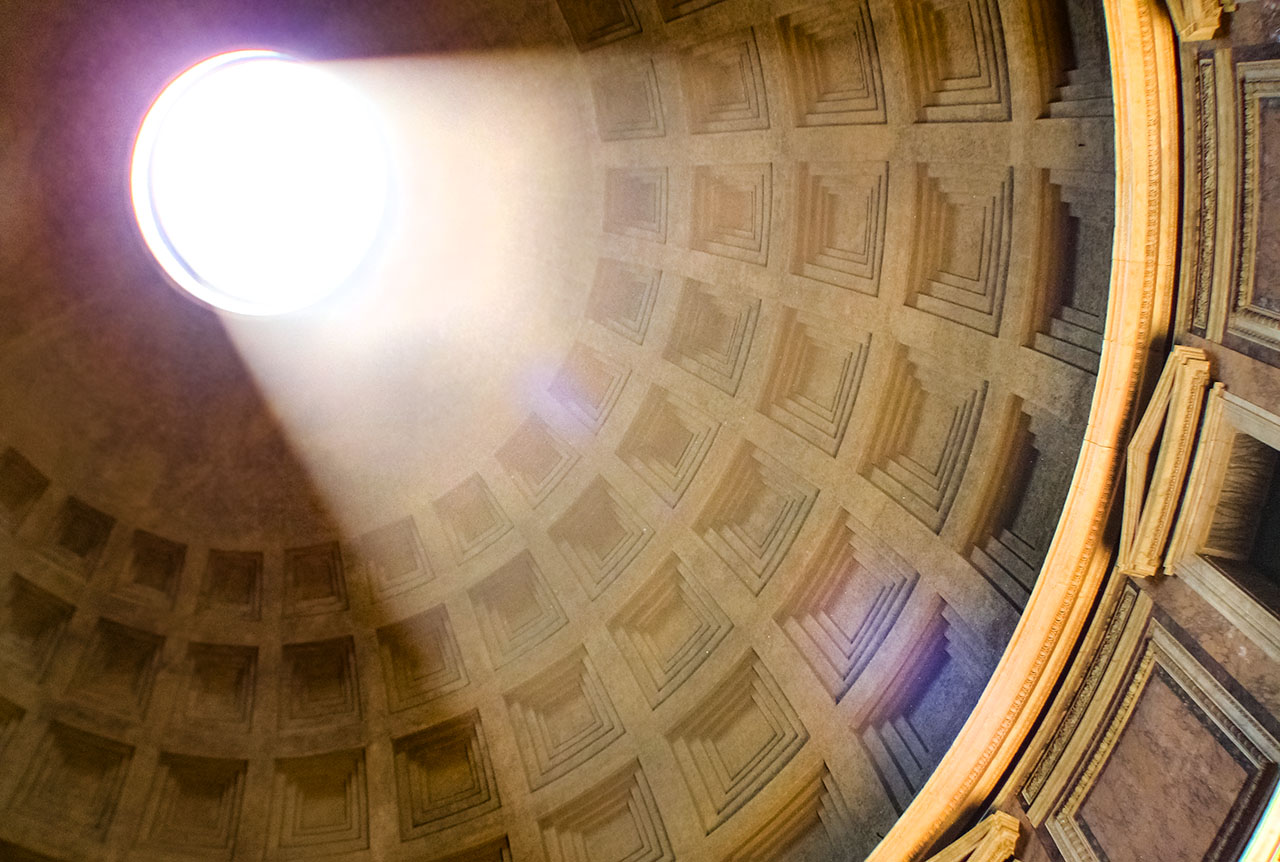
.
.
The Pantheon Oculus as a Sundial of Light:
.
One of the most practical uses of the oculus is as a natural source of light. The only two ways that light enters the Pantheon are through the oculus and the large doorway. Throughout the day, as the sun moves across the sky, sunlight streams through the oculus and casts a moving circle of light that traces a path along the interior walls of the Pantheon.
In this way, the oculus acts like a sundial, measuring the passage of time not through shadows, as is typically the case, but through light itself. As the sunlight shifts, it illuminates different parts of the building, making the experience of standing within the Pantheon unique depending on the time of day.
This phenomenon is particularly dramatic during the Summer Solstice on June 21. On this day, around 1:08 PM, the sunlight entering through the oculus aligns perfectly with the entrance, flooding the interior with brilliant light. The beam of sunlight moves across the floor like a celestial spotlight, intensifying the sense of connection between the heavens and the earth.
At this moment, the Pantheon seems to become an instrument of cosmic alignment, a space where architecture and nature converge. The event is a reminder of the Pantheon’s symbolic role as a representation of the heavens and its ability to transform ordinary sunlight into something deeply spiritual and profound.
.
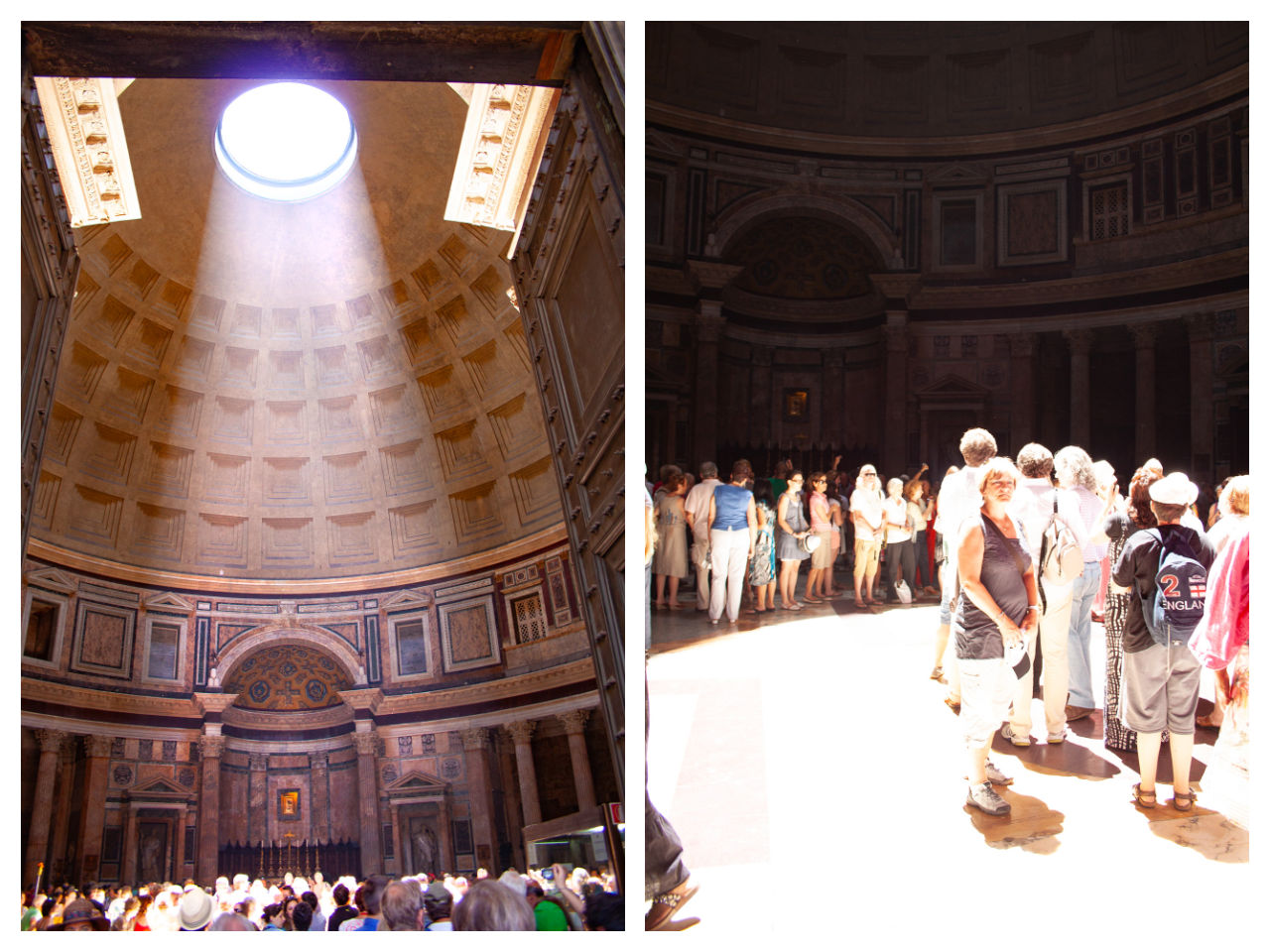
.
.
The Pantheon Oculus as a Symbol of the Heavens:
.
Many historians and scholars believe that the Pantheon was designed to represent the heavens or the cosmos. The name Pantheon is derived from Greek, meaning “all gods“, and the building was originally dedicated to the entire Roman pantheon of gods. Since the oculus serves as a direct connection to the sky, allowing natural light to flood the space, it created a sense of openness to the divine.
Standing beneath the oculus, it’s easy to imagine ancient Romans viewing the sunlight as a manifestation of the gods’ presence. The circular form of the dome, combined with the central oculus, gives the impression that the Pantheon is a model of the celestial sphere, with the oculus serving as a window through which the divine can look down upon Earth.
.
.
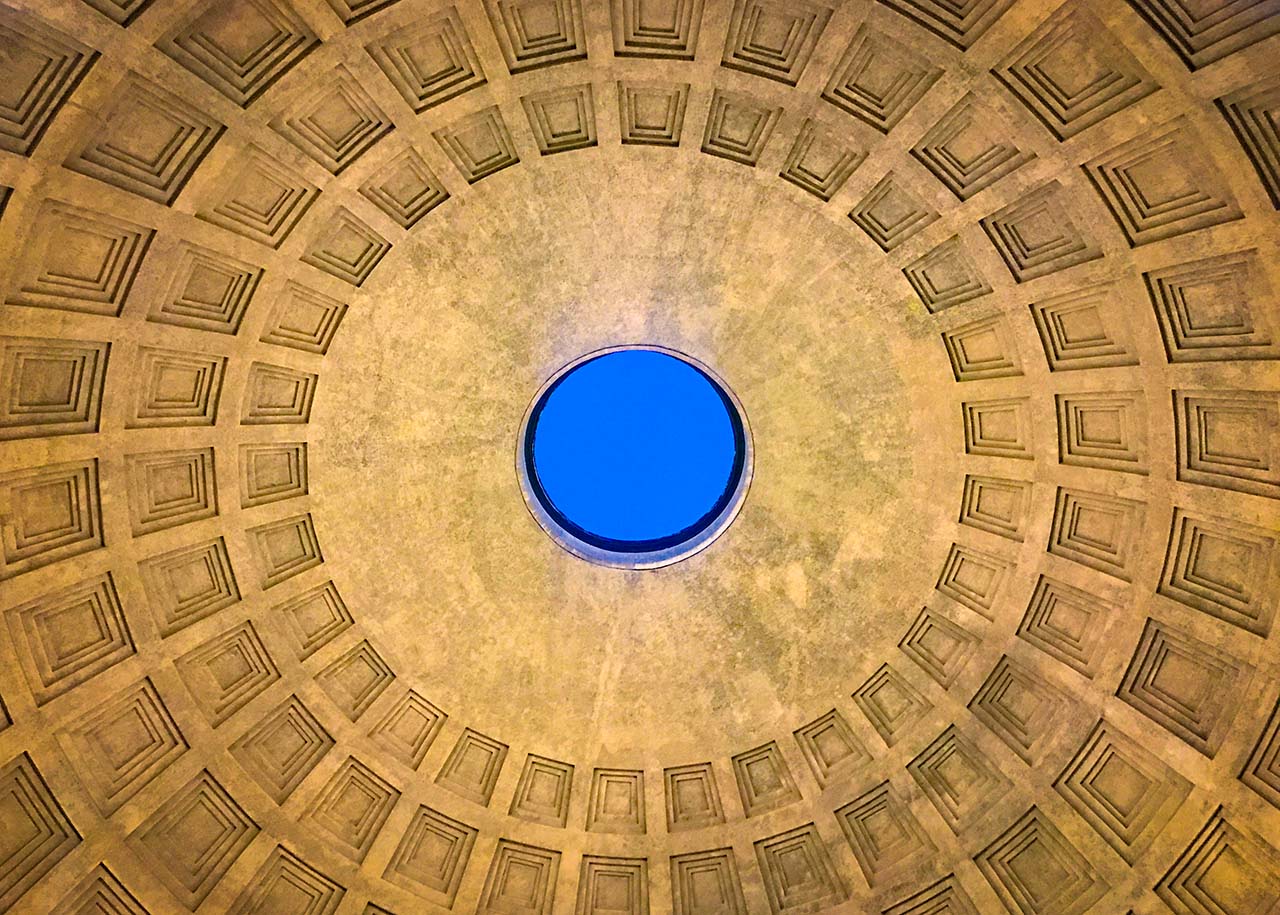
.
.
Cooling and Ventilation: In practical terms, the oculus also served as an early form of ventilation.
The open design allowed heat, smoke, and fumes from oil lamps or ceremonial fires to escape the building naturally, keeping the interior cool and comfortable. Even in ancient times, architects were acutely aware of the need to manage airflow in large, enclosed spaces. The oculus, in this way, was not only a spiritual design choice but a functional one as well.
Handling the Elements: One of the most surprising aspects of the Pantheon is that the oculus was deliberately left uncovered, even though it is open to the elements.
Rainfall can—and does—pour through the oculus onto the floor of the Pantheon. However, the Romans, ever practical, built a slight incline into the floor, about 30 centimeters (12 inches), to allow water to run off and drain.
Beneath the marble floors are drainage holes and channels that efficiently carry away rainwater, a testament to Roman engineering prowess.
.
.

.
.
Cultural and Religious Significance of the Oculus
.
The Pantheon’s oculus was not just an architectural feat; it played a crucial role in the religious and cultural life of ancient Rome. The building itself was dedicated to all the gods, and the oculus was a way of inviting divine light into the sacred space.
While the building’s religious function shifted over time, particularly after it was converted into a Christian church in the 7th century as the Basilica of St. Mary and the Martyrs (in Italian, Basilica di Santa Maria ad Martyres), the oculus has remained a powerful symbol of the connection between heaven and earth.
In Roman culture, light was often seen as a metaphor for the presence of the gods, and the oculus, in particular, could be interpreted as a cosmic eye, always open to the heavens. When Hadrian rebuilt the Pantheon, the Roman Empire was at the height of its power, and the Pantheon’s design reflects the emperor’s vision of a world that was orderly, harmonious, and blessed by the gods. The oculus, which literally opens up to the sky, reinforced this view by allowing light—associated with divine favor—to continuously enter the space.
Later, during the building’s use as a Christian church, the symbolism of the oculus shifted. Light continued to be associated with the divine, but instead of the Roman pantheon, the light was now seen as a manifestation of the Christian God. The sun’s rays streaming through the oculus were likened to the Holy Spirit descending upon the congregation, particularly during religious ceremonies.
.

.
.
The Pantheon’s Influence on Later Architecture
.
The Pantheon, and particularly its dome and oculus, has had a profound influence on Western architecture. Many of the great domed structures that followed drew inspiration from the Pantheon’s innovative design, including St. Peter’s Basilica, the Florence Cathedral, and even the U.S. Capitol. Architects throughout the Renaissance and beyond have studied and emulated the Pantheon, marveling at its perfect proportions and the ingenious use of light and space.
The oculus, in particular, became a key feature in many subsequent designs. Michelangelo, who designed the dome of St. Peter’s Basilica, is said to have drawn inspiration from the Pantheon’s oculus. The idea of a central, unbroken opening to the sky has been repeated in various forms in buildings around the world. In some cases, the oculus was used symbolically, as in the Pantheon, to connect a sacred space with the heavens. In others, it served more practical purposes, such as allowing light and air into a building.
.
.
.
.
Myths and Misconceptions about the Pantheon’s Oculus
.
Over the years, various myths and misconceptions about the Pantheon’s oculus have emerged. One popular myth is that the Oculus was designed to be completely waterproof, with rain magically avoiding the interior despite the open hole. This is not true—rain does enter the Pantheon, but the ingenious drainage system ensures that the water is quickly carried away, preventing any significant damage.
Another misconception is that the oculus was covered with glass or another material in ancient times, but there is no evidence to support this. The oculus has always been open to the elements, a deliberate choice by the architects which is evident in the underground drainage systems for the rain that falls through.
.
.
Why Has the Pantheon Endured While Others Crumbled?
.
One of the most fascinating aspects of the Pantheon is its remarkable state of preservation. While other ancient Roman monuments, such as the Colosseum, have fallen into partial ruin, the Pantheon remains almost completely intact, continuing to impress visitors with its architectural perfection. So, what has allowed the Pantheon to survive nearly two millennia of wars, natural disasters, and urban transformation?
Several factors have contributed to the Pantheon’s longevity:
.
1. The Pantheon’s Religious Reuse and Protection
.
Perhaps the most crucial factor in the Pantheon’s preservation is its early conversion into a Christian church. In 609 AD, Pope Boniface IV consecrated the Pantheon as a church dedicated to St. Mary and the Martyrs. This transition from a pagan temple to a Christian church was vital, as it ensured that the building would be maintained and protected under the care of the Catholic Church.
Unlike the Colosseum, which was abandoned and later used as a quarry for building materials, the Pantheon’s religious function made it a valuable and sacred space. This protected it from the fate that befell many other Roman monuments, which were either neglected, repurposed, or dismantled for their materials during the Middle Ages and the Renaissance. The church’s active use of the Pantheon also ensured that it was regularly maintained, repaired, and adapted, keeping it structurally sound.
.
.
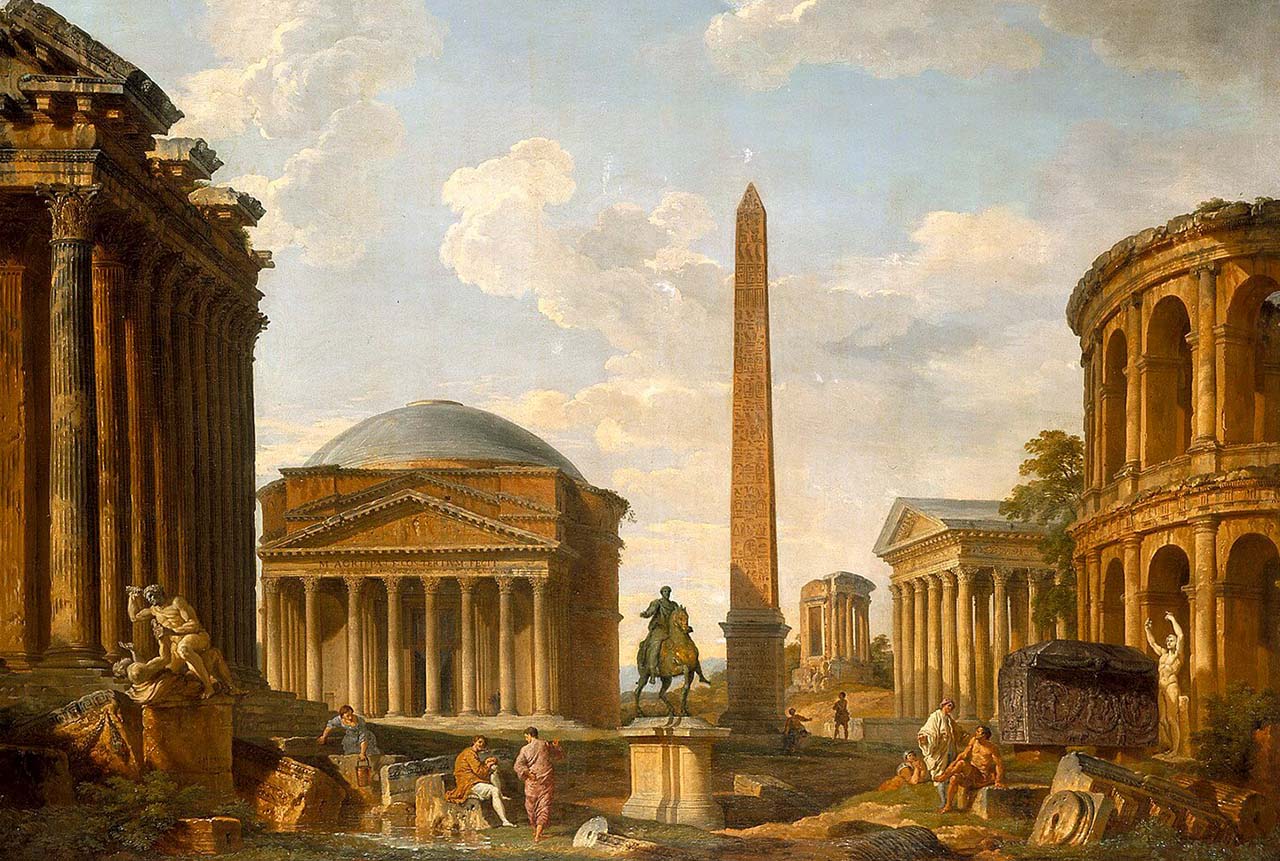
.
.
.
2. The Quality of Roman Engineering
.
The Pantheon’s design and construction are nothing short of a masterpiece of Roman engineering. While the Colosseum and other ancient buildings were subjected to structural failures and collapse over the centuries, the Pantheon’s unique architectural innovations have contributed to its durability.
The Pantheon’s dome, for example, is made from unreinforced concrete, which was carefully designed to reduce weight and distribute stress evenly. The Romans used progressively lighter materials toward the top of the dome, making it less likely to collapse under its own weight. This intelligent use of materials, combined with a strong foundation and the ingenious incorporation of the oculus, has allowed the Pantheon to remain structurally sound despite the passage of time.
Additionally, the Pantheon’s walls are much thicker than those of many other Roman structures, which makes it less susceptible to damage from earthquakes, a common occurrence in the region. The building’s foundation, made from heavy and stable materials, has also played a key role in its longevity, preventing it from settling unevenly or collapsing due to structural instability.
.
.

.
.
3. Pantheon’s Architectural Harmony and Adaptation
.
The Pantheon’s balanced design also contributed to its survival. The symmetrical relationship between its dome and cylindrical base helped distribute the weight evenly, which has kept the building standing without the need for external reinforcements. Many ancient structures, such as the Colosseum, had to support multiple stories, arches, and complex passageways, which made them more susceptible to collapses and structural weaknesses over time.
The Pantheon’s simplicity and clean lines made it easier to maintain over the centuries. Furthermore, its ongoing use and adaptability throughout history ensured that it remained relevant and functional. The Pantheon has been continuously adapted for different purposes, from its original role as a Roman temple to its later use as a Christian church and now as both a functioning religious site and a historical monument.
.
3. Protection from External Damage
.
Another reason the Pantheon has survived so well is its relatively sheltered location within the city. The Colosseum, on the other hand, was exposed to greater environmental and human-induced threats over the centuries.
Rome has experienced numerous sackings and invasions, including by the Visigoths in 410 AD and the Vandals in 455 AD, which led to significant damage to many monuments. However, the Pantheon, located within the more centralized and protected parts of the city, escaped much of the looting and destruction that affected other buildings.
While the Colosseum was damaged by earthquakes, fires, and neglect, the Pantheon’s structural design, reinforced by its thick walls and solid foundation, helped it withstand similar natural events. Additionally, the Pantheon has never been subjected to large-scale dismantling or quarrying. The same cannot be said for the Colosseum, which was stripped of its marble and valuable materials during the Middle Ages and Renaissance to be used in the construction of other buildings, including St. Peter’s Basilica.
.
.
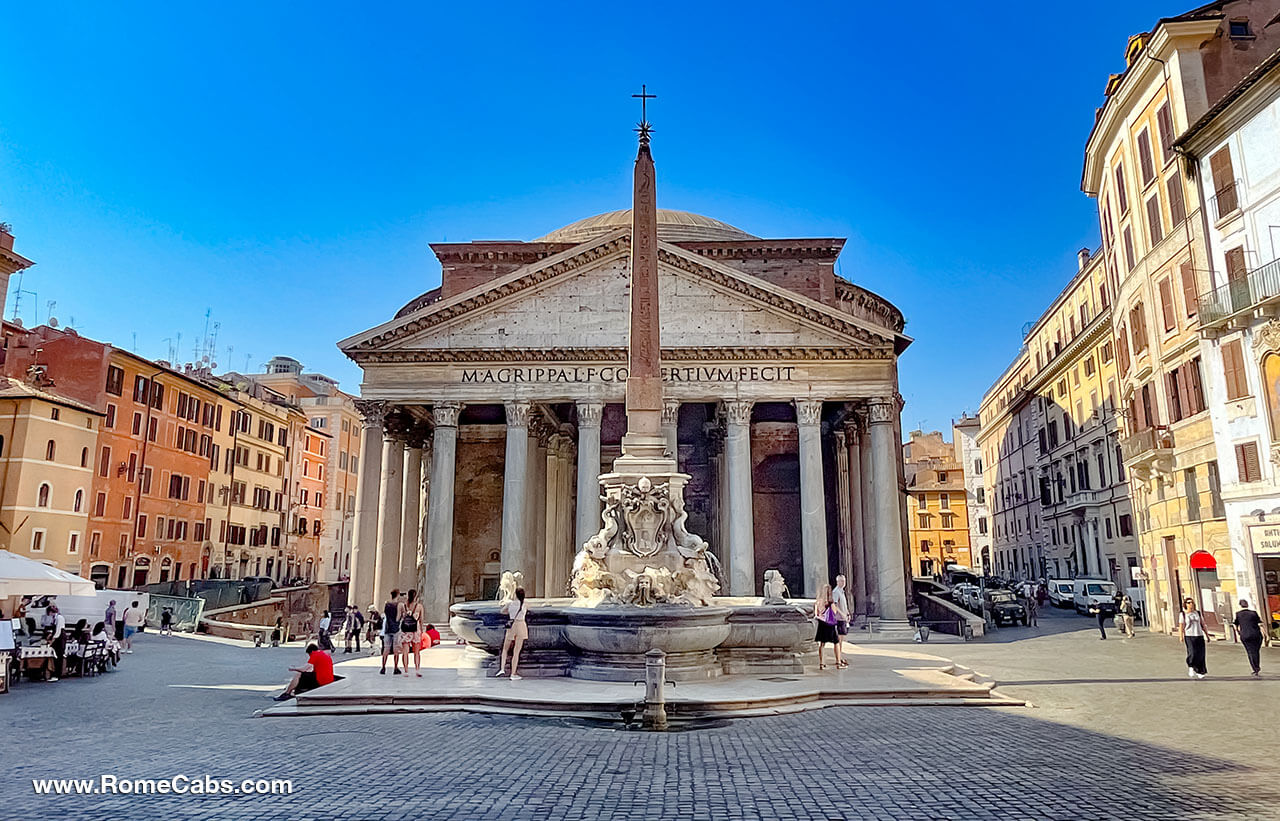
.
.
5. Pantheon Restorations and Preservation Efforts
.
While the Pantheon has survived in remarkable condition, it has not remained untouched by time. Over the centuries, several restorations and conservation efforts have helped to protect the building from decay. These interventions have ranged from minor repairs to more extensive preservation efforts.
During the Renaissance, Pope Urban VIII, a member of the powerful Barberini family, ordered the removal of bronze from the Pantheon’s portico in 1625. The bronze was melted down to create the grand baldachin, or canopy, over the altar of St. Peter’s Basilica, as well as to cast cannons for the Castel Sant’Angelo.
The phrase “Quod non fecerunt barbari, fecerunt Barberini”—”What the barbarians did not do, the Barberini did“—encapsulates a sharp critique of the destruction wrought upon Rome’s ancient monuments not by foreign invaders, but by the city’s own leaders during the Renaissance.
In the modern era, the Italian government and various cultural heritage organizations have taken steps to ensure the Pantheon remains intact for future generations. Regular maintenance of the roof, dome, and drainage system has helped to protect the building from environmental damage, while modern technologies like laser cleaning have been employed to remove centuries of grime and pollution without harming the original structure.
.

.
.
6. The Pantheon’s Continued Relevance
.
The Pantheon’s enduring status as a symbol of Roman greatness and a masterpiece of architectural innovation has ensured that it continues to be valued and cared for throughout the ages. Unlike the Colosseum, which lost its original function after the fall of the Roman Empire and was later used for less prestigious purposes like animal housing and stone quarrying, the Pantheon has always been seen as a site of cultural and religious significance.
This reverence for the building—both as a Christian church and as an architectural icon—has helped protect it from the neglect and misuse that affected other ancient structures. Today, the Pantheon is not only a tourist attraction but also a functioning place of worship.
Every year on Pentecost, a ceremony is held inside the Pantheon where rose petals are dropped through the oculus to symbolize the descent of the Holy Spirit. This blending of ancient architecture with ongoing cultural and religious practices ensures that the Pantheon remains a living, breathing part of Rome’s history.
.
.

.
.
.
Modern Pantheon for Visitors
.
Today, the Pantheon is one of Rome’s most visited sites, attracting millions of tourists each year. The experience of standing beneath the oculus is as powerful today as it was two thousand years ago. Visitors often stand transfixed, watching the light move across the building’s interior or gazing upward at the sky framed by the oculus.
Despite its age, the Pantheon remains remarkably well-preserved. Conservation efforts over the years have ensured that the building—and the oculus—continue to withstand the test of time. Modern architects and engineers have marveled at the longevity of the Pantheon, particularly the fact that it has survived without significant structural reinforcements. The oculus, which could easily have been seen as a weakness, has instead proven to be a crucial element in the building’s design, contributing to its durability and resilience.
To visit the Pantheon, tickets are required. Currently, tickets are about 5 Euros Per Person and can be purchased online or on-site at the ticket counter. Expect long lines and wait times due to huge crowds.
.
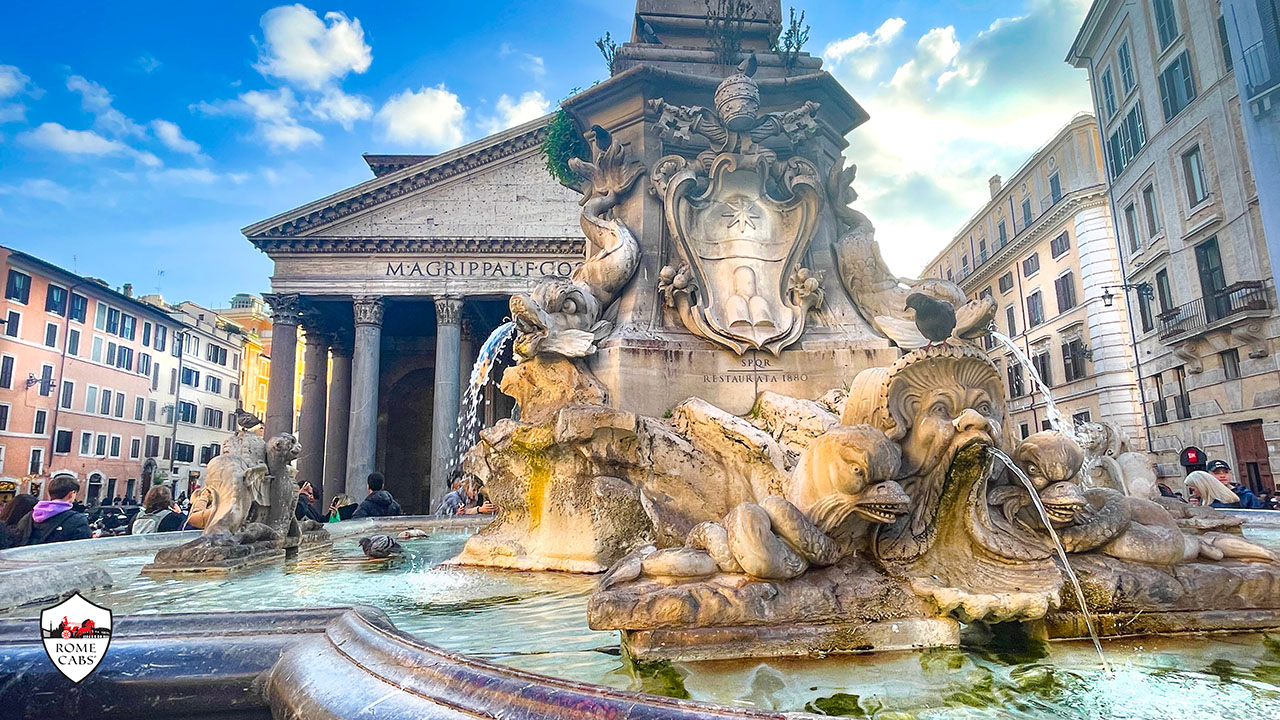
.
.
The oculus of the Pantheon is much more than a hole in the ceiling—it is a symbol of human ingenuity, divine inspiration, and architectural mastery. For nearly two thousand years, it has allowed light and air to pour into the Pantheon, creating a space that feels both grounded and ethereal. Its design has influenced countless buildings and continues to inspire architects and visitors alike. In the end, the oculus serves as a reminder that even the most advanced technologies can learn from the past, where simplicity and elegance combine to create something timeless.
.
Check out our other Italy Travel Blogs by RomeCabs:
https://rome-cabs.org/
https://rome-cabs.net/
https://romecabsdotnet.wordpress.com/
https://romecabs.wordpress.com/
.
* Find RomeCabs online also on:
- RomeCabs FACEBOOK
- RomeCabs PINTEREST
- RomeCabs TWITTER
- RomeCabs INSTAGRAM
- RomeCabs FLICKR Photo Gallery
- RomeCabs Recommended on Cruise Critic
.
.
.
.
.
.
.

.
.
5 Amazing Churches in Rome you can’t miss (Beyond St. Peter’s Basilica)
Buongiorno and welcome to RomeCabs Rome Travel blog! Rome, the Eternal City, is renowned for its profound history and unparalleled religious significance. While St. Peter’s Basilica stands as a monumental symbol of the Catholic Church, the city is adorned with numerous other churches that are equally compelling and steeped in history. While it may not be possible to visit too many churches during one trip to Rome (as there are more than 900 churches in Rome), we included the following 5 amazing churches in Rome you can’t miss on your next trip to Italy that showcase the city’s rich spiritual and architectural heritage.
.
Amazing Churches in Rome you can’t Miss
.
.
1. Basilica of Santa Maria Maggiore
.
The Basilica of Santa Maria Maggiore is one of Rome’s four major basilicas and stands as a testament to the grandeur and evolution of early Christian architecture. Dedicated to the Virgin Mary, this basilica is among the oldest in the city, with its origins dating back to the 5th century. It is a pivotal site for both its historical significance and its architectural splendor, making it an essential destination for those delving into Rome’s spiritual and artistic heritage.
The basilica was initially constructed under the patronage of Pope Sixtus III between 432 and 440 AD. It was built to commemorate the Council of Ephesus, which affirmed the title of Theotokos (Mother of God) for the Virgin Mary. The foundation of the church is steeped in legend, with a story that a miraculous snowfall on the Esquiline Hill in August (later celebrated as the Feast of the Assumption) guided the pope to the site where the church would be built.
Exterior: The basilica’s façade is a striking example of Romanesque architecture with elements of classical influence. The exterior is relatively austere, but the grandeur of the basilica becomes apparent as one steps inside.
Interior: Inside, Santa Maria Maggiore boasts a grand nave that is supported by majestic columns. The interior features a harmonious blend of architectural styles, including early Christian, Renaissance, and Baroque elements, reflecting the church’s evolution over the centuries. The use of marble and elaborate mosaics enhances the sense of opulence and sanctity.
.

.
.
Mosaics of Santa Maria Maggiore:
Santa Maria Maggiore is renowned for its 5th-century mosaics, which are among the most complete and well-preserved examples from the early Christian period. These mosaics offer a vivid portrayal of biblical stories and theological concepts, serving as both artistic masterpieces and religious texts.
The mosaics in the nave depict scenes from the Old Testament, including the stories of the Creation and the Flood. These works are notable for their rich colors, intricate patterns, and the ability to convey complex theological ideas through visual art.
Above the triumphal arch, the mosaics depict scenes from the life of Christ, including the Adoration of the Magi and the Last Supper. These images are not only artistically significant but also serve as a narrative of salvation history, providing a visual journey through the key events of Christian theology.
.
.
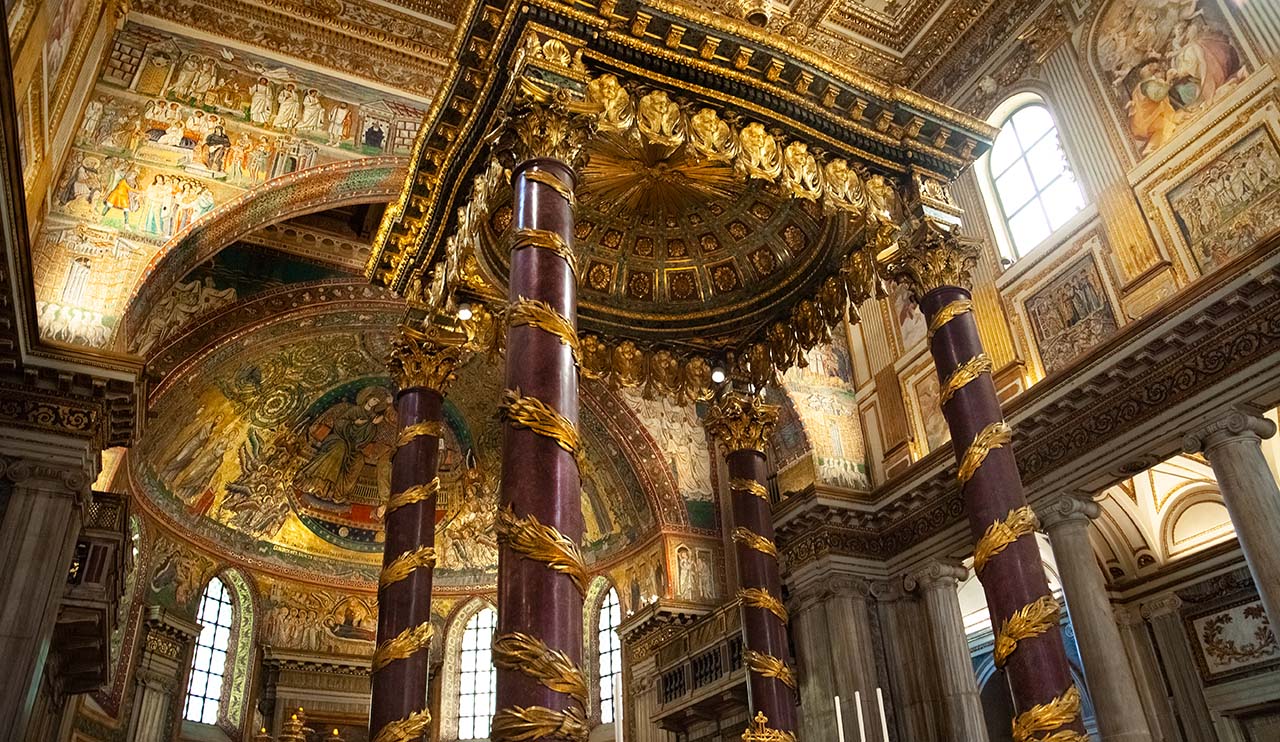
.
.
Borghese Chapel:
The Borghese Chapel, also known as the Pauline Chapel, is famed for housing the revered icon of the Salus Populi Romani (Protectress of the Roman People). This image of the Virgin Mary, attributed with miraculous powers, has been a focal point of devotion and pilgrimage for centuries.
The chapel itself is a masterpiece of Baroque art, characterized by its elaborate frescoes and gilded decorations. The ornate altarpiece, the richly decorated ceiling, and the intricate marble work create a visually stunning environment that enhances the veneration of the icon.
.
.

.
The Holy Crib:
Beneath the high altar of Santa Maria Maggiore lies the Holy Crib, a reliquary said to contain pieces of the wooden crib from the Nativity of Jesus. This relic, encased in a gilded crystal reliquary, draws pilgrims and visitors who come to pay homage and reflect on the humble beginnings of Christ.
.
.
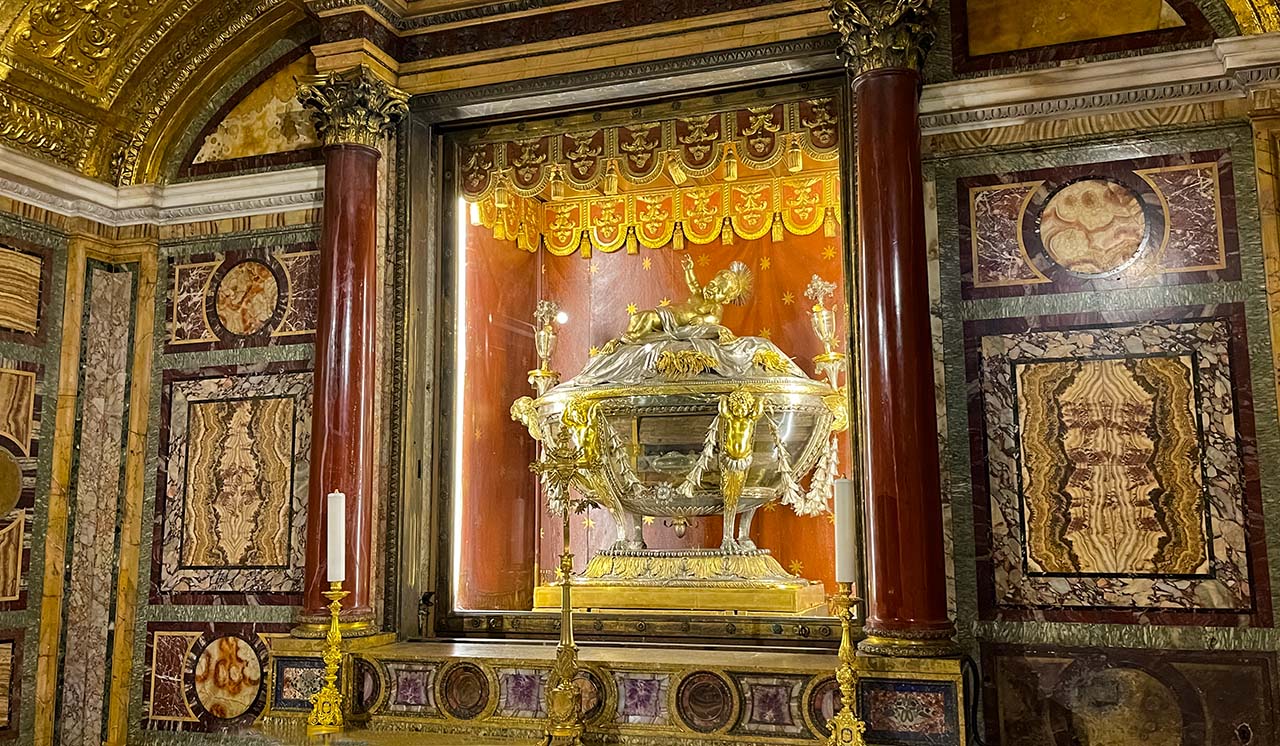
.
.
Gian Lorenzo Bernini’s Tomb in Santa Maria Maggiore
Gian Lorenzo Bernini, a towering figure of Baroque art and architecture, is interred in the Basilica of Santa Maria Maggiore. His tomb, located in the basilica, stands as a tribute to his immense contributions to art and architecture. Bernini, whose work includes masterpieces such as the Ecstasy of Saint Teresa and the redesign of St. Peter’s Square, is celebrated for his innovative and dynamic approach to sculpture and architectural design.
.
.
2. Santa Maria degli Angeli e dei Martiri
.
Located in Piazza della Repubblica, Santa Maria degli Angeli e dei Martiri is a striking church in Rome that embodies a fascinating blend of ancient and Renaissance artistry. Originally constructed within the ruins of the Baths of Diocletian, this church is a testament to Michelangelo’s architectural genius and Rome’s layered history.
.
History and Architecture of Santa Maria degli Angeli e dei Martiri :
Portions of Santa Maria degli Angeli e dei Martiri was designed by Michelangelo Buonarroti in the late 16th century. The church was built inside the remains of the Baths of Diocletian, one of the largest and most lavish public baths of ancient Rome. The decision to repurpose the ancient baths into a church was driven by Pope Pius IV, who sought to preserve the grandeur of the ruins while creating a new space for worship.
Michelangelo’s design ingeniously integrates the remnants of the ancient baths with Renaissance elements. The church features a grand façade that merges classical and Renaissance styles, with a striking simplicity that highlights the raw beauty of the ancient structures. The original architectural features of the baths, including the imposing arches and vaulted ceilings, are seamlessly incorporated into the church’s design, creating a dramatic and awe-inspiring interior.
.
.

.
.
.
Interior Highlights of Santa Maria degli Angeli e dei Martiri :
.
The Nave and Sanctuary: The church’s interior is dominated by a large, barrel-vaulted nave, a characteristic of Michelangelo’s architectural style. The sanctuary area is adorned with intricate details and delicate ornamentation that contrast beautifully with the rugged ancient walls. The combination of the old and new creates a unique spiritual atmosphere, blending the majesty of ancient Rome with Renaissance elegance.
Frescoes and Artworks: The interior of Santa Maria degli Angeli e dei Martiri is decorated with significant artworks. The church is home to frescoes by Daniele da Volterra, a pupil of Michelangelo. These frescoes add a vibrant and dynamic element to the church, enriching the visual experience for visitors. The art is carefully integrated into the architectural framework, creating a harmonious fusion of painting and structure.
The Meridian Line: One of the most intriguing features of the church is its meridian line, a large brass line set into the floor that was part of an astronomical instrument used to determine the solar year. This feature, designed by the Italian astronomer Giovanni Domenico Cassini, reflects the church’s role as a center of both spiritual and scientific inquiry.
.
.

.
.
.
3. San Pietro in Vincoli (St. Peter in Chains Basilica)
.
The Basilica di San Pietro in Vincoli, also known as St. Peter in Chains, is a distinguished church in Rome that offers a unique blend of artistic brilliance and spiritual significance. Located on the Esquiline Hill, this basilica is renowned for housing Michelangelo’s acclaimed statue of Moses and the sacred relics of the chains that bound Saint Peter. With its rich historical context, impressive architecture, and profound religious artifacts, the basilica stands as a notable destination for both art lovers and pilgrims.
The church was originally founded in the 5th century by Pope Leo I. It was constructed to house the relics of Saint Peter’s chains, which were believed to have been brought from Jerusalem. The basilica’s dedication to Saint Peter, the leader of the apostles, and its role in housing these significant relics underscore its importance in early Christian tradition.
.
.
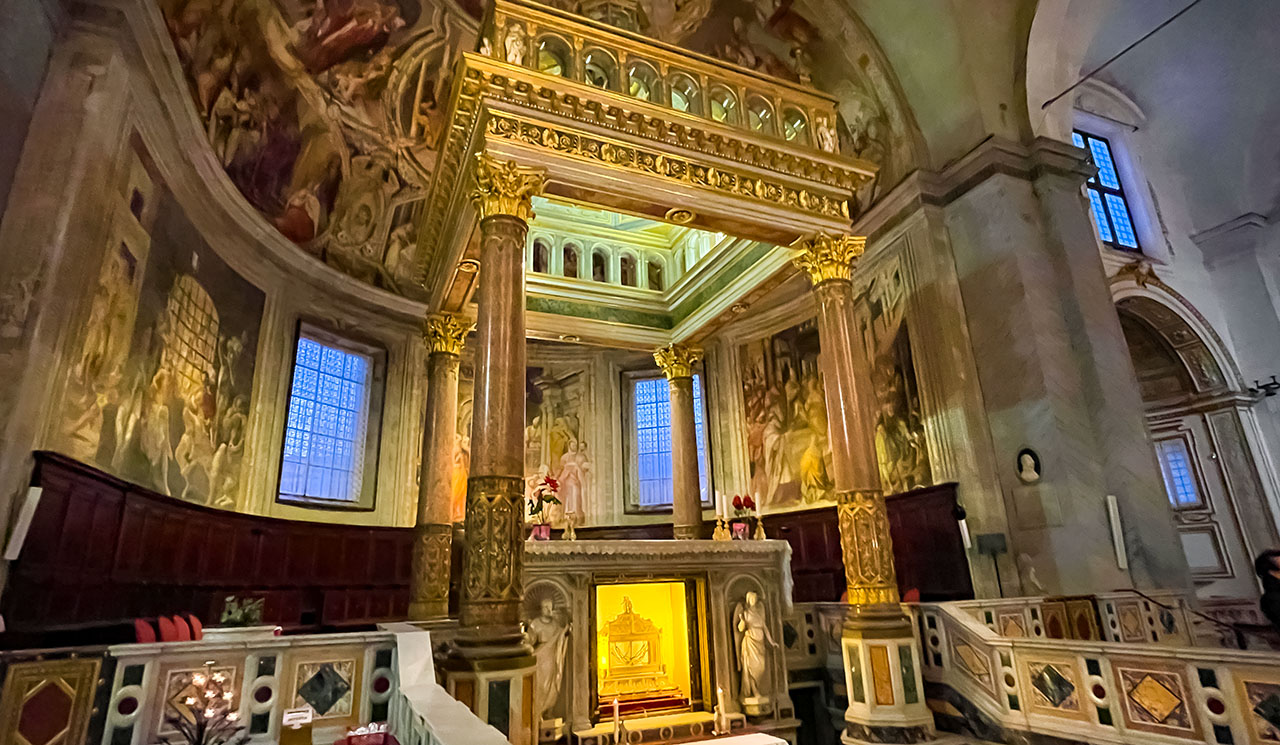
.
.
Highlights of Basilica of St. Peter in Chains
.
Michelangelo’s Moses:
One of the most compelling reasons to visit St. Peter in Chains is to see Michelangelo’s statue of Moses. Commissioned by Pope Julius II for his tomb, the statue was completed in 1515. It is renowned for its exceptional realism and dramatic expression, capturing Moses with an intense gaze and dynamic presence. Michelangelo’s meticulous attention to detail is evident in the figure’s muscular form, intricate facial expression, and the symbolic horns on Moses’ head, a result of a translation error from Hebrew texts referring to rays of light.
The Moses statue stands out as a masterpiece of Renaissance sculpture, showcasing Michelangelo’s unparalleled skill in rendering human emotion and physicality. The statue’s commanding presence and intricate details make it a focal point of the basilica and a testament to Michelangelo’s genius.
.
.
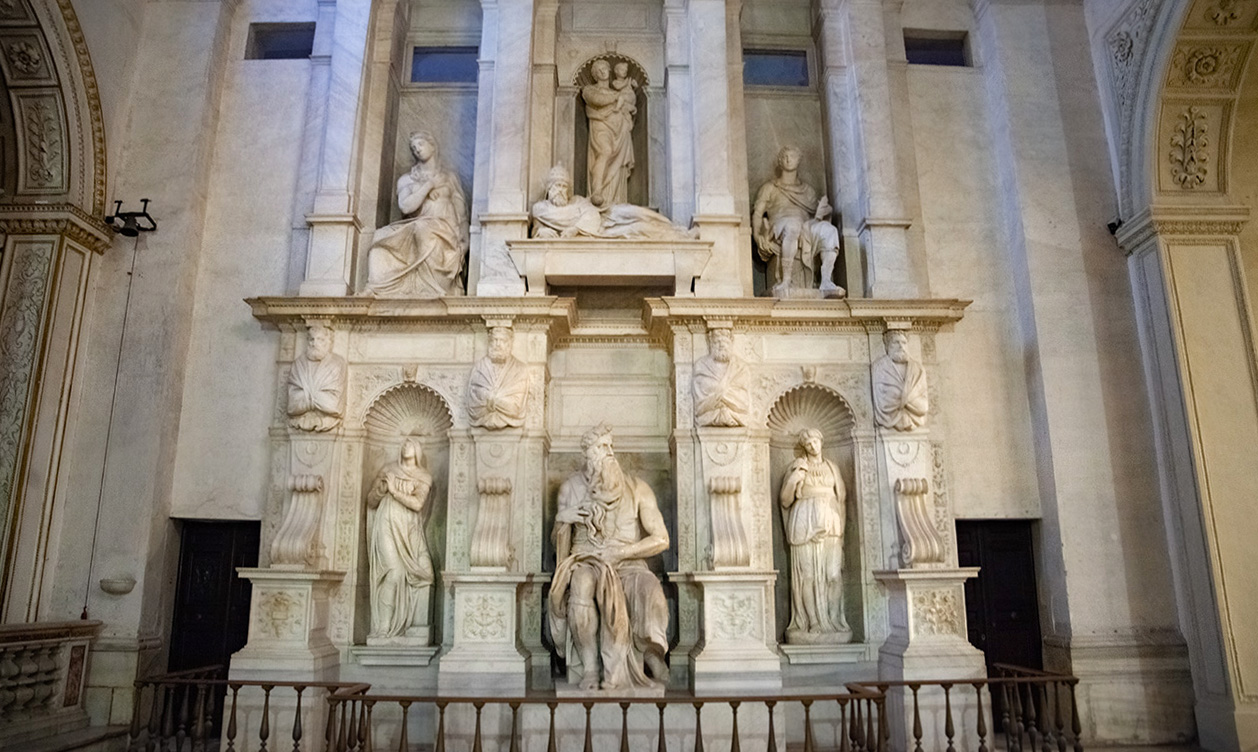
.
.
Relics of St. Peter:
The basilica is renowned for housing the relics of the chains that bound Saint Peter during his imprisonment in Jerusalem. According to tradition, these relics were brought to Rome by Emperor Constantine in the 4th century and were believed to have been preserved in the basilica since then.
Legend holds that when the chains from Jerusalem were brought to Rome, they miraculously fused with the chains that bound Peter during his Roman imprisonment. This miraculous event symbolizes the unity and continuity of the Church and enhances the spiritual significance of the relics.
The chains are displayed in a beautifully adorned reliquary beneath the main altar of the basilica. Pilgrims and visitors come to venerate these relics, reflecting on the suffering and faith of Saint Peter, and seeking spiritual inspiration from his example.
.
.

.
.
Art and Architecture of Basilica of St. Peter in Chains:
St. Peter in Chains features a rich array of Renaissance art and architectural elements. The basilica’s nave is adorned with elegant marble columns and features an array of frescoes and decorative elements that reflect its historical and artistic evolution.
The church houses several important frescoes, including works by artists like Masaccio and others who contributed to its visual splendor. The intricate decorations and vibrant colors add to the basilica’s spiritual and aesthetic ambiance.
The basilica’s interior is designed to evoke a sense of reverence and contemplation. The serene ambiance, coupled with the historical artifacts and artistic masterpieces, offers a profound and immersive experience for those who visit.
.
.
.
.
.
The Basilica di St. Peter in Chains is a remarkable destination in Rome, offering a compelling blend of Renaissance artistry and deep spiritual significance. Michelangelo’s Moses stands as a pinnacle of artistic achievement, while the relics of Saint Peter provide a profound connection to early Christian history. The basilica’s rich architectural and artistic heritage, combined with its serene and contemplative atmosphere, makes it a must-visit site for those exploring Rome’s religious and cultural landscape.
.
.
4. Santa Maria Sopra Minerva
.
Santa Maria Sopra Minerva is a rare and striking example of Gothic architecture in Rome, a city predominantly known for its Baroque and Renaissance masterpieces. Located in the historic center, just behind the Pantheon, this church stands out for its architectural uniqueness and its rich historical and artistic heritage. Built on the site of an ancient Roman temple dedicated to Minerva, the church seamlessly blends elements of its ancient past with the Gothic style introduced during the Middle Ages.
The church is built on the remains of a Roman temple dedicated to Minerva, the goddess of wisdom. The name “Sopra Minerva” means “over Minerva“, indicating the church’s location atop this ancient site. Construction of the church began in the late 13th century, around 1280, during the papacy of Nicholas IV, and it was completed in the early 14th century.
The choice of the Gothic style for Santa Maria Sopra Minerva is significant, as it contrasts with the more commonly seen Romanesque and Baroque styles in Rome. The church reflects the architectural innovations of the time, including the use of pointed arches, ribbed vaults, and flying buttresses, although some of these features are less pronounced than in the Gothic cathedrals of northern Europe.
.
.
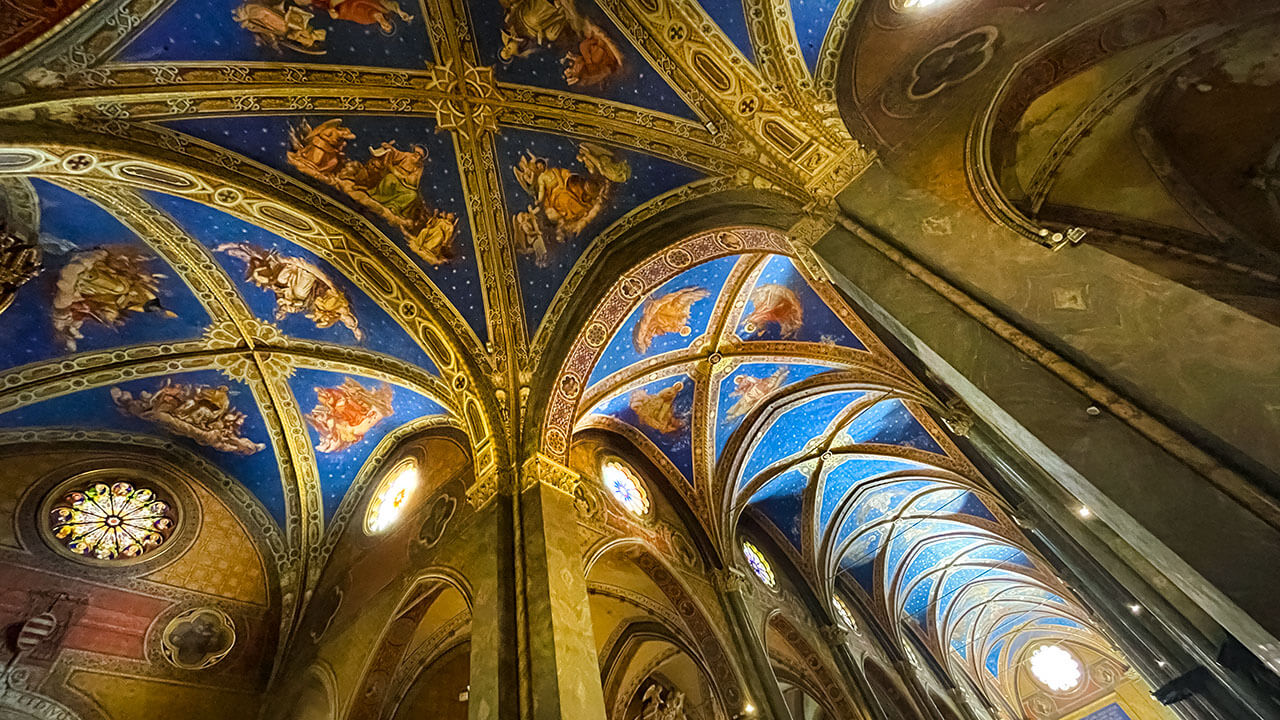
.
.
.
Architectural Highlights of Santa Maria Sopra Minerva
.
Facade: The church’s façade is a rare example of Gothic architecture in Rome, featuring pointed arches and intricate sculptures. The façade is relatively simple compared to other Gothic churches but includes elements such as a rose window and decorative tracery that highlight its Gothic roots.
.
Bernini’s Elephant:
The Elephant and Obelisk: Located in the Piazza della Minerva, right in front of the church, Bernini’s Elephant is a famous and charming sculpture created by Gian Lorenzo Bernini in 1667. The sculpture consists of a marble elephant carrying an ancient Egyptian obelisk on its back. The obelisk, which stands about 3.6 meters (12 feet) tall, is an ancient Roman artifact that dates back to the reign of Emperor Diocletian.
The elephant is depicted in a playful, almost whimsical manner, with its trunk raised and a gentle, supportive stance. The choice of an elephant to carry the obelisk was a clever and humorous design by Bernini, who was commissioned to create this work by Pope Alexander VII. The sculpture serves as a symbol of the pope’s enduring strength and resilience. The obelisk itself, with its ancient Egyptian origins, represents Rome’s cultural and historical connections to antiquity.
.
.

.
.
Interior: The interior of Santa Maria Sopra Minerva is characterized by its spacious nave and soaring vaulted ceilings. The church’s Gothic arches and ribbed vaults create a dramatic effect, emphasizing vertical lines and a sense of height. The use of colorful stained glass windows adds to the interior’s luminous quality, filtering light into the sacred space.
The blue ceiling of Santa Maria Sopra Minerva is a striking feature that enhances the church’s interior ambiance. The ceiling is adorned with rich blue tones and gilded star patterns, creating a celestial effect that complements the Gothic architecture. The use of blue and gold evokes a sense of heavenly tranquility and adds to the church’s spiritual atmosphere.
The blue ceiling is more than just a decorative element; it symbolizes the divine and eternal nature of the heavens. The celestial motif aligns with the Gothic emphasis on verticality and the aspiration to reach toward the divine. The vibrant colors and intricate patterns are designed to inspire awe and reverence, drawing the eyes upwards and reinforcing the church’s sacred character.
.
.
.
.
Notable Features and Artworks inside Santa Maria Sopra Minerva:
.
Michelangelo’s Christ the Redeemer:
One of the most significant features of the church is Michelangelo’s statue of Christ the Redeemer. Carved in 1521, this statue depicts Christ in a contemplative pose with a serene expression, showcasing Michelangelo’s masterful sculptural skills.
The statue was originally intended for a tomb but was placed in Santa Maria Sopra Minerva due to its association with the Dominican order. Michelangelo’s work here is a testament to his ability to capture profound spiritual themes with remarkable realism and emotional depth.
.
.

.
.
Tomb of Saint Catherine of Siena:
Santa Maria Sopra Minerva is also the final resting place of Saint Catherine of Siena, one of the Church’s most venerated saints. Her tomb, located in the church’s main altar area, is adorned with an ornate marble monument. Saint Catherine’s relics are housed here, and the tomb is a significant pilgrimage site.
Santa Maria Sopra Minerva stands out not only for its rare Gothic architecture in Rome but also for its distinctive artistic features. Bernini’s Elephant and the church’s blue ceiling contribute to its unique charm and historical significance. The Elephant and Obelisk in the piazza showcases Bernini’s inventive spirit and technical prowess, while the blue ceiling enhances the church’s celestial and spiritual ambiance. Together, these elements enrich the experience of visiting Santa Maria Sopra Minerva, offering a compelling blend of Gothic architecture, Baroque artistry, and historical depth.
.
.
5. San Paolo fuori le Mura (Basilica of St. Paul Outside the Walls)
.
The Basilica di San Paolo fuori le Mura, or St. Paul Outside the Walls, is one of Rome’s four major basilicas and holds a profound place in the city’s religious and architectural heritage. Situated outside the ancient city walls, this grand basilica is revered not only for its architectural splendor but also for its traditional association with the burial site of Saint Paul the Apostle. The basilica serves as a major pilgrimage destination and a testament to both early Christian and Renaissance artistry.
The original basilica was constructed by Emperor Constantine in the early 4th century, making it one of the oldest Christian churches in Rome. The present structure, however, was built following a devastating fire in 1823 that destroyed the original church. The current basilica was reconstructed under the direction of Pope Leo XII and completed in 1854. The new design carefully preserved the architectural grandeur and religious significance of the original.
As one of the four major basilicas of Rome, St. Paul Outside the Walls holds a unique place in Christian tradition. It is traditionally believed to be the burial site of Saint Paul, who was martyred in Rome around 64-67 AD. The basilica’s location outside the ancient city walls, where Saint Paul was thought to have been buried, adds to its sacred significance.
.
.
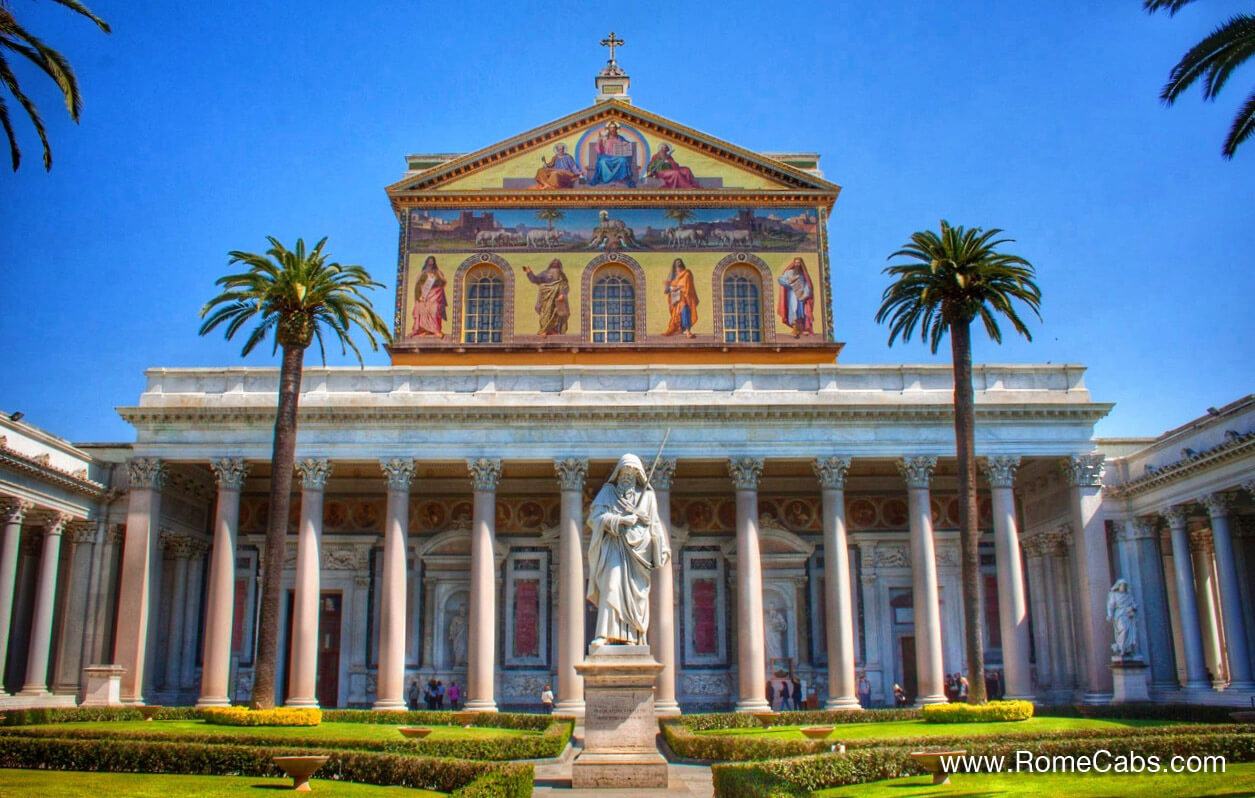
.
.
Architectural Highlights of St. Paul Outside the Walls
.
Facade: The basilica’s façade is a striking example of neoclassical architecture. The grand entrance is adorned with a series of Corinthian columns and features a portico with a bronze door that was added in the 19th century. The façade’s grandeur reflects the basilica’s status as a major pilgrimage site and its importance in the Catholic tradition.
Interior: The interior of St. Paul Outside the Walls is equally impressive, characterized by its vast nave and exquisite mosaics. The basilica is built in the traditional basilican plan with a long nave, side aisles, and a large apse. The use of marble, gold, and elaborate mosaic work creates a sense of opulence and reverence. The high ceilings and expansive space enhance the basilica’s solemn and awe-inspiring atmosphere.
.
.

.
.
Mosaics and Decorations inside St. Paul Outside the Walls
.
The basilica is renowned for its stunning mosaics, which are among the most beautiful and historically significant in Rome. The mosaics depict scenes from the life of Saint Paul and various episodes from the Bible, providing a visual narrative of Christian history and theology.
The apse is adorned with a magnificent mosaic of Christ in Majesty, surrounded by saints and angels. This mosaic dates back to the 5th century and was restored during the 19th-century reconstruction. It serves as a focal point of the basilica’s interior, highlighting the divine glory of Christ and the veneration of saints.
.
.

.
.
The mosaics along the nave illustrate the life of Saint Paul and his missionary journeys. These works are intricately designed and use vibrant colors to capture key moments in the saint’s life, making them both an artistic and theological treasure.
.
Tomb of Saint Paul:
The central feature of the basilica is the tomb of Saint Paul, which is located beneath the high altar in the Confessio. This sacred area is marked by a beautifully decorated baldaquin, which shelters the tomb and emphasizes its importance as a place of veneration.
The tomb itself is a simple yet profound structure, where the remains of Saint Paul are believed to rest. It is enclosed in a marble shrine, and the area is often adorned with candles and flowers by pilgrims and visitors.
The tomb of Saint Paul is a major pilgrimage destination for the faithful. The basilica’s status as the final resting place of one of Christianity’s most significant figures makes it a place of deep spiritual significance. Pilgrims come to pay their respects, seek blessings, and reflect on the teachings and legacy of Saint Paul.
.
.
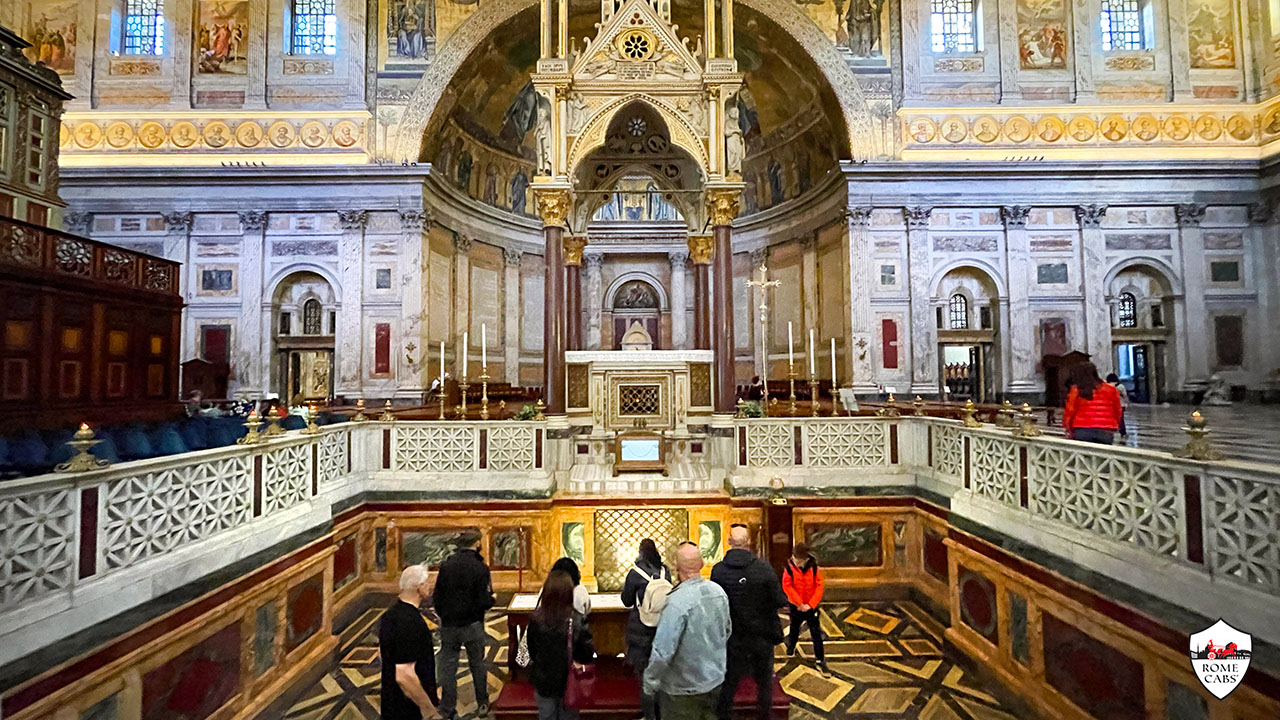
.
.
Cloister and Courtyard of St. Paul Outside the Walls:
The basilica is surrounded by a beautiful cloister with a serene courtyard. The cloister features elegant columns and arches, providing a peaceful space for reflection and contemplation. The courtyard is adorned with sculptures and inscriptions that enhance the historical and spiritual ambiance of the basilica.
The Basilica of St. Paul Outside the Walls is a majestic and spiritually significant landmark that embodies the grandeur of early Christian architecture and the deep reverence for Saint Paul. Its stunning mosaics, grandiose façade, and the revered tomb of Saint Paul make it a central site for both pilgrims and art enthusiasts. The basilica’s rich history, combined with its artistic and architectural splendor, ensures its place as a must-visit destination in Rome for those exploring the city’s religious and cultural heritage.
Basilica of Saint Paul Outside the walls is also featured on RomeCabs Panoramic Rome Tour
.
Rome’s churches are much more than places of worship; they are repositories of art, history, and spirituality that reflect the city’s rich cultural tapestry. From the grand mosaics of Santa Maria Maggiore to the rare Gothic charm of Santa Maria Sopra Minerva, and the profound relics and artistry found in San Paolo fuori le Mura and San Pietro in Vincoli, each basilica offers a unique glimpse into the artistic and religious heritage that has shaped the Eternal City.
Exploring these churches reveals not only the artistic genius of their creators but also the deep-seated faith and traditions that continue to inspire and attract pilgrims from around the world. Each basilica, with its unique history and artistic treasures, contributes to the rich mosaic of Rome’s spiritual and cultural identity. For anyone visiting Rome, these churches are essential destinations, offering a profound and immersive experience into the heart of the city’s heritage.
Although we only included 5 churches in Rome you can’t miss on your next trip to Italy, there are so many more that merit a visit, which we included some of them below.
Thank you for reading our travel blog 5 amazing churches in Rome you can’t miss (beyond St Peter’s Basilica) and choosing RomeCabs for your private tours in Rome and beyond.
.
.
.
.
.
* Find RomeCabs online also on:
- RomeCabs Facebook: https://www.facebook.com/RomeCabsToursAndTransfers
- RomeCabs Pinterest: https://www.pinterest.it/romecabs
- RomeCabs Twitter: https://twitter.com/RomeCabs
- RomeCabs Instagram: https://www.instagram.com/romecabs/
- RomeCabs Flickr Photos: https://www.flickr.com/photos/romecabs/
- RomeCabs Recommended on Cruise Critic
.
.

.
.
Discover Montepulciano: The Jewel of the Tuscan Hills of Italy
Buongiorno and welcome to RomeCabs Italy Travel Blog! A treasure trove of historic charm, architectural splendor, and world-renowned wines, Montepulciano is one of Tuscany’s most famous hilltop towns featured in many day trips from Rome to Tuscany. Perched high on a limestone ridge, Montepulciano offers breathtaking views of the surrounding countryside, with its lush vineyards, olive groves, and rolling hills. This picturesque town is a must-visit destination for anyone exploring southern Tuscany.
.
History of Montepulciano
.
Montepulciano’s history dates back to Etruscan times, and it became a significant Roman settlement in the 4th century BC. Its strategic location on a hilltop made it a valuable military and trade center throughout the medieval and Renaissance periods. The town’s architecture reflects its prosperous past, with numerous palaces, churches, and fortifications that bear witness to its rich cultural heritage.
The earliest known records of Montepulciano date back to the 8th century when it was under Lombard rule. By the 12th century, Montepulciano had developed into a free commune, asserting its independence and establishing its own municipal government. This period was marked by frequent conflicts with neighboring cities, such as Siena and Florence, each vying for control over the prosperous town.
.

.
.
.
Montepulciano during the Renaissance Era
.
During the Renaissance, Montepulciano flourished under the patronage of powerful local families and the influence of the Medici. This period saw the construction of many of the town’s most notable buildings, designed by renowned architects such as Michelozzo, Antonio da Sangallo the Elder, and Bartolomeo Ammannati. The magnificent Palazzo Comunale, reminiscent of Florence’s Palazzo Vecchio, and the stunning Cathedral of Santa Maria Assunta are testaments to the town’s architectural renaissance.
Montepulciano’s strategic importance continued into the late Renaissance, as it became a center for art, culture, and education. The establishment of the Montepulciano Academy in the 16th century attracted scholars and artists, further enhancing the town’s cultural significance. The production of Vino Nobile di Montepulciano, one of Italy’s oldest and most prestigious wines, also began during this time, contributing to the town’s economic prosperity.
In the centuries that followed, Montepulciano managed to preserve its historical and architectural heritage, avoiding significant damage during various conflicts and wars. Today, visitors can stroll through its well-preserved streets and squares, exploring the rich history that is palpable at every corner.
Montepulciano stands not only as a testament to Tuscany’s storied past but also as a vibrant community that continues to celebrate its cultural legacy through festivals, culinary traditions, and, of course, its famous wines. Whether you’re a history enthusiast, an architecture lover, or a wine connoisseur, Montepulciano offers a unique and enriching experience that captures the essence of Tuscany.
.

.
.
.
Architectural Highlights of Montepulciano
.
If visiting Montepulciano, don’t miss these amazing architectural beauties.
.
Palazzo Comunale
The Palazzo Comunale, or Town Hall, stands as one of Montepulciano’s most iconic architectural landmarks. Situated prominently in the town’s main square, Piazza Grande, this impressive edifice dates back to the 14th century. Originally constructed as the seat of municipal government, the building was later renovated during the Renaissance, reflecting the artistic and architectural influences of the period.
Its facade, adorned with elegant arches and a crenellated tower, closely resembles Florence’s Palazzo Vecchio, a testament to the architectural exchange between Montepulciano and Florence. The building’s design, characterized by its fortified appearance and imposing presence, was intended to convey both civic authority and defense.
Visitors are invited to climb the tower of the Palazzo Comunale, which offers a panoramic view of Montepulciano and the surrounding landscape. From this vantage point, one can enjoy breathtaking vistas of the Val d’Orcia, with its patchwork of vineyards and olive groves, and even catch sight of the distant hills of Umbria and Lazio. The tower provides a unique perspective on the town’s medieval layout and the beauty of the Tuscan countryside.
.

.
.
Montepulciano Cathedral (Duomo)
The Cathedral of Santa Maria Assunta, commonly known as the Montepulciano Cathedral, is another architectural marvel located on Piazza Grande. The cathedral was constructed between the 16th and 17th centuries, replacing an earlier parish church that had stood on the site. Its facade, although unfinished, adds to the building’s distinctive and evocative charm.
.
The Tower of Pulcinella
Adding a touch of whimsy to Montepulciano’s historic streets is the Tower of Pulcinella. Located near the Church of Sant’Agostino, this charming landmark features a clock with a mechanical figure of Pulcinella, a well-known character from Italian commedia dell’arte. Dressed in his traditional mask and costume, Pulcinella performs the delightful task of striking the bell every hour, providing a playful and historic element to the town’s daily life.
.
.
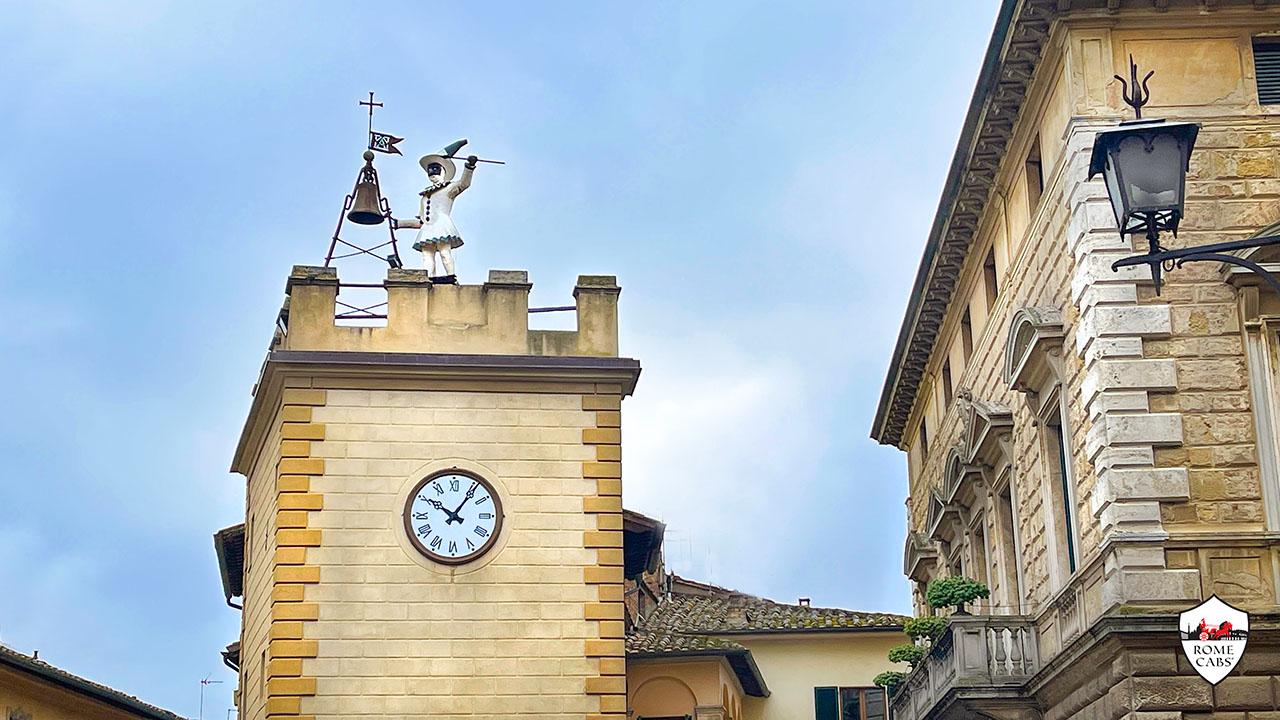
.
.
.
Fortezza di Montepulciano
Adding to Montepulciano’s rich architectural tapestry is the Fortezza di Montepulciano, or the Fortress of Montepulciano. Constructed in the 16th century, this imposing fortress was built as a defensive structure during a period of frequent conflicts between the town and rival powers. Designed by the military engineer Antonio da Sangallo the Younger, the fortress features a bastion-style design with angular fortifications and a strategic layout aimed at enhancing its defensive capabilities.
.
Church of San Biagio
Just outside the town walls, the Church of San Biagio stands as a masterpiece of Renaissance architecture. Designed by Antonio da Sangallo the Elder and constructed between 1518 and 1545, this church is celebrated for its elegant use of travertine and its classic Greek cross plan, which is crowned by a central dome. The church’s harmonious proportions and serene design epitomize the ideals of Renaissance architecture, showcasing a perfect balance of form and function.
San Biagio’s setting, nestled among cypress trees and overlooking the rolling hills of the Val d’Orcia, enhances its tranquil and picturesque ambiance. The church’s location provides visitors with a stunning backdrop of the Tuscan landscape, offering a peaceful retreat and a chance to reflect on the architectural beauty of this Renaissance gem.
.
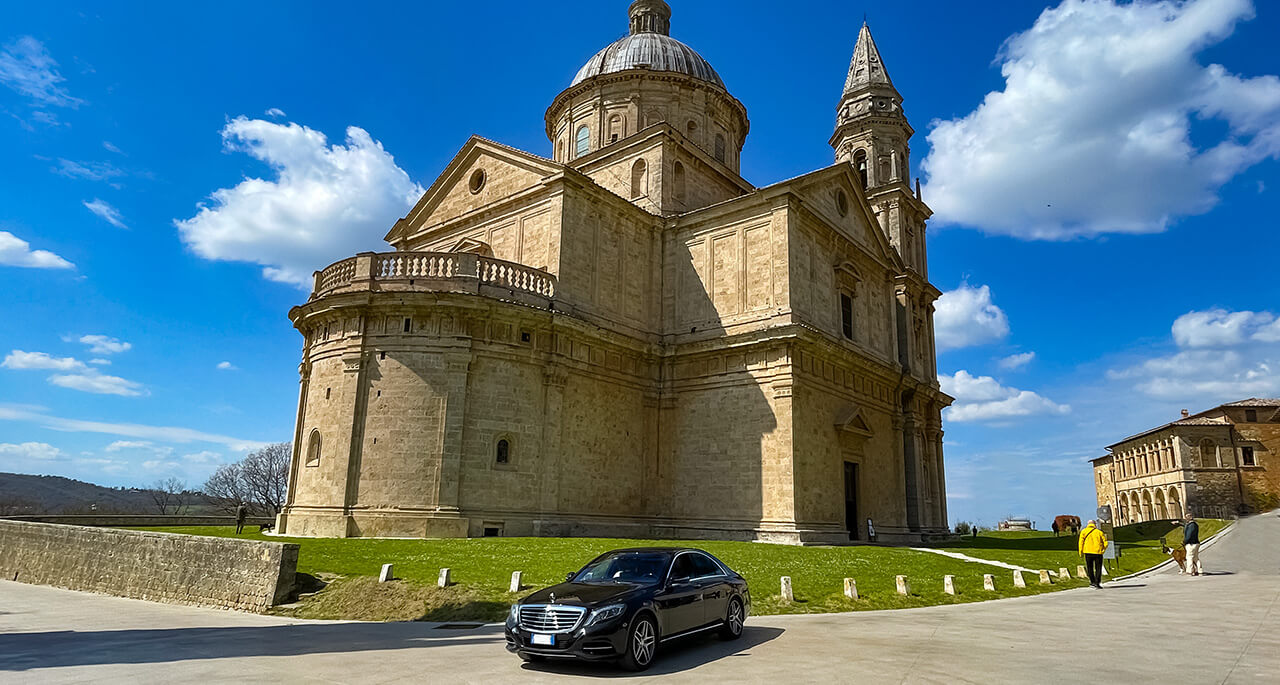
.
.
Wine Culture: Vino Nobile di Montepulciano
.
Vino Nobile di Montepulciano stands as one of Tuscany’s most distinguished and revered wines, embodying centuries of winemaking tradition and the unique terroir of the Montepulciano region. This celebrated red wine is renowned for its rich flavors, exceptional complexity, and aging potential, making it a prized choice for connoisseurs and casual drinkers alike.
The origins of Vino Nobile di Montepulciano trace back to the 16th century, when local winemakers began to refine their craft, guided by the principles of Italian Renaissance viticulture. The wine’s name, “Nobile“, meaning “noble” in Italian, reflects its esteemed status and historical connections to the local aristocracy who favored it. The designation of “Vino Nobile” was officially recognized in the 19th century, and the wine received Denominazione di Origine Controllata e Garantita (DOCG) status in 1980, further cementing its reputation as one of Italy’s premier wines.
.

.
.
Vino Nobile di Montepulciano is primarily crafted from the Sangiovese grape, locally known as Prugnolo Gentile. This varietal is central to the wine’s character, offering a robust structure, vibrant acidity, and a spectrum of flavors ranging from ripe cherries and plums to earthy undertones and subtle spices. The wine’s complexity is enhanced by the region’s unique terroir, characterized by well-drained soils, a temperate climate, and an altitude that provides optimal growing conditions for the grape.
.
Production and Aging of Vino Nobile di Montepulciano
The winemaking process for Vino Nobile di Montepulciano involves meticulous care and traditional techniques. After harvesting, the grapes undergo fermentation in temperature-controlled vats, followed by aging in oak barrels. The aging process is critical, as it imparts additional layers of complexity and refinement to the wine. Typically, Vino Nobile is aged for at least two years, though some exceptional examples may be aged longer to develop even more nuanced flavors.
.
.

.
.
.
The result is a wine with a deep ruby color, a bouquet of dark fruit, dried herbs, and a hint of tobacco, alongside a full-bodied palate with velvety tannins and a lingering finish. The aging potential of Vino Nobile di Montepulciano is notable, with well-cellared bottles often improving over a decade or more, evolving to reveal new dimensions of flavor and aroma.
.
Wine Tastings in Montepulciano
.
Wine enthusiasts visiting Montepulciano are in for a treat, as the town offers a plethora of opportunities to indulge in its rich vinous heritage. Numerous local shops and wineries provide immersive wine-tasting experiences where you can sample a diverse range of wines.
Among these, Vino Nobile di Montepulciano is the star, alongside its more youthful counterpart, Rosso di Montepulciano. Rosso di Montepulciano, often seen as a more accessible and less aged version of its prestigious relative, provides a lighter, fruitier alternative that is perfect for casual sipping.
One of the most captivating aspects of wine tasting in Montepulciano is the chance to explore the town’s historic underground wine cellars. The Ercolani winery, for example, is renowned not only for its exceptional Vino Nobile but also for its impressive enoteca —an elegant wine shop in Montepulciano that showcases its best local offerings. Here, visitors can immerse themselves in the local wine culture while exploring the cellars’ cool, dimly lit passages, which have been used for aging wine for generations.
.
.
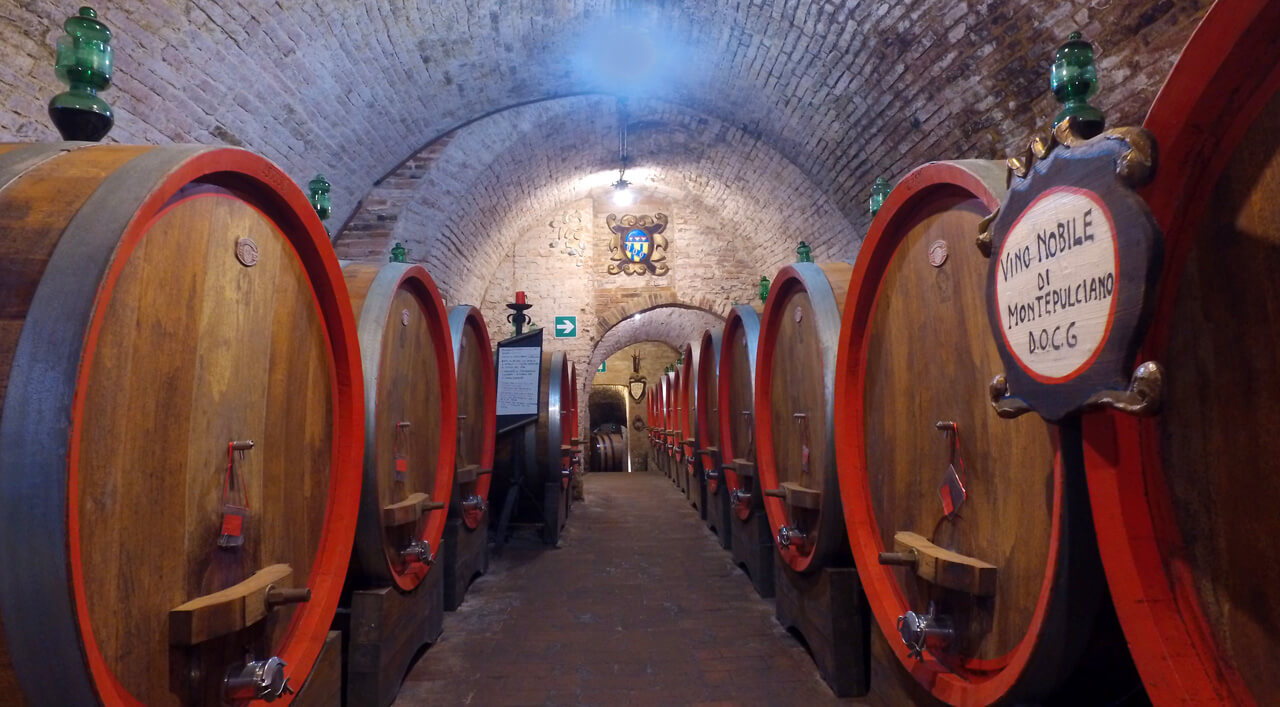
.
.
.
Annual Events and Festivals in Montepulciano
.
Montepulciano’s cultural vibrancy is brought to life through its numerous annual festivals and events, each offering a unique glimpse into the town’s rich traditions and communal spirit.
.
Bravio delle Botti:
Held in late August, the Bravio delle Botti is one of Montepulciano’s most exhilarating and time-honored events. This traditional barrel-rolling race transforms the town into a lively, competitive arena. Teams from different contrade (neighborhoods) compete in rolling large wooden barrels through Montepulciano’s narrow, winding streets, all while navigating the town’s challenging slopes. The event is marked by a festive atmosphere with spectators cheering on the competitors, colorful costumes, and a sense of community camaraderie. The Bravio delle Botti is not only a testament to Montepulciano’s rich historical traditions but also a celebration of local pride and athleticism.
.
Christmas Market in Piazza Grande:
As the holiday season approaches, Montepulciano’s Piazza Grande transforms into a festive wonderland with its annual Christmas Market. This enchanting market features a variety of stalls selling artisanal crafts, local delicacies, and holiday decorations. The atmosphere is enhanced by the twinkling lights, festive music, and the scent of roasted chestnuts and mulled wine. Visitors can explore the market’s offerings while enjoying the picturesque setting of Piazza Grande, which is beautifully adorned for the season. The Christmas Market is a highlight of Montepulciano’s winter festivities, providing a warm and joyful experience during the colder months.
.
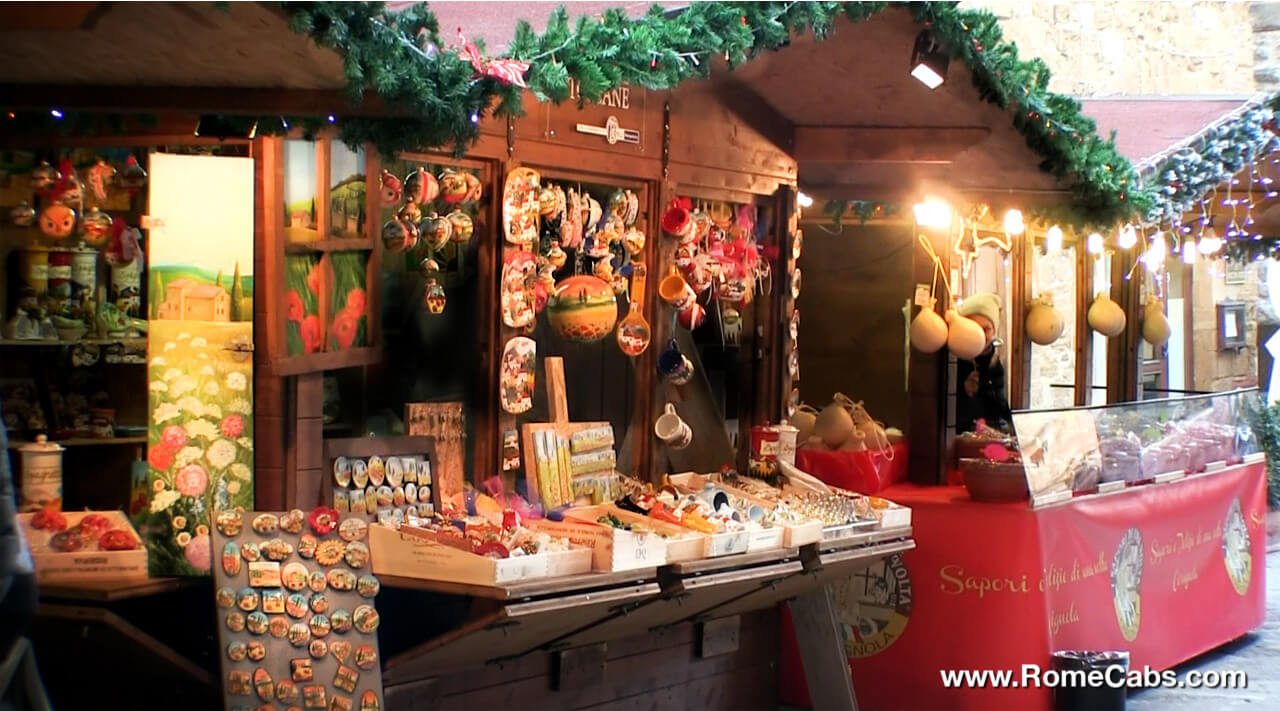
.
.
.
Exploring the Surrounding Area around Montepulciano
.
Montepulciano’s central location in Tuscany makes it an excellent base for exploring the enchanting countryside and neighboring towns. The region surrounding Montepulciano is rich in history, culture, and natural beauty, offering a wealth of experiences for travelers. From Montepulciano, you can discover many charming towns in Tuscany. Below are a few examples:
.
Pienza – A Renaissance Utopia
A short drive from Montepulciano, Pienza is often hailed as a Renaissance masterpiece. Designed by Pope Pius II, the town exemplifies the principles of Renaissance urban planning and architecture. Pienza’s harmonious layout and stunning vistas of the Val d’Orcia make it a must-visit destination.
The Pienza Cathedral, also known as the Cathedral of the Assumption, is a highlight of the town. Its façade and interior reflect the Renaissance ideals of balance and proportion, featuring works by renowned artists of the time. Inside, the cathedral houses important religious art, including an altar piece by Giovanni di Paolo.
Pienza is also famous for its pecorino cheese, a local specialty made from sheep’s milk. The cheese is available in various forms, from young and mild to aged and sharp, and can be sampled in local markets and eateries. Visitors can also explore the town’s quaint streets, lined with artisanal shops and charming cafés.
.
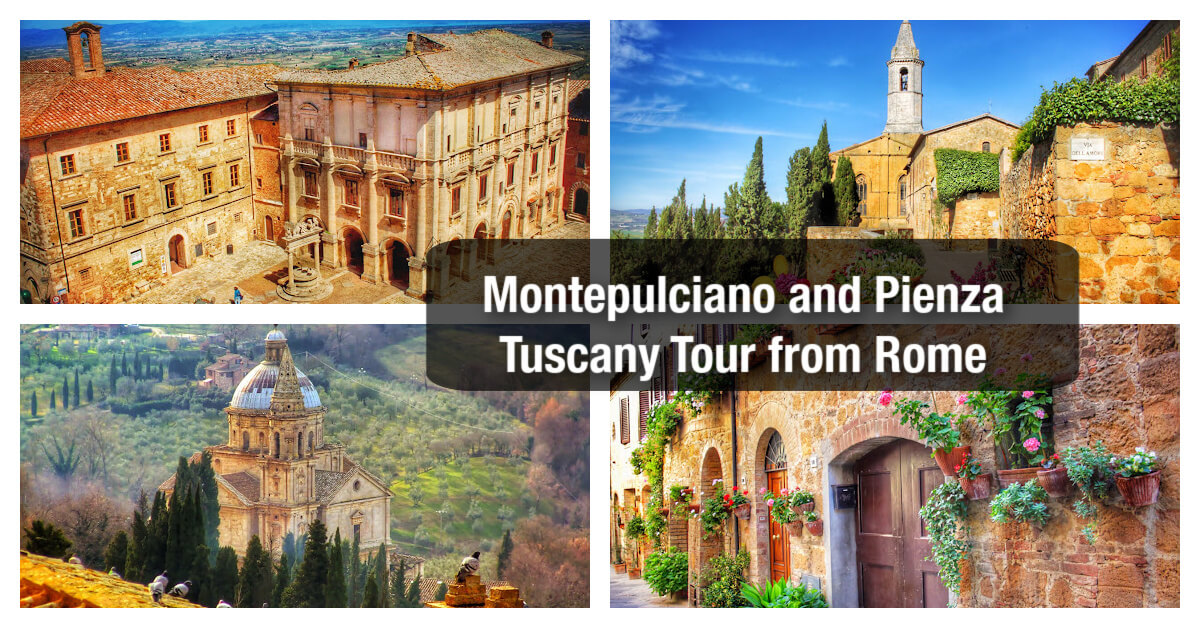
.
.
Cortona – Jewel of Tuscany
Situated to the northeast of Montepulciano, Cortona is a picturesque hilltop town that offers a blend of historical charm and modern vibrancy. Known for its well-preserved medieval streets and stunning views of the surrounding countryside, Cortona is a destination rich in cultural and historical significance.
The Museo dell’Accademia Etrusca is a must-visit for history enthusiasts. This museum houses an extensive collection of Etruscan artifacts, providing insight into the ancient civilization that once thrived in the region. Additionally, Cortona’s Diocesan Museum features an impressive array of Renaissance and medieval art, including works by artists like Luca Signorelli.
Cortona’s lively atmosphere is further enhanced by its annual events, such as the Cortona on the Move photography festival, which showcases contemporary photography from around the world. The town also hosts various food and wine festivals, offering visitors a chance to experience local culinary delights.
.

.
.
.
Montalcino – home of Brunello Wine
Known for its prestigious wine, Montalcino is another gem in Tuscany’s crown. Located to the southwest of Montepulciano, Montalcino is renowned for producing Brunello di Montalcino, one of Italy’s most celebrated red wines. The town is surrounded by vineyards and rolling hills, making it a picturesque and aromatic destination for wine lovers.
.
Bagno Vignoni – a Thermal Spa Village
To the west of Montepulciano lies Bagno Vignoni, a unique village renowned for its thermal baths. The village’s central square is filled with thermal waters, and visitors can enjoy the warm, mineral-rich pools that have been used for centuries for relaxation and therapeutic purposes. The historic bathhouse, Le Terme di Bagno Vignoni, offers a range of wellness treatments and is an ideal spot for relaxation.
.
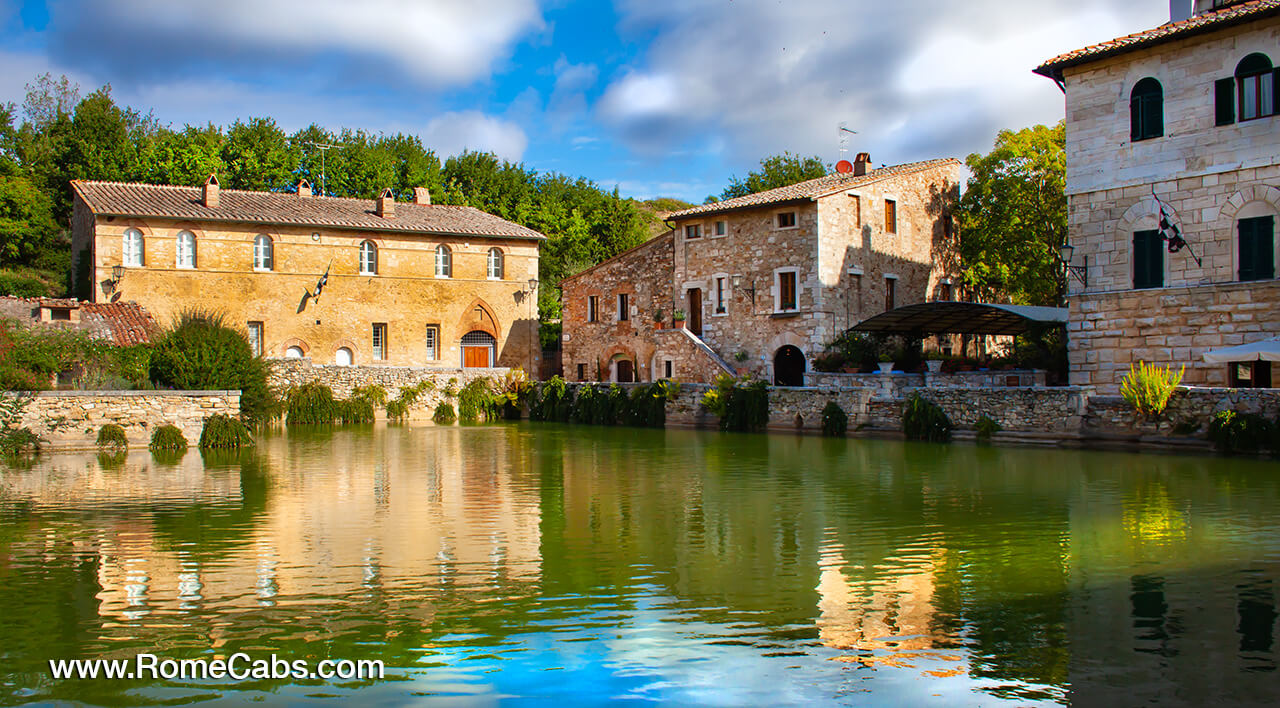
.
.
.
Practical Tips for Visiting Montepulciano
.
Montepulciano is most conveniently reached by car, especially if you are coming from Rome. The town is located approximately 120 kilometers (about 75 miles) from Rome, making it about a 1.5 to 2-hour drive, depending on traffic and road conditions. The route takes you through some of Tuscany’s most picturesque landscapes, including rolling hills, vineyards, and olive groves. Renting a car is highly recommended as it offers the best flexibility to explore Montepulciano and the surrounding Tuscan countryside at your own pace.
Parking: Montepulciano’s historic center is a pedestrian zone, so cars are not permitted within the town’s medieval walls. Fortunately, there are several parking areas conveniently located just outside the town center. These parking lots are clearly marked and offer easy access to the town via a short walk.
Wear Comfortable Footwear: Montepulciano is known for its steep, cobbled streets at an incline. Wearing comfortable walking shoes is essential to fully enjoy your exploration of the town’s historic sites and scenic viewpoints.
Savor Local Tuscan Cuisine: Don’t miss the opportunity to savor local Tuscan cuisine. Montepulciano offers a range of dining options, from cozy trattorias to fine dining establishments. Try local specialties such as pici pasta, wild boar ragu, and of course, Vino Nobile di Montepulciano.
.
.
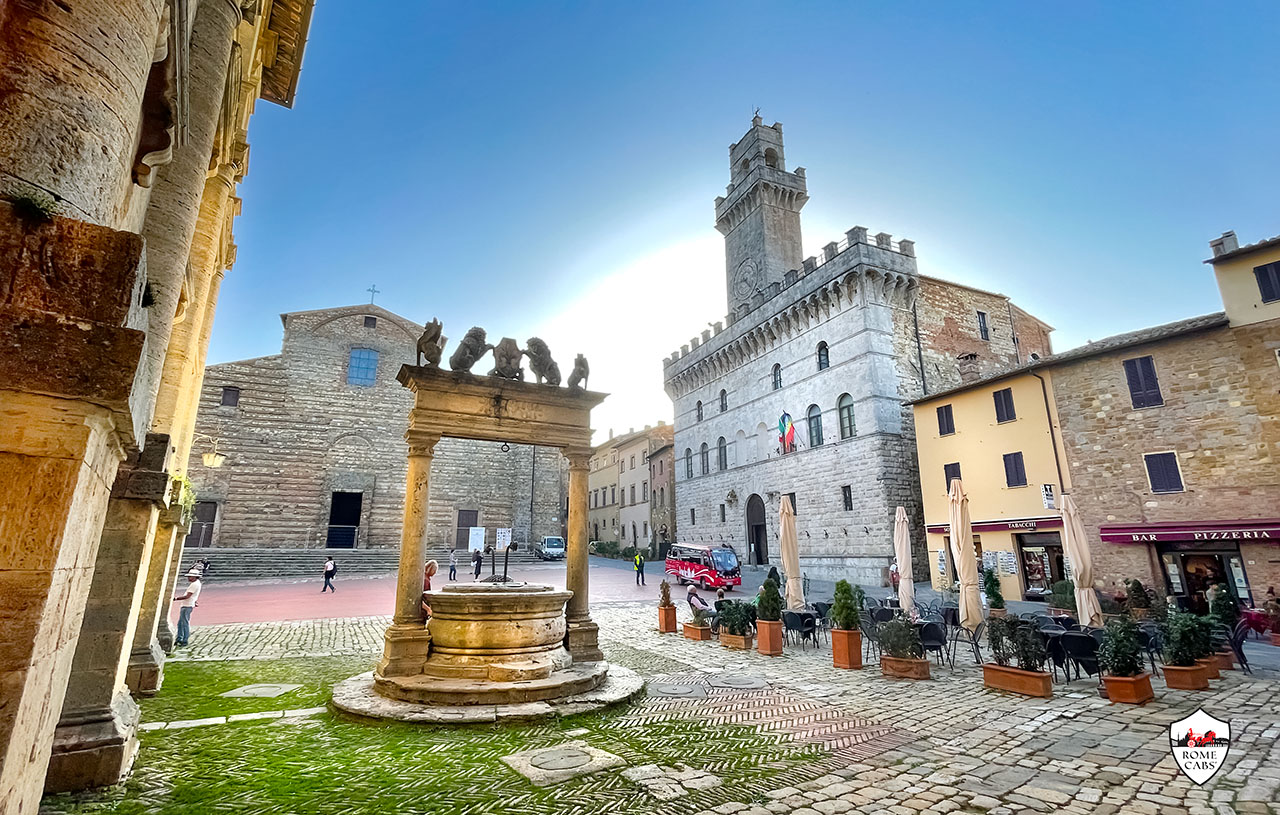
.
.
.
Best Time of the Year to Visit Montepulciano
.
The optimal times to visit Montepulciano are during the spring (April to June) and fall (September to October). During these seasons, the weather is generally mild, and the surrounding countryside is at its most stunning, with vibrant flowers in the spring and rich autumnal colors. These periods also offer a more relaxed atmosphere, as the summer crowds are fewer.
Summer (July and August) in Montepulciano can be quite hot, with temperatures often reaching into the high 80s or low 90s Fahrenheit (30-35°C). Despite the heat, summer is a lively time to visit due to the numerous local festivals and events, such as the Bravio delle Botti, which injects the town with vibrant energy and offers a unique cultural experience.
Winter (the off-season from November to February) is the least popular time to visit due to cooler temperatures and the potential for rain. However, this season offers a quieter experience with fewer tourists, and the chance to enjoy the town’s seasonal charm and holiday decorations.
.
.
.
.
.
Tours from Rome to Montepulciano with RomeCabs
.
If you’re staying in Rome and want to explore Montepulciano, there are several tour options available. RomeCabs offers a variety of Tuscany Day Trips from Rome, including visits to Montepulciano. These tours often include transportation and additional stops at other Tuscan gems such as Pienza, Cortona, and Montalcino. Wine Tours from Rome to Tuscany with RomeCabs also include visits to Montepulciano. For an exciting experience, visit Tuscany during Vendemmia and celebrate Italian harvest culture between September to October.
Booking a private tour from Rome to Tuscany can be a convenient way to experience Montepulciano and other nearby destinations without the need to navigate logistics on your own.
.
.
.
.
.
Montepulciano is a captivating destination that offers visitors a perfect blend of history, culture, and wine. Whether you’re exploring its winding streets, visiting its historic buildings, or savoring its renowned Vino Nobile di Montepulciano, Montepulciano promises an unforgettable experience. Its rich heritage, stunning architecture, and vibrant community make it a highlight of any visit to Tuscany.
As you plan your travels in Tuscany, be sure to include Montepulciano in your itinerary. Its enchanting charm and welcoming atmosphere will leave you with lasting memories and a deeper appreciation for the beauty and culture of this remarkable region. Buon viaggio!
.
* Find RomeCabs online also on:
- RomeCabs Facebook: https://www.facebook.com/RomeCabsToursAndTransfers
- RomeCabs Pinterest: https://www.pinterest.it/romecabs
- RomeCabs Twitter: https://twitter.com/RomeCabs
- RomeCabs Instagram: https://www.instagram.com/romecabs/
- RomeCabs Flickr Photos: https://www.flickr.com/photos/romecabs/
- RomeCabs Recommended on Cruise Critic
.
.
.
.
.

.
From Civitavecchia Port to Rome: Craft Your Perfect Itinerary with RomeCabs
Buongiorno and welcome to RomeCabs Rome Travel Blog! Whether you’re a seasoned traveler to Rome or have specific places in mind that the standard excursions don’t cover, our “Rome Your Way with Private Driver” shore excursion from Civitavecchia is designed just for you! Imagine having the opportunity to create your own personalized Roman adventure from Civitavecchia to Rome! Explore Rome’s iconic sights while crafting your perfect itinerary, choose your pace, and visit the attractions that matter most to you.
All of this is made even more convenient with a private deluxe vehicle and an English-speaking driver at your service who will pick you up right next to your ship and whisk you away for a fun-filled excursion to Rome. Get ready for a unique Roman experience tailored precisely to your interests and preferences!
.
.
.
.
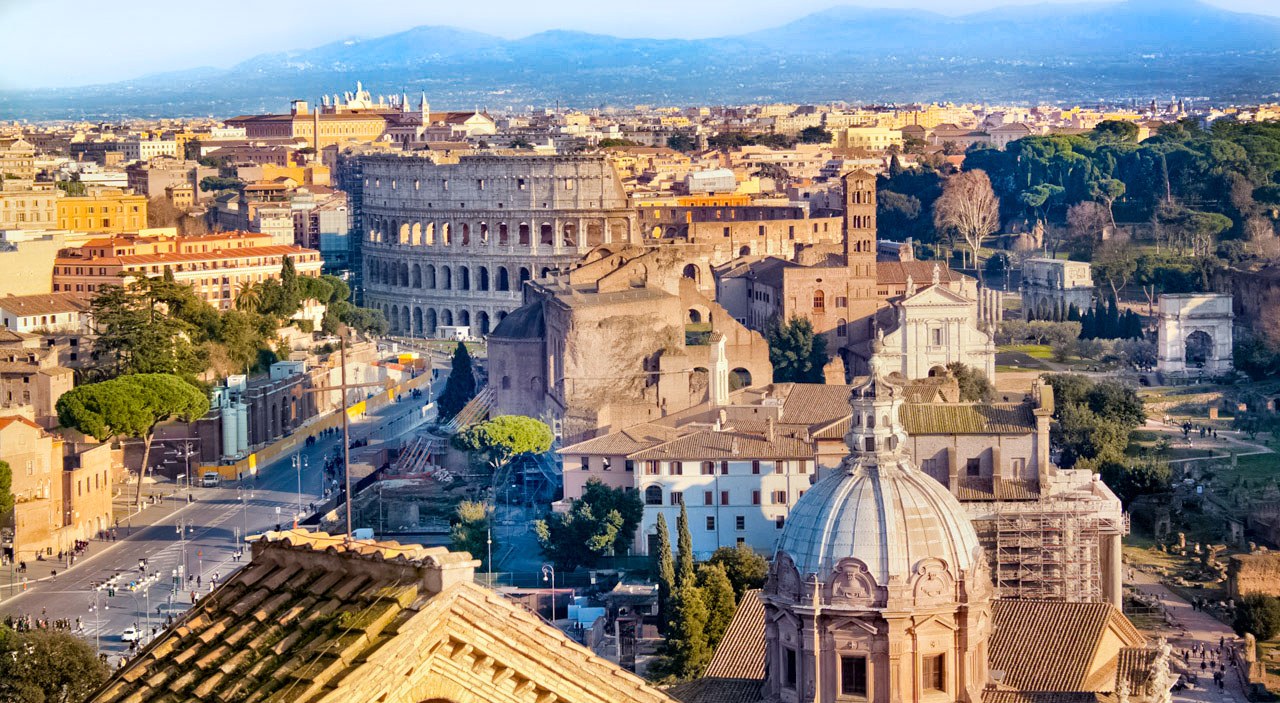
.
.
.
Discover Rome Your Way at Your Own Pace
.
Imagine stepping into the heart of Rome, where every corner brims with history, culture, and a timeless charm. The Eternal City awaits your exploration, but this time, there’s a twist—you get to dictate the journey. With RomeCabs’ “Rome Your Way with Private Driver” shore excursion from Civitavecchia, the freedom to create your own adventure is entirely yours.
Savor the Freedom of a Personalized Itinerary
Gone are the days of adhering to rigid schedules and crowded tour buses. On this bespoke tour, you’re the master of your itinerary. Whether you’re a first-time visitor or a seasoned traveler with a list of must-see attractions, this excursion offers the ultimate flexibility. Stroll through Rome’s most famous squares like Piazza Navona, Piazza della Rotonda, and Spanish Steps, throw a coin into the Trevi Fountain, or discover Rome’s hidden gems.
Your personal RomeCabs Tour driver, fluent in English and knowledgeable about Rome’s intricate streets and historical landmarks, is your gateway to a truly personalized experience. They’re not just a driver but a local expert ready to offer insights and suggestions based on your interests. Want to know where to find the most authentic gelato? Your driver has the answers.
.

.
.
.
Follow Your Own Itinerary and Visit Attractions You Choose
.
Embarking on a journey through Rome is always an exhilarating experience, but imagine having the freedom to shape every moment according to your desires and interests. With RomeCabs’ “Rome Your Way with Private Driver” shore excursion from Civitavecchia, that dream becomes a reality. This unique tour empowers you to explore the Eternal City entirely on your terms, making the most of your day from Civitavecchia.
.
Tailor Your Adventure in Rome from Civitavecchia
From the moment you book your excursion from Civitavecchia, your adventure begins. RomeCabs understands that every traveler is unique, with distinct preferences and interests. That’s why your tour starts with you. Discuss your interests with your private English-speaking driver, an expert in navigating Rome’s streets and attractions. Share your sightseeing preferences, and your personal driver will assist you in crafting an itinerary that perfectly matches your vision for the day.
Perhaps you’re passionate about ancient history or wish to enjoy more off-the-beaten-path places in Rome. Your driver can guide you to these historic sites, ensuring you get the most out of your visit to Rome with insights and tips.
.

.
.
.
Flexibility for Special Experiences in Rome
If you’ve pre-arranged special experiences like exclusive walking tours, cooking classes, or private museum visits, providing these details when booking ensures a seamless day. Your driver will be well-prepared, having planned the most efficient routes and timing to incorporate these activities into your itinerary without any hassle.
Imagine starting your day with a private guided tour of the Vatican Museums, including the Sistine Chapel and St. Peter’s Basilica, before moving on to a hands-on cooking class where you learn to make traditional Roman pasta. Such a blend of iconic and immersive experiences is only possible with a personalized itinerary that you crafted and your driver will take you where you need to go while in Rome.
.
Discover Rome beyond the Crowds and Hidden Corners
Rome is a city of contrasts, where world-renowned landmarks stand side by side with hidden gems waiting to be discovered. Your private driver can help you strike the perfect balance between visiting major attractions and uncovering lesser-known treasures.
Start your morning by visiting the most famous squares, then perhaps explore the charming streets of the Trastevere neighborhood. Wander through its narrow, cobblestone lanes, discover quaint cafés, and perhaps visit the serene botanical gardens. Your driver’s local knowledge will ensure you experience the authentic soul of Rome.
.
Explore Rome Your Way from Civitavecchia in Deluxe Comfort
.
Bid farewell to crowded public transportation, fixed group tours, or bus tours that cannot access the historical center of Rome. When it comes to exploring Rome, comfort and convenience can make all the difference between a hectic day and a truly memorable experience. With RomeCabs’ “Rome Your Way with Private Driver” shore excursion from Civitavecchia, you can bid farewell to the usual travel hassles and embrace a day of luxury and personalized service.
.
The Perfect Blend of Luxury and Adventure from Civitavecchia
Imagine stepping off your cruise ship in Civitavecchia and being greeted by your private English-speaking driver waiting for you on the Pier next to your ship, ready to whisk you away in a deluxe vehicle. This marks the beginning of a day where your comfort is the priority. No need to navigate crowded public transportation or struggle with the rigid schedules of group tours. Your journey to Rome starts with ease and elegance.
.

.|.
.
Your private vehicle is not just a mode of transport; it’s your mobile sanctuary. Designed for comfort and style, it provides a serene escape from the bustling city outside. Relax in plush seating, enjoy the climate-controlled environment, and take in the sights of the Italian countryside en route to Rome.
Journey through the historical center of Rome in Comfort and Style
Rome is a city where history and modernity coexist in a labyrinth of narrow streets and bustling piazzas. Navigating this intricate landscape can be daunting, especially for visitors. However, with your private driver at the helm, you can traverse the city effortlessly. Your driver knows Rome inside out, including all the best routes to avoid traffic and reach your destinations quickly and comfortably.
Once in Rome, the advantages of your private tour become even more apparent. Public buses and large tour groups often can’t access the historical center’s narrow streets and restricted zones. But your private vehicle can get you as close as possible to the iconic landmarks, minimizing walking distances and maximizing your time for sightseeing.
Exploring Rome can be physically demanding, with its extensive attractions and sometimes uneven terrain. The comfort of your deluxe vehicle ensures you have a relaxing haven between stops.
Efficient Use of your Time in Rome
Time is precious, especially when you have only a day to explore one of the world’s most fascinating cities. Your private driver is adept at optimizing your time, ensuring you see as much of Rome as possible without feeling rushed. RomeCabs drivers are skilled at planning routes that minimize travel time between attractions and can suggest the best times to visit each site to avoid long lines and crowds.
.

.
.
How Much Can You See in Rome in One Day from Civitavecchia?
.
Rome is a city of immense beauty, history, and culture, with a wealth of attractions to explore. When visiting Rome during a shore excursion from Civitavecchia, it’s natural to wonder just how much you can see in a single day. The answer largely depends on several factors, including the time spent at each attraction, driving distances, and local traffic conditions.
However, with careful planning and the expertise of your private driver from RomeCabs, you can maximize your time and experience an unforgettable day in the Eternal City.
Your Private RomeCabs Driver can Assist you with planning your day
Your private driver plays a crucial role in ensuring you make the most of your time in Rome. Their local knowledge and experience enable them to navigate the city’s streets efficiently, avoiding common traffic bottlenecks and finding the quickest routes between attractions. This expertise is invaluable, as it minimizes time spent in transit and maximizes your sightseeing opportunities.
Prioritizing Your Must-See Attractions in Rome
Given the sheer number of landmarks in Rome, it’s essential to prioritize your must-see attractions. Begin by listing the sites that are at the top of your list—whether it’s the iconic Colosseum, the awe-inspiring Vatican Museums, or the enchanting Trevi Fountain. By focusing on your favorites, you ensure that you won’t miss out on the experiences that matter most to you.
Your private driver can help you create a realistic itinerary based on your preferences. For example, a well-balanced day might include visits to the Colosseum and Roman Forum in the morning, followed by a leisurely lunch near Piazza Navona, and an afternoon exploring the Vatican City. The key is to allocate sufficient time for each attraction while allowing for travel and any unforeseen delays.
PRO TIP: When planning visits to popular attractions like the Vatican Museums, Colosseum, or Pantheon, it’s crucial to plan well in advance and secure time slot tickets or tours that align with your shore excursion schedule. RomeCabs can help you find suitable time slots to avoid potential issues, such as arriving too late and missing your tickets or tours, or departing too late and risking your embarkation.
Additionally, be mindful that overloading your itinerary with too many time slot tickets and tours in a single day can make your schedule rigid and reduce your ability to explore more of Rome. Balancing your itinerary will help you make the most of your visit without feeling rushed.
Send RomeCabs an email when booking a Rome On Your Own Shore Excursion from Civitavecchia for guidance on when to book your tickets or tours in Rome. This ensures you have plenty of time to arrive in Rome from Civitavecchia, and don’t risk departing from Rome back to your ship in Civitavecchia too late in the day.
.

.
Balance Exploration and Relaxation
While it’s tempting to pack your day with as many sites as possible, it’s also important to enjoy your experience without feeling rushed. Rome is a city that rewards leisurely exploration, whether it’s sipping espresso at a café, wandering through charming streets, or discovering hidden corners away from the main tourist routes.
For instance, after visiting major attractions, consider spending some time in the quieter neighborhoods like Trastevere. Here, you can stroll through narrow, cobblestone streets, visit small boutiques, and enjoy the local atmosphere at a slower pace.
.
Pro Tips for booking Rome Your Way Shore Excursion from Civitavecchia
.
Provide Detailed Itinerary Information:
When booking your “Rome Your Way with Private Driver” shore excursion, include detailed information about your planned destinations and any special experiences you’ve arranged. This helps your driver prepare for the day and ensures a seamless and tailored experience.
.
Customizable Itinerary:
While this service does not include a pre-set itinerary created by us. Instead, you have the freedom to craft your own itinerary based on your interests and preferences. Your driver will assist in organizing the day according to your wishes so you will see more of Rome, Italy in less time.
.
Unified Itinerary for All Guests:
To ensure a smooth and enjoyable tour experience, all members of your party must agree to the same itinerary. This ensures that everyone can make the most of their time in Rome and that the driver can efficiently navigate the city based on your collective plans.
.

.
.
If you wish to make the most of your day in Rome from Civitavecchia, consider these wonderful places in Rome:
Experience these Iconic Squares of Rome:
.
Piazza Navona
Piazza Navona is a lively square renowned for its baroque beauty and three magnificent fountains, including the famous Fountain of the Four Rivers by Gian Lorenzo Bernini. Stroll through the piazza, admire the ornate architecture, and soak in the vibrant atmosphere.
Campo dei Fiori
Head to Campo dei Fiori, a historic market square that transforms from a bustling morning market to a lively gathering spot in the evening. Here, you can experience Rome’s daily life, enjoy local produce, and immerse yourself in the vibrant ambiance.
Spanish Steps
The Spanish Steps, a masterpiece of Roman architecture, lead you from Piazza di Spagna to the Trinità dei Monti church. Relax on the steps and enjoy people-watching while appreciating the elegant surroundings and the vibrant energy of this popular spot.
Trevi Fountain
No visit to Rome is complete without tossing a coin into the Trevi Fountain. This stunning Baroque fountain, sculpted by Nicola Salvi, is one of Rome’s most iconic landmarks. Make a wish and marvel at the intricate sculptures and cascading waters.
Colosseum Square
Explore this square dominated by the grandeur of the Colosseum Square, home to the ancient Colosseum itself. Standing as a testament to Roman engineering, the Colosseum invites you to delve into its rich history and imagine the epic gladiatorial contests that once took place within its walls.
Piazza della Rotonda
Discover Piazza della Rotonda, where the magnificent Pantheon stands. This ancient temple, now a church, boasts a stunning dome with a central oculus and remains remarkably well-preserved. Enjoy the surrounding cafes and soak in the historical ambiance.
St. Peter’s Square
St. Peter’s Square is the grand plaza in Vatican City. Designed by Gian Lorenzo Bernini, this expansive square is flanked by colonnades and leads to St. Peter’s Basilica. It’s a spiritual and architectural marvel that offers a profound sense of awe.
.

.
.
.
Enjoy these Off the Beaten Path Places in Rome:
.
Trastevere
Venture into the charming neighborhood of Trastevere, known for its narrow cobblestone streets and vibrant nightlife. Explore the local eateries, picturesque squares, and the stunning Santa Maria in Trastevere church, which features beautiful mosaics.
Janiculum Hill
For panoramic views of Rome, visit Janiculum Hill. This tranquil spot offers some of the best vantage points in the city, along with historical monuments such as the Fontana dell’Acqua Paola and the Garibaldi Monument.
Aventine Hill
Explore Aventine Hill, a serene area known for its peaceful gardens and ancient churches. Don’t miss the famous Keyhole of the Knights of Malta, which provides a unique view of St. Peter’s Basilica framed by lush greenery.
Ancient Appian Way
Travel along the Ancient Appian Way (Via Appia Antica), one of Rome’s oldest roads. This historic route is lined with ancient tombs, ruins, and catacombs, offering a glimpse into Rome’s early history and a serene escape from the city’s hustle.
Christian Catacombs
Discover the Christian Catacombs, such as those of San Callisto or San Sebastiano. These underground burial sites provide fascinating insights into early Christian practices and offer a unique perspective on Rome’s religious history.
.

.
.
.
Experience Rome’s Authentic Charm on a Car Tour with RomeCabs —your way. Book your “Rome Your Way with Private Driver” shore excursion today and embark on a personalized journey through this remarkable city with RomeCabs Limousine tours.
From the moment you leave Civitavecchia to the moment you return, your comfort, convenience, and enjoyment are the top priorities. Say goodbye to travel stress and hello to an extraordinary day of exploration and discovery in Rome. When it comes to Rome tours and Shore Excursions, RomeCabs has you covered! We look forward to seeing you in Italy on our RomeCabs tours!
.
.
.
Check out our other Italy Travel Blogs by Romecabs:
https://rome-cabs.org/
https://rome-cabs.net/
https://romecabsdotnet.wordpress.com/
https://romecabs.wordpress.com/
Find RomeCabs online also on:
- RomeCabs Facebook: https://www.facebook.com/RomeCabsToursAndTransfers
- RomeCabs Pinterest: https://www.pinterest.it/romecabs
- RomeCabs Twitter: https://twitter.com/RomeCabs
- RomeCabs Instagram: https://www.instagram.com/romecabs/
- RomeCabs Flickr Photos: https://www.flickr.com/photos/romecabs/
- RomeCabs Recommended on Cruise Critic
.
.
What to See and Do in Ceri – A tiny Medieval jewel near Rome – RomeCabs
Buongiorno and welcome to RomeCabs Italy Travel Blog! We invite you to step into the timeless charm of Ceri, a picturesque medieval village nestled in the scenic landscape of Lazio (the region of Rome), just a short distance from Rome itself. Despite its small size, this tiny Medieval jewel boasts a rich history, culture, and culinary delights that enchant visitors with its old-world allure. If you’re wondering what to see and do in Ceri, read on.
Ceri is not only a destination in itself but also features prominently in some of our top Rome countryside tours from Rome and shore excursions from Civitavecchia. From the historic Sanctuary of Santa Maria of Ceri to the culinary delights of local trattorias, and from the narrow ancient streets, Ceri offers a delightful blend of experiences.
Discover why this medieval clifftop village is a must-visit destination for those seeking authentic charm and timeless beauty in the heart of Italy. Let’s dive into the magic of Ceri!
.
Sanctuary of Santa Maria of Ceri
.
Perched majestically over Ceri’s bustling square resides a gem of profound importance: the Sanctuary of Madonna di Ceri. Erected atop the remnants of an ancient pagan shrine venerating the goddess Vesta, this church embodies layers of history and devotion.
.

.
.
.
The history of the Church of Ceri took a dramatic turn with the acquisition of Pope Felix II‘s relics, a revered saint and martyr from the era of Emperor Constantius. This pivotal moment likely catalyzed the church’s expansion, culminating in its transformation into a magnificent edifice featuring a nave, aisles, and a canopy housing the sacred remains.
Legend has it that the saint’s relics were initially resisted by oxen en route to Rome, thus securing their eternal abode in Ceri. Today, the saint’s relics rest solemnly behind a grate in the central nave, while the canopy, once adorned with the image of S. Giovanni Calabria for veneration, was replaced in October 2009.
In 1980, restoration efforts revealed a remarkable find within the church’s confines. Beneath layers of time, intricate frescoes dating back to the 12th century emerged, depicting vivid scenes from the Old Testament and narratives of San Silvestro’s life. Subsequent endeavors in 1989 unearthed additional frescoes along the nave’s right side, accompanied by the relocation of the altar of San Felice to the transept chapel.
.
The Chapel of Received Grace: A Haven of Secrets and Gratitude
.
Nestled discreetly on the right side of the church you’ll discover a modest chapel: Capella delle Grazie Ricevute, or the “Chapel of Received Graces“. Behind its unassuming door lies a trove of unexpected yet deeply moving revelations.
.
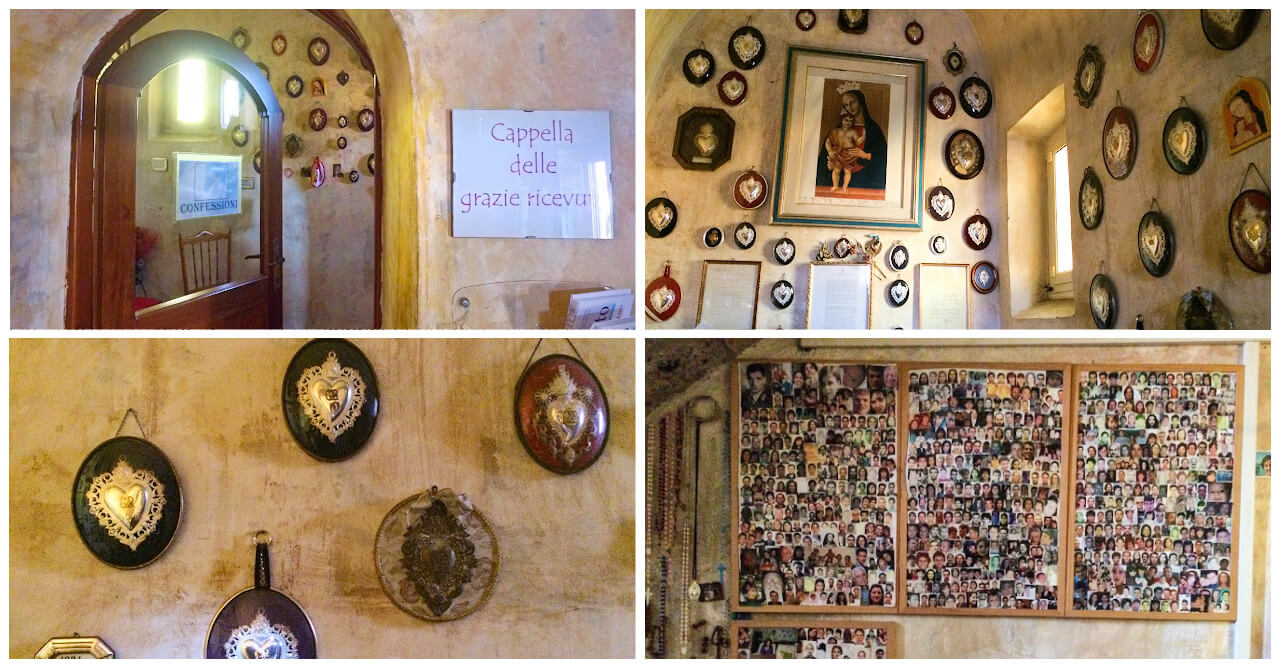
.
.
The chapel’s walls are adorned with an array of unexpected treasures. Bulletin boards display countless thumbnail photographs, each bearing the fervent supplications of loved ones seeking miracles and blessings from the revered Madonna of Ceri. These images transcend mere photographs; they embody heartfelt pleas for divine intervention in times of need.
Yet, the chapel’s walls do not solely echo with pleas for aid; they also resonate with expressions of gratitude. Ex-voto offerings, including plaques, paintings, and other tokens, narrate tales of personal miracles and blessings attributed to Mary’s intercession.
Stepping into this unassuming chapel is akin to entering a sanctuary of faith and devotion, where hope takes tangible form, and gratitude finds eloquent expression. The Capella delle Grazie Ricevute stands as a poignant testament to the enduring bond between Ceri’s inhabitants and the Madonna di Ceri, illustrating the profound impact of belief and divine benevolence.
.
.
Ceri’s Culinary Delights: A Hidden Epicurean Haven
.
Here, in this quaint village, two family-owned culinary gems shine brightly: Sora Lella and Trattoria La Rocca. These establishments are renowned across the region for their unrivaled cuisine.
.

.
.
With a steadfast dedication to excellence, these restaurants craft each dish with meticulous care, utilizing the finest seasonal ingredients sourced locally. Their menus are a testament to tradition, featuring recipes cherished and passed down through generations.
While Ceri may offer only a duo of dining destinations, the quality of their offerings surpasses expectations. A meal in Ceri is not just sustenance; it’s an immersive journey into the heart of Italian culinary heritage. Prepare to indulge in a symphony of flavors that will linger on your palate long after your visit, ensuring that Ceri remains a destination not to be missed for any discerning food enthusiast.
.
Ceri’s ancient street is wide enough for 1 car to pass through
.
As you approach this medieval marvel by car, your gaze is drawn to the imposing cliffs upon which the village stands, remnants of a time when they served as formidable fortifications. But how exactly do you access Ceri? Then, you’ll see a traffic light at the bottom that serves a unique purpose.
.

.
.
.
Reaching the hamlet of Ceri on top of the cliff involves passing through a medieval gateway, where the village’s only street winds its way upwards. Carved into the rocky terrain, this ancient street is scarcely wide enough to accommodate a single vehicle at a time.
To ensure the orderly flow of traffic, traffic lights positioned at both the bottom of the cliff and the top of the village regulate the ascent and descent of vehicles, allowing only one direction of travel at a time.
This journey through Ceri’s historic street embodies the village’s fusion of past and present, where modern convenience meets medieval heritage. It’s a testament to Ceri’s enduring charm and adaptability, where each step reveals layers of history waiting to be explored.
.

.
.
.
Discover the Artistry Handcrafted Jewelry
.
In Ceri, discover the exquisite handcrafted jewelry of local artisans. Together with her husband a master metalsmith Nadia curates the esteemed collection, recreating ancient coins with museum-quality detail that trace back to the Etruscans and Ancient Romans—integral to Ceri’s heritage.
Nadia’s commitment to her craft reflects her family’s legacy of artistic excellence. While SofiaLorenza jewelry is renowned across Italy, Ceri remains its humble nucleus. Visitors can explore their home-based atelier, where exceptional creations await discovery. Each piece tells a unique story, destined to become a cherished heirloom for those who appreciate extraordinary craftsmanship.
You can also purchase a treasured masterpiece online at Etsy Shop
.

.
.
.
.
Beyond Ceri: Explore Nearby Marvels
.
Beyond Ceri awaits a plethora of captivating destinations, each boasting its own distinct allure and charm. Discover ancient necropolises rich in history, medieval lakeside villages along the shores of a prehistoric crater lake, and magnificent castles steeped in medieval grandeur. With a myriad of adventures to be had, the surrounding area of Ceri offers unforgettable experiences for every traveler.
.
Cerveteri – land of the Etruscans
.
Just a stone’s throw away lies the ancient town of Cerveteri. This renowned destination is famed for its UNESCO-listed Etruscan necropolis, a sprawling archaeological site that offers a fascinating glimpse into the ancient civilization that once thrived in this region. Wander through the labyrinthine pathways of the necropolis, where intricately carved tombs and imposing monuments stand as silent witnesses to a bygone era.
.
.
.
.
Lake Bracciano – Pristine Volcanic Crater Lake
.
Nearby, the serene beauty of Lake Bracciano beckons. The pristine crater lake is a living testament to Italy’s volcanic past, formed over half a million years ago. Its waters, prized for their purity, serve as a vital source for Rome. Protected from motorized boats, the lake offers tranquility for swimming and kayaking, preserving its pristine beauty for visitors to enjoy.
The lake itself, with its crystal-clear waters reflecting the azure sky, provides a tranquil oasis for relaxation and recreation. Surrounding its shores are the charming villages of Trevignano Romano, Anguillara Sabazia, and Bracciano, each exuding its own unique charm and allure.
.

.
.
.
Trevignano, along the shores of Lake Bracciano
.
Trevignano Romano, nestled along Lake Bracciano’s shores, blends old-world charm with modern comforts. Its history traces back to ancient Etruscan settlements, with Roman villas submerged beneath the lake.
Throughout the medieval era, noble families like the Orsini left their mark, evident in the remnants of the fortified castle. During the Renaissance, Trevignano was a favored retreat for popes. Today, the town’s medieval borgo offers a glimpse into its rich past, while the scenic beauty of the lake along its promenade continues to enchant visitors.
.

.
.
.
.
Anguillara Sabazia, Lake Bracciano
.
Anguillara, another village on the shores of Lake Bracciano, boasts a rich history and noble lineage. Its name, possibly derived from “angui” for eels, hints at its past as an eel fishing hub. The town’s association with the Anguillara family, prominent during medieval times, adds to its allure.
Visitors can stroll along the scenic lakeside promenade, enjoy the black sand beaches in summer, and admire the geological wonders shaped by the region’s volcanic past. Anguillara offers a captivating blend of history, natural beauty, and cultural heritage, inviting exploration and discovery.
.
.
.
.
.
Bracciano and Bracciano Castle
.
Overlooking Lake Bracciano is the city by the same name: Bracciano. Its well-preserved medieval streets and charming piazzas offer a step back in time, while the serene lakeside promenade invites leisurely strolls and alfresco dining. Indulge in traditional Italian cuisine paired with local Lazio wine for an authentic culinary experience in this enchanting town.
Majestically crowning the town of Bracciano, Bracciano Castle (Castello Odescalchi) stands as a symbol of Italy’s storied past. This 15th-century marvel, also known as Castello di Bracciano, offers visitors an immersive journey through medieval history. Commissioned by Napoleone Orsini, the castle boasts a blend of medieval and Renaissance architecture, with imposing stone walls and elegant courtyards transporting guests to another era.
Lovingly preserved by the Odescalchi family, the castle welcomes visitors to explore its rich heritage. Inside, museum collections showcase the Orsini family’s historical importance, while opulent staterooms offer a glimpse into Renaissance aristocracy. Climb the ramparts for panoramic views of the lake and countryside, completing an unforgettable experience steeped in history and grandeur.
.
.
.
.
.
Santa Severa: the Castle by the Sea
.
Santa Severa Castle, built on the shore of the Tyrrhenian sea, is a treasure trove of historical and cultural significance. Named after the Christian martyr Severa, tradition holds that she was slain in this location in 298 AD, along with her brothers Calendino and Marco, under the reign of Roman Emperor Diocletian.
The site’s history traces back to ancient times, with evidence of Bronze Age settlements and the Etruscan port of Pyrgi, which later became a Roman colony. The castle’s current structure dates back to the 14th century, featuring a moat and corner towers connected by a wooden bridge to the cylindrical fortification known as the “Maschio“.
.
.

.
.
.
Throughout the centuries, ownership of the castle changed hands several times, eventually passing to the Order of the Holy Spirit in 1482. The castle flourished under their stewardship, with the village thriving between the 15th and 16th centuries. Today, it stands as a testament to over 2000 years of history, offering visitors a glimpse into its storied past and cultural legacy.
Ceri is a true hidden gem in the Rome countryside, offering a captivating glimpse into Italy’s rich history and culture. From the historic Sanctuary of Santa Maria of Ceri to the culinary delights of local trattorias, and the artisanal treasures of SofiaLorenza Handcrafted Jewelry, Ceri invites visitors to step back in time and experience its authentic charm.
.
Book your Rome Countryside Tour and experience the magic of Ceri
.
If you’re planning a trip to Rome or arriving on a cruise ship in Civitavecchia, don’t miss the opportunity to explore Ceri and its surrounding marvels. Join one of our Rome Countryside Tours such as our Medieval Magic Rome Countryside Tour, Rome Countryside Pre-Cruise Tour, or Countryside Splendor Shore Excursions from Civitavecchia to discover the magic of Ceri and beyond.
.
.
.
.
Book your tour today and embark on an unforgettable journey through the picturesque landscapes and hidden treasures of Lazio. Let Ceri enchant you with its medieval allure and timeless beauty—it’s a destination not to be missed on your Italian adventure!
.
Check out our other Italy Travel Blogs by Romecabs:
https://rome-cabs.org/
https://rome-cabs.net/
https://romecabsdotnet.wordpress.com/
https://romecabs.wordpress.com/
.
Find RomeCabs online also on:
- RomeCabs Facebook: https://www.facebook.com/RomeCabsToursAndTransfers
- RomeCabs Pinterest: https://www.pinterest.it/romecabs
- RomeCabs Twitter: https://twitter.com/RomeCabs
- RomeCabs Instagram: https://www.instagram.com/romecabs/
- RomeCabs Flickr Photos: https://www.flickr.com/photos/romecabs/
- RomeCabs Recommended on Cruise Critic
.
.
.
.

.
.
Booking Your Transfer from Rome to Civitavecchia – Best Insider Tips from RomeCabs
Buongiorno and welcome to RomeCabs Rome Travel Blog! Ensuring a seamless transfer from Rome to Civitavecchia requires careful planning and proactive decision-making. Based on our 20+ year of experience providing Civitavecchia Transfers, here are 7 best insider tips on booking your transfer from Rome to Civitavecchia.
.
.
.
1. Book Your Civitavecchia Transfers Well in Advance to Secure Availability:
.
Should you book your Civitavecchia transfers and tours in advance? Absolutely!
On busy ship days, availability for transfers from Rome to Civitavecchia can be limited. To avoid disappointment and secure your preferred timing and vehicle choice, we recommend booking your transfer at least 2-3 months in advance. This allows us to accommodate your needs effectively and ensures a stress-free experience on the day of your journey.
.

.
.
2. Book your hotel or accommodation in Rome carefully
.
If you’re someone who prefers door-to-door service, it’s essential to book a hotel or accommodation in Rome situated on a street or area accessible to vehicles for parking and passenger loading/unloading.
Rome has hundreds of charming streets, alleys, and squares, but many are either restricted to vehicle access or too narrow for vehicles to stop and unload passengers without causing traffic disruptions.
Therefore, selecting a location with convenient access for vehicles ensures a smoother and more convenient travel experience, allowing you to arrive and depart without hassle. Check with your hotel or rental host to find out if their location is on a street or square easily accessible to vehicles.
.

.
.
3. Best time to book your transfer from Rome to Civitavecchia
.
Last-minute requests for changes in pick-up times may be challenging to accommodate, depending on availability. To streamline the process and avoid any scheduling conflicts, settle on a preferred pick-up time in advance when booking your transfer.
Since many cruisers disembark in the morning up until 9:30 – 10 AM, cruise ships need some time to prepare for new cruisers to embark for their departure. Therefore, for most cruise ships, general embarkation time is between approximately Noon 12 PM to 3:00 PM.
This means that the best time of the day to book your transfer from Rome to Civitavecchia is between 11:00 AM to 1:00 PM to arrive safely at the port during general embarkation.
This proactive approach ensures smoother coordination and minimizes the risk not finding availability at the best time slot.
.
.
4. Inform your Transfer Company in Rome of Changes in Group Size:
.
Many cruisers book shared Civitavecchia Transfers with friends and family they are traveling with, or with other cruisers from their ship. If your group size increases due to additional friends or family joining your trip, please inform us in advance. This enables us to reserve a larger vehicle if needed, ensuring everyone travels comfortably and safely.
Due to limited availability on busy ship days, it’s important to inquire as far in advance as possible if increasing your group size will require a larger vehicle. It’s not a good idea to book for a certain number of people and then show up with more than the vehicle can hold based on your original reservation.
By keeping your transfer company in Rome updated on your group size, we can make sure our services fit your needs perfectly.
.

.
.
5. Provide Accurate Luggage Details in Advance:
.
One of the costly mistakes cruisers make with Civitavecchia Transfers is not informing the transfer provider of all their luggage to ensure that all their luggage can be accommodated inside a vehicle . To ensure a proper-sized vehicle is provided and to avoid any issues with exceeding the vehicle’s luggage capacity, please inform us of your luggage amount in advance. This includes both suitcases and carry-ons. This is because certain size vehicles can accommodate a maximum amount of luggage in the baggage compartment.
By providing us with detailed information about your luggage, we can assist you with options to accommodate extra baggage and ensure a hassle-free journey from Rome to Civitavecchia.
.

.
.
6. Cruising with small children?
.
When cruising with small children, especially those aged 7 years and younger, it’s important to plan ahead if you need a car seat provided by your transfer company. Make sure to include the children as passengers when booking your vehicle, ensuring that the vehicle can accommodate all passengers comfortably.
Additionally, request an age-appropriate car seat by providing the child’s age and weight. It’s crucial to note that car seats are not automatically provided without a request, so be proactive in specifying your needs to ensure a safe and enjoyable journey for your little ones.
.
.
7. Optimize Your Time and Italy adventure with Pre-Cruise Tours
.
Looking to make the most of your time before your cruise? Consider booking a Rome Pre-Cruise Tour or Countryside Pre-Cruise Tour for a seamless and enjoyable experience.
.
.
.
.
Our Rome Pre-Cruise Tours begin with a morning of sightseeing in Rome by car, followed by a transfer directly to Civitavecchia for your cruise embarkation.
Alternatively, our Countryside Pre-Cruise Tour offers a unique experience visiting one of Italy’s stunning Medieval/Renaissance Castles overlooking a volcanic crater lake, followed by a delightful lunch in a charming Medieval village. After lunch, your driver will take you directly to your cruise ship in Civitavecchia.
.
.
For history enthusiasts, our Ostia Antica Pre-Cruise tour allows you to walk in the footsteps of ancient Romans before boarding your cruise.
Rest assured, your luggage will travel with you securely stowed inside your vehicle’s luggage compartment, providing you with a hands-free and hassle-free experience throughout your tour.
.
Why Choose RomeCabs for your Civitavecchia Transfers?
.
Booking with RomeCabs guarantees a smooth and enjoyable journey from Rome to Civitavecchia. With 20 years of experience, RomeCabs has been providing quality and reliable transfers since 2004.
Professional Drivers: Our team of professionally licensed drivers boasts extensive experience and expertise in navigating the streets of Rome and beyond. With security clearance and professional licenses, we have access to Rome’s historical center and Civitavecchia cruise port for convenient pick up from your hotel in Rome and drop off next to your cruise ship in Civitavecchia.
Customer-Centric Approach: From the moment you book your transfer to the final drop-off at Civitavecchia’s cruise port, our dedicated customer service team is available to address any queries or concerns you may have. With a commitment to excellence and personalized service, we strive to ensure a seamless and enjoyable travel experience from start to finish.
.

.
.
Trust in RomeCabs to elevate your travel experience and make your journey from Rome to Civitavecchia a memorable one. With our secure access to Rome’s historical center and the ability to drop you off right on the pier next to your ship at Civitavecchia cruise port, you can embark on your adventure with confidence and peace of mind.
See you soon in Italy and bon voyage!
.
MORE CIVITAVECCHIA TRANSFER TIPS FROM ROMECABS
Easiest Way to get from Rome Airport (Fiumicino) to Civitavecchia
How NOT to Miss your Ship in Civitavecchia
Top 10 Civitavecchia Transfer FQA / Questions Answered
9 Helpful Blogs Posts on TIPS on Rome Airport and Civitavecchia Transfers
Summer in Rome Travel Trips from Rome Cabs
.https://www.aroadretraveled.com/summer-in-rome-travel-trips-romecabs/
* Find us online also on:
- RomeCabs Facebook: https://www.facebook.com/RomeCabsToursAndTransfers
- RomeCabs Pinterest: https://www.pinterest.it/romecabs
- RomeCabs Twitter: https://twitter.com/RomeCabs
- RomeCabs Instagram: https://www.instagram.com/romecabs/
- RomeCabs Flickr Photos: https://www.flickr.com/photos/romecabs/
- RomeCabs Recommended on Cruise Critic
.
.
.
.
.
.

.
.
Beyond the Crowds: Experience Rome’s Authentic Charm on a Car Tour with RomeCabs
Buongiorno and welcome to RomeCabs Italy Travel Blog! In the heart of Rome, where history whispers through ancient cobblestone streets and iconic monuments stand as a testament to centuries past, lies a journey beyond the crowds, a voyage into the soul of the Eternal City. With RomeCabs, experience Rome’s Authentic Charm on a Car Tour, savoring each moment of La Dolce Vita and discovering Rome as the locals do.
Our “Tour Rome as Romans Do” is a delightful tour by car of Rome’s beating heart, offering guests the opportunity to immerse themselves in the city’s rich culture and history without the hassle of tourist-packed attractions or elusive time slot tickets.
Sure, there will always be crowds in Rome – after all, it’s one of the most visited cities in the world! However, on this tour, we veer away from attractions with crushing crows in favor of more hidden gems and iconic landmarks that have captivated Romans for generations.
.
.
.
ADMIRE ANCIENT ROMAN WONDERS
..
Stroll through Colosseum Square
Our journey begins at the iconic Colosseum Square, where the ancient ruins of the Colosseum stand as a silent witness to Rome’s glorious past. Marvel at the grandeur of this architectural masterpiece from various angles, capturing its timeless beauty through your lens. Nearby, the imposing Arch of Constantine stands as a tribute to the triumphs of an era long gone, inviting you to step back in time and envision the splendor of ancient Rome.
.

.
.
Stop at Circus Maximus
A short drive away, discover the remnants of the legendary Circus Maximus, once the grandest stadium in ancient Rome. As you soak in the surroundings, let your imagination roam free, picturing the exhilarating chariot races that once enthralled the masses. Today, Circus Maximus has transformed into a beloved public park, offering a serene retreat amidst the hustle and bustle of the city.
.
EXPERIENCE ROME OFF THE BEATEN PATH
.
.
Discover the Elegant Aventine Hill
Perched atop the majestic Aventine Hill, a hidden oasis awaits those who seek tranquility amidst the urban chaos. Wander through the verdant Garden of the Oranges and marvel at the breathtaking panoramic views of Rome stretching before you. Discover the enchanting Piazza of the Knights of Malta, where a small keyhole unveils a mesmerizing glimpse of St. Peter’s Basilica framed by meticulously trimmed hedges, a true testament to Rome’s architectural marvels.
.
View Rome from top of Janiculum Hill
Ascend to the heights of Janiculum Hill and behold one of the most magnificent panoramic views of Rome. From this vantage point, witness the timeless beauty of Rome’s skyline, where ancient monuments intertwine with modern structures in a captivating tableau. Let the gentle breeze of Janiculum Hill whisper tales of ancient glory as you take in the breathtaking scenery.
.
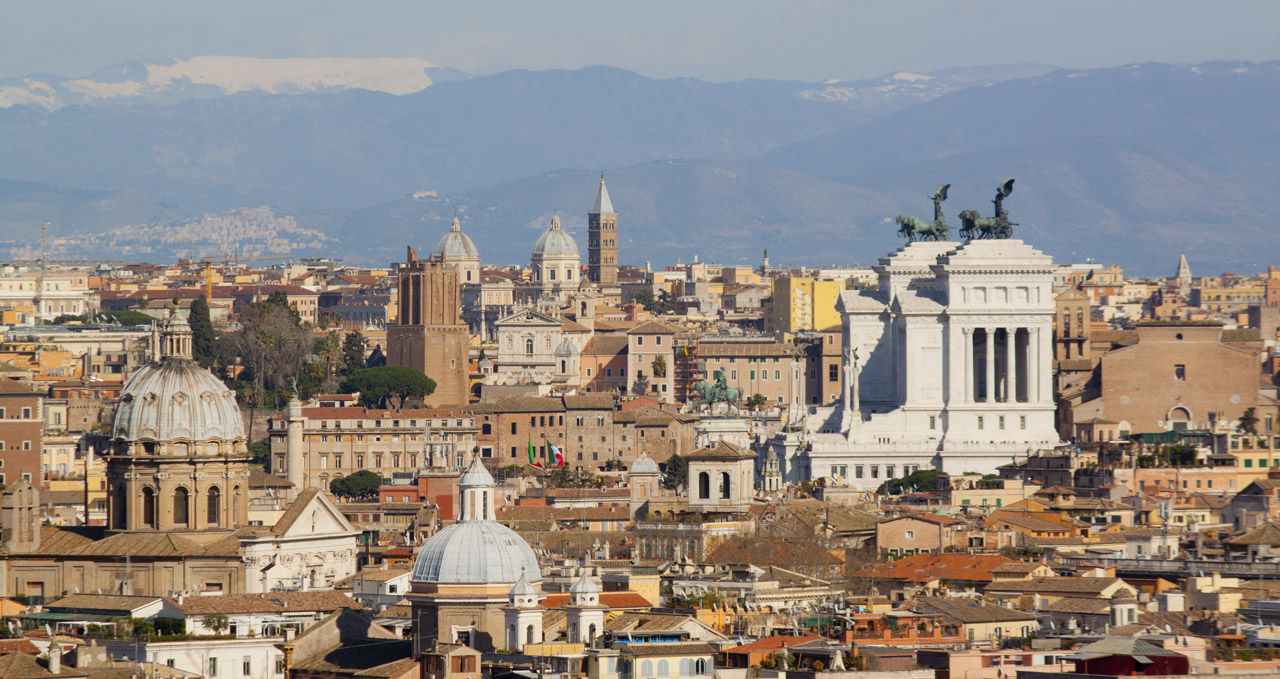
.
.
Enjoy Trastevere for a Stroll and Lunch
In the spirited district of Trastevere, immerse yourself in the vibrant atmosphere of Roman life. Meander through narrow alleys adorned with colorful facades and vibrant street art, soaking in the charm of this beloved neighborhood. Indulge in a delectable lunch at a local trattoria, savoring the flavors of traditional Roman cuisine prepared with love and expertise passed down through generations.
There are so many hidden gems in Rome to explore, but on this tour we will explore the best ones.
.
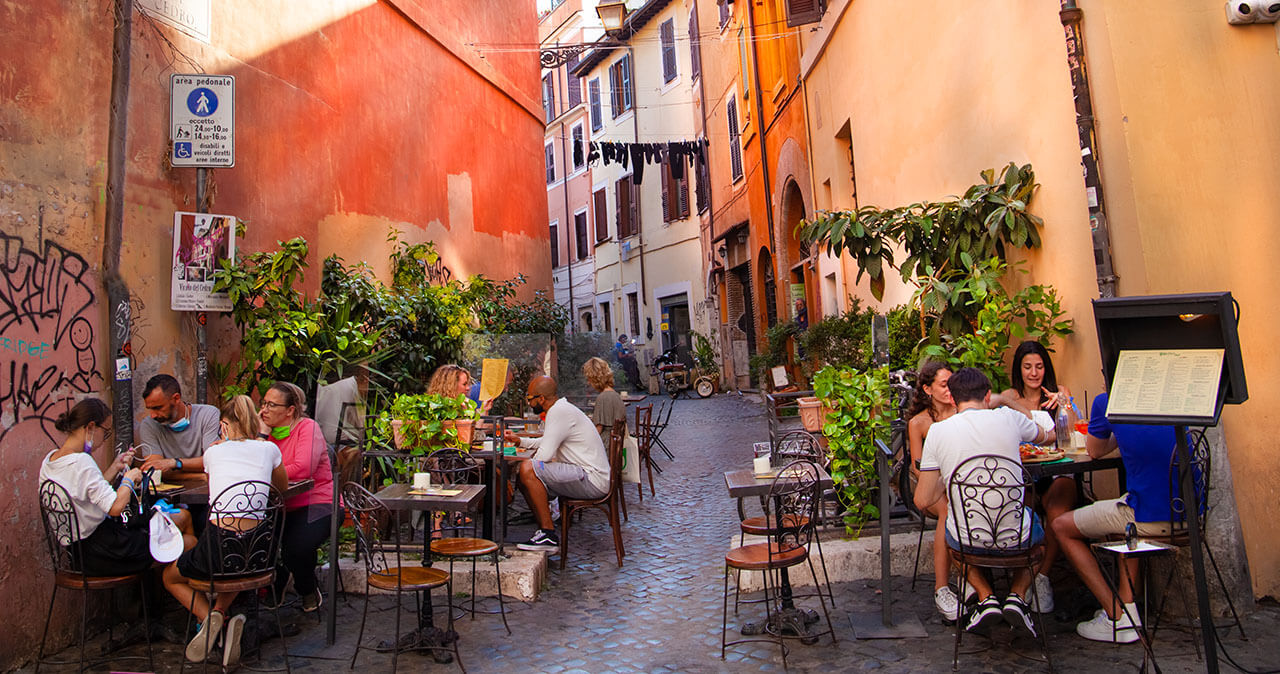
.
DELIGHT IN ROME’S MOST FAMOUS SQUARES
.
.
Stand in awe in Peter’s Square
Step into the grandeur of St. Peter’s Square, where history and spirituality converge in a breathtaking display of architectural brilliance. Marvel at the majestic colonnades enveloping the square, designed to embrace visitors with open arms. Gaze upon the magnificent St. Peter’s Basilica, the largest church in the world, and behold the awe-inspiring Egyptian obelisk that stands as a symbol of ancient power and enlightenment.
.
.
.
Timeless Piazza della Rotonda
In the vibrant energy of Piazza della Rotonda, be captivated by the majestic presence of the Pantheon and the intricate beauty of the baroque fountain. Take a leisurely stroll around the square, exploring local shops and savoring a refreshing gelato from a nearby gelateria. Let the timeless charm of Piazza della Rotonda transport you to a bygone era, where history and modernity intertwine in perfect harmony.
.
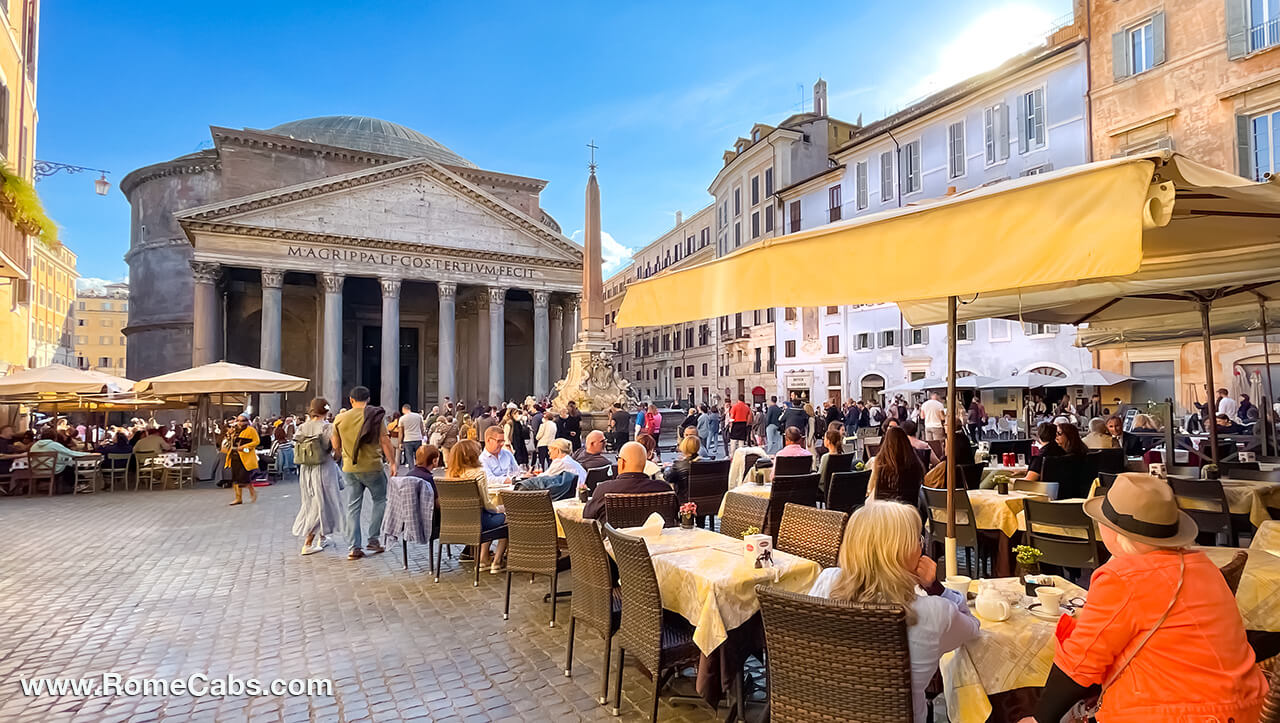
.
.
Delight in the lively Piazza Navona
Discover the lively atmosphere of Piazza Navona, where the Fountain of Four Rivers takes center stage amidst colorful paintings and bustling cafes. Marvel at the intricate details of Gian Lorenzo Bernini’s masterpiece, representing the four major rivers of the world. Let the vibrant energy of Piazza Navona envelop you as you immerse yourself in the lively ambiance of this beloved square.
.
.
.
Toss a Coin into the Trevi Fountain
As you approach the timeless beauty of Trevi Fountain, let the melodious symphony of cascading water enchant your senses. Take a moment to toss a coin into the fountain, joining the ranks of countless visitors who have wished for a return to the Eternal City. Be transported to cinematic moments immortalized on the silver screen, where the Trevi Fountain has served as a backdrop for timeless romance and adventure.
.
.
.
Climb the Spanish Steps
Ascend the elegant Spanish Steps and admire the graceful architecture that has captivated generations of visitors. Let your eyes wander to the Keats-Shelley Memorial House, a tribute to the literary giants who found inspiration amidst the beauty of Rome. As you climb the steps, feel the heartbeat of the city pulsating beneath your feet, beckoning you to explore further.
.
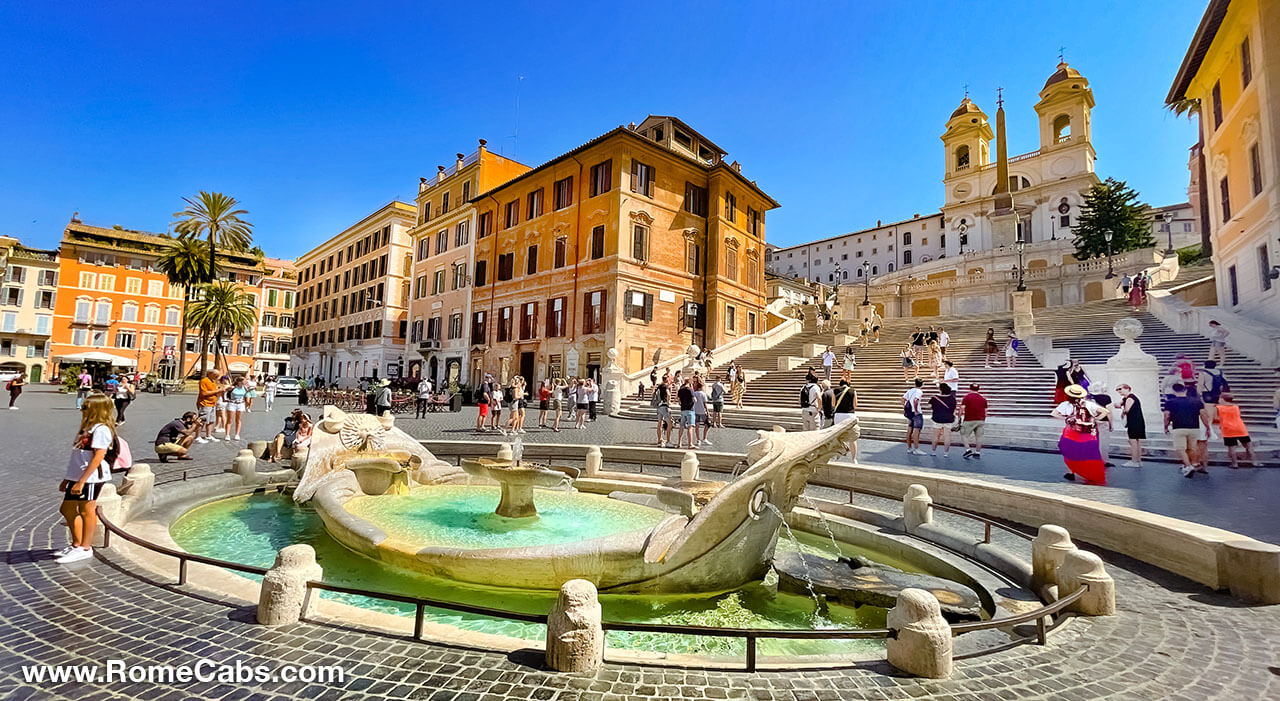
.
With RomeCabs, embark on a journey beyond the crowds and experience Rome’s authentic charm like a true local. Let us guide you through the storied streets and hidden gems of the Eternal City, crafting memories that will last a lifetime. Join us on the “Tour Rome as Romans Do” and discover the magic of Rome in a way that only locals know how on our Rome private driving tour.
Our Tour Rome as Romans Do tour by car is also offered as a Shore Excursion from Civitavecchia and a Post Cruise Tour from Civitavecchia.
.
DISCOVER MORE OF ROME WITH ROMECABS:
5 Simple Things to Do in Rome to Feel More Like a Local
Unveiling Rome’s Secrets: 7 Hidden Gems You Must See
Exploring Beyond Civitavecchia: Captivating Shore Excursions
.
Find RomeCabs online also on:
Santa Maria del Popolo Basilica: Legend, History, and Art
.
Buongiorno and welcome to the RomeCabs Travel blog! Located in the heart of Rome’s historic center just next to Piazza del Popolo, the Basilica of Santa Maria del Popolo stands as a testament to centuries of legend, historical transformations, and artistic brilliance. If you are visiting Rome just for the day on a shore excursion from Civitavecchia, or spending a few days exploring the Eternal City, don’t miss this must-see church in Rome!
In this travel blog, we will explore the Basilica’s legendary founding, the amazing masterpieces by Caravaggio, and the famous Chigi Chapel that was featured in Dan Brown’s blockbuster Angels and Demons.
.

.
.
Santa Maria del Popolo’s Legendary Founding
.
The legend surrounding the founding of the Basilica of Santa Maria del Popolo, though steeped in mysticism and grandeur, faces historical scrutiny. As suggested by Suetonius, the Roman biographer, and historian, Emperor Nero’s mausoleum, where the demonic disturbances were believed to have originated, was located on the higher slopes of the Pincian Hill. This geographical incongruence challenges the accuracy of the tale linking the basilica’s origin to the demonic legacy of Nero.
Historically, the mausoleum of Emperor Nero was perched on the summit of the Hill of Gardens, offering a panoramic view visible from the Campus Martius. The actual site of the mausoleum contradicts the narrative placing it at the foot of the Pincian Hill, where Santa Maria del Popolo now stands. This geographical misalignment raises questions about the veracity of the legend that forms the cornerstone of the basilica’s founding story.
.
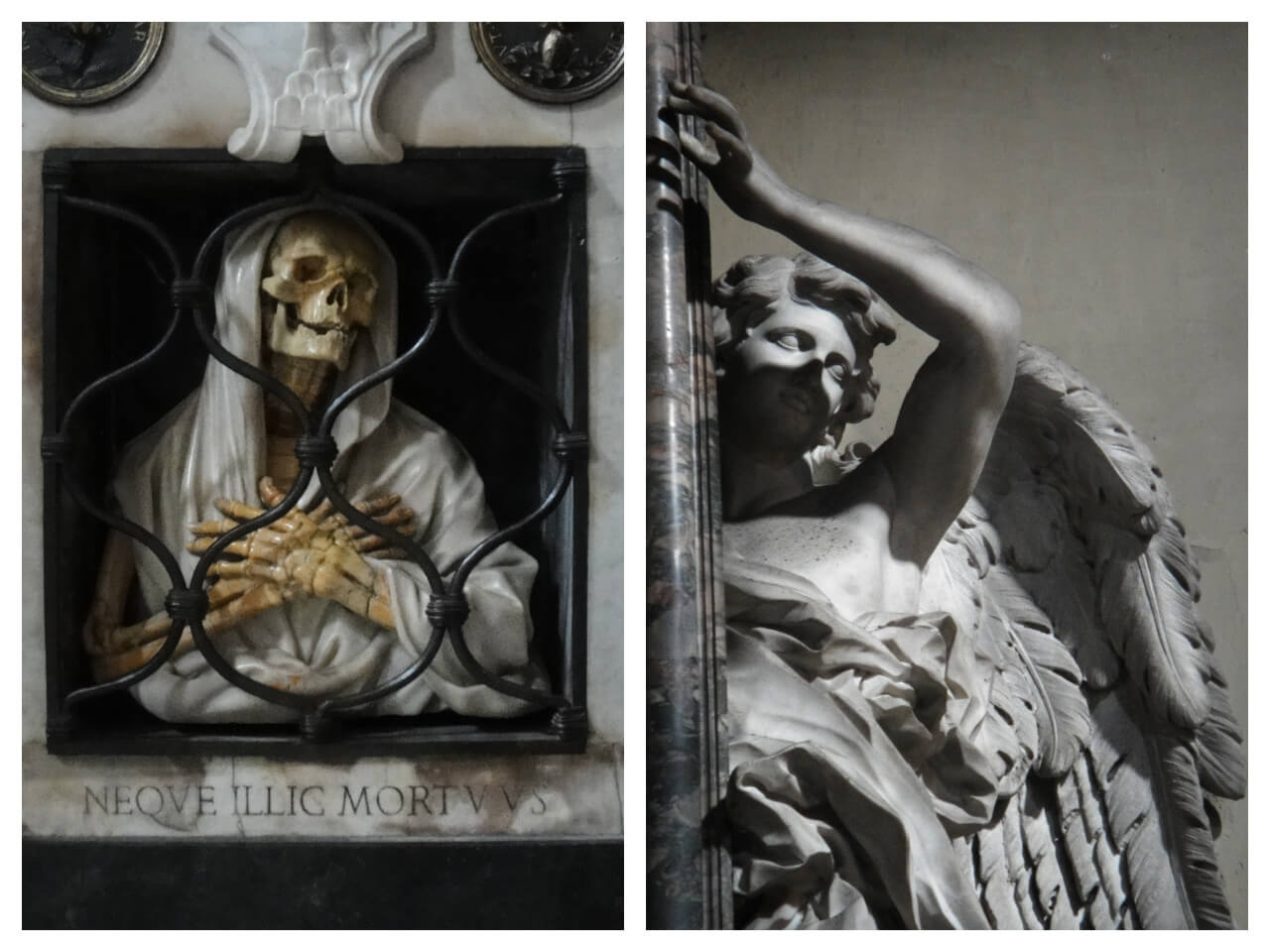
.
However, despite these historical discrepancies, the legend has endured and taken on a life of its own. The story of Pope Paschal II exorcising demons and consecrating the site to Christian worship has become a symbolic saga within the broader context of Rome’s religious and cultural history. The persistence of the legend throughout the centuries underscores its significance in shaping the basilica’s identity.
The tale of demonic expulsion and Christian triumph has transcended its historical context to become a powerful allegory. It symbolizes the constant struggle between good and evil, with the Pope serving as a divine intermediary ensuring the safety of the flock. The walnut tree, once a haunt for malevolent spirits, transforms into a powerful metaphor for the resilience of faith against adversarial forces.
This enduring story has not only contributed to the mystique surrounding Santa Maria del Popolo but has also served as a foundational element in shaping the basilica’s cultural and spiritual significance. Pilgrims and visitors are drawn not only to the physical structure of the basilica but also to the intangible aura created by centuries of storytelling and belief.
.
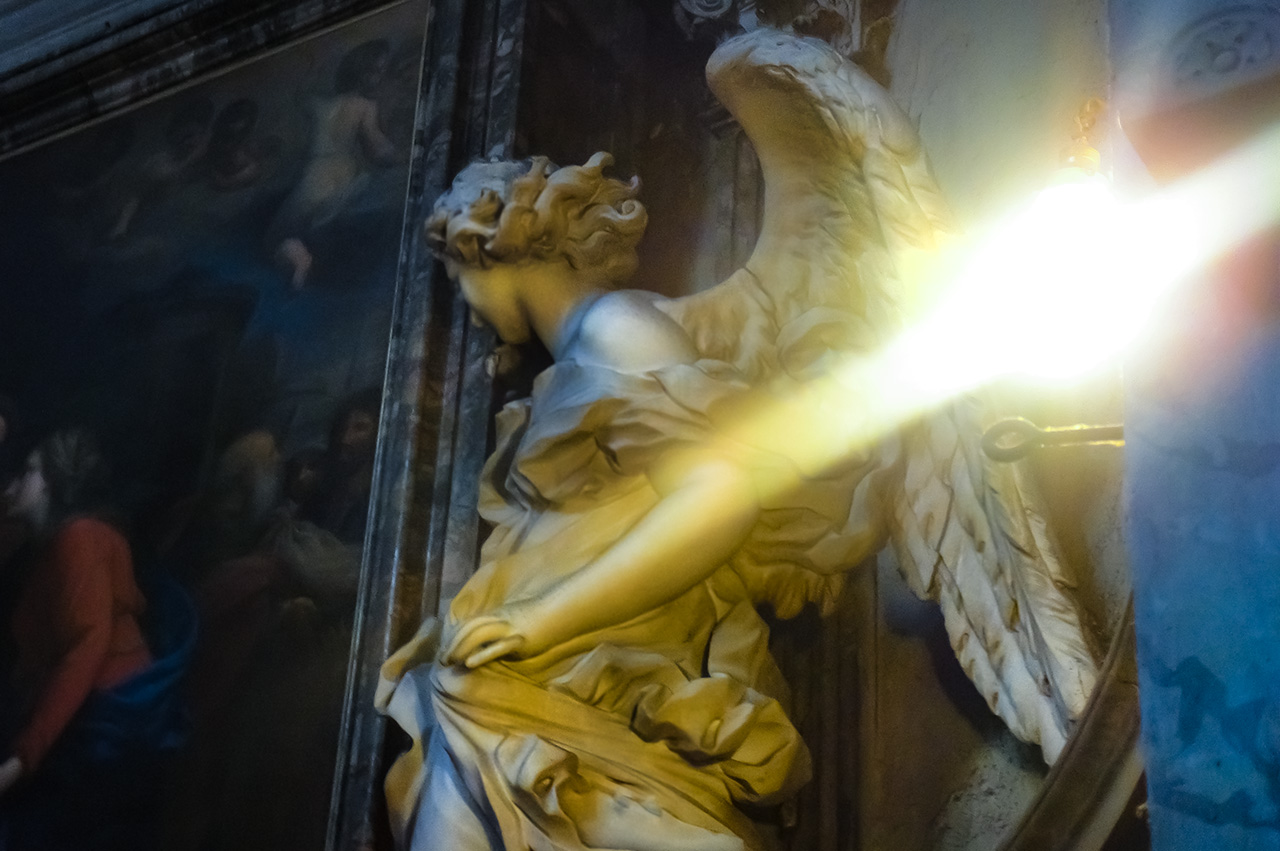
.
In essence, while the historical accuracy of the legend may be questionable, its enduring presence and the role it plays in the basilica’s cultural and religious narrative highlight the complex interplay between history, myth, and the spiritual aspect of Santa Maria del Popolo. The basilica stands not only as a physical testament to centuries of architectural and artistic evolution but also as a living testament to the enduring power of storytelling in shaping the identity of sacred spaces.
The basilica’s early chapel, erected by Pope Paschal II in 1099, marked the beginning of its architectural journey. Over the centuries, it underwent various modifications and expansions, witnessing the addition of significant artworks and funeral monuments. The Augustinians took charge of the basilica in 1250, and it became a parish in 1561, later becoming the titular church of the cardinalate in 1587.
The basilica’s interior is a treasure trove of art and monuments from the 15th to the 19th centuries. The left transept features the impactful Cerasi Chapel, while the right side hosts the elaborate Chigi Chapel, designed by Raphael and later restored by Gian Lorenzo Bernini. The church’s nave showcases various chapels, each with its unique artwork and history.
.
Caravaggio’s Masterpieces inside Santa Maria del Popolo
.
The early 17th century marked a transformative period for the Basilica of Santa Maria del Popolo, particularly with the commissioning of the Cerasi Chapel, a significant chapter that would further enrich the Basilica’s cultural and artistic heritage.
Monsignor Tiberio Cerasi, Treasurer-General of Pope Clement VIII, played a pivotal role in shaping the basilica’s artistic landscape. His vision was realized through the commission of the talented architect Carlo Maderno to design the Cerasi Chapel, a space that would soon become a showcase for the finest examples of Baroque art.
The chapel, erected between 1600 and 1601, stands as a testament to the opulence and grandeur of the Baroque period. Carlo Maderno, a prominent architect of his time, brought his innovative vision to life in the design, creating a harmonious space that would complement the artistic masterpieces it would house.
What truly elevates the Cerasi Chapel to artistic eminence is the inclusion of works by the renowned Italian Baroque painter, Caravaggio. Two of his masterpieces, the “Conversion of Saint Paul” and the “Crucifixion of Saint Peter“, adorn the chapel’s walls, capturing the attention of visitors with their emotional intensity, dramatic lighting, and expertly rendered realism.
,

.
In the “Conversion of Saint Paul“, Caravaggio skillfully portrays the transformative moment on the road to Damascus, where Saint Paul is struck by divine light, undergoing a profound spiritual conversion. The play of light and shadow, a hallmark of Caravaggio’s style, adds a dynamic and theatrical quality to the scene, drawing viewers into the narrative.
The “Crucifixion of Saint Peter” continues Caravaggio’s paintings of religious themes with a raw and visceral depiction of the martyrdom of Saint Peter. The use of chiaroscuro, or the contrast between light and dark, imparts a sense of immediacy and emotional intensity to the scene. Caravaggio’s innovative approach to composition and his ability to convey the human drama of religious narratives made these paintings revolutionary in the context of Baroque art.
.
Chigi Chapel – a Masterpiece by Rafael and Bernini
.
The Chigi Chapel, also known as the Chapel of the Madonna of Loreto, unfolds as a hidden gem weaving together art, history, and spirituality. Its inception in 1507, when Pope Julius II bestowed the chapel upon the affluent banker Agostino Chigi, marked the genesis of a mausoleum project initiated by Raphael.
.

.
Raphael’s original plan centered around the Resurrection, a harmonious blend of Christian themes and classical influences. Although Raphael’s untimely demise in 1520 interrupted the project, his vision endured through the hands of Lorenzetto. The completion faced a temporary halt as Agostino Chigi found his final resting place in 1520, aligning with Raphael’s and the patron’s widow’s deaths.
The true magnificence of the Chigi Chapel materialized during the Baroque era when Gian Lorenzo Bernini undertook significant renovations between 1652 and 1655. Under the patronage of Fabio Chigi, cardinal-priest of the basilica, the chapel witnessed the culmination of its pyramids, altar elevation, and floor enhancements, transforming it into a Baroque masterpiece.
.

.
Adorned with mosaics by Luigi da Pace, the chapel’s dome narrates a celestial tale inspired by Raphael’s original design. Central roundels depict God surrounded by putti, while mosaic panels illustrate celestial bodies as pagan deities. Prophetic statues, a fusion of Raphael’s and Bernini’s contributions, stand in shell-headed niches, each narrating a story of faith.
Pyramidal tombs for Agostino and Sigismondo Chigi, initially conceived by Raphael, were completed and simplified by Bernini. The chapel’s pavement, a mesmerizing display of white and grey marble designed by Bernini, complements the overall symbolism. The geometric patterns and the raised altar emphasize the chapel’s symbolic significance, featuring the Chigi family coat-of-arms.
Extending beyond its sacred confines, the allure of the Chigi Chapel has found a place in popular culture. In Dan Brown’s “Angels & Demons“, the sculpture of Habakkuk and the Angel becomes a crucial element, leading protagonists on a thrilling quest.
.

.
Santa Maria del Popolo’s rich history, fascinating legends, and breathtaking art continue to captivate visitors from around the world. Its enduring legacy stands as a testament to the intertwining threads of faith, creativity, and the ever-evolving story of Rome. As one wanders through this magnificent church, each step echoes the footsteps of centuries past, inviting contemplation and appreciation for the enduring spirit of this venerable basilica.
.
DISCOVER MORE OF ROME WITH ROME CABS:
Summer in Rome Travel Trips from RomeCabs
The Grand Illusion of Sant’Ignazio Church’s Fake Dome in Rome
10 Reasons to Book your Rome Civitavecchia Shore Excursions with Rome Cabs
Explore Santa Maria in Trastevere Church
TIPS on selecting the Best Tour Company in Rome for Private Shore Excursions from Civitavecchia
.
* Find us online also on:
Exploring the Majesty of Basilica of Saint Mary Major – Santa Maria Maggiore in Rome
.
Buongiorno and welcome to RomeCabs Italy Travel Blog! The Basilica of Saint Mary Major, also known as Basilica di Santa Maria Maggiore in Italian, stands as a testament to Rome’s rich history and spiritual significance. As one of the Seven Pilgrim Churches of Rome, it is a major papal basilica and the largest Catholic Marian church in the city. Let’s explore the majesty of the Basilica of Santa Mary Major in Rome.
.
A Tale of Snow and Devotion: Our Lady of the Snows
.
The endearing title “Our Lady of the Snows” bestowed upon the Basilica di Santa Maria Maggiore encapsulates a fascinating tale that traces its roots to the 14th century. Steeped in devotion and wonder, the legend unfolds during the pontificate of Liberius, when a Roman patrician named John and his wife found themselves without heirs. Seeking divine guidance, they fervently prayed to the Virgin Mary, vowing to dedicate their possessions in her honor.
.

.
In a celestial response that would become the stuff of legends, the night of August 5 witnessed a miraculous event on the Esquiline Hill—the heart of ancient Rome. Snow, an unusual occurrence during the Roman summer, descended upon the hill, blanketing it in a pristine layer of snow. Taking this celestial event as a divine sign, John and his wife, inspired by a shared vision of the Virgin Mary, decided to erect a basilica on the very spot where the snow had fallen.
The legend, although first reported after the year 1000, became increasingly popular in the 14th century. It tells of a couple’s unwavering faith and the extraordinary intervention of the Virgin Mary. As a result of this heavenly guidance, the Basilica di Santa Maria Maggiore came into existence, a tangible testament to the couple’s commitment and the enduring connection between the divine and the mortal.
The feast of the Dedication of the Basilica celebrated annually, serves as a poignant reminder of this miraculous event. White rose petals, symbolizing the celestial snowfall, are dropped from the dome during the Mass and Second Vespers of the feast, keeping the legend alive and connecting the present-day pilgrims to the miraculous origins of the basilica.
.
A Rich History of Devotion and Construction
.
.
The earliest building on the site, the Liberian Basilica, is associated with Pope Liberius, who dreamed of a summer snowfall and marked the future church’s location. The present structure was consecrated by Pope Sixtus III in 434 to honor the Virgin Mary, following the Council of Ephesus, which declared Mary as the Mother of God.
Despite multiple construction projects and the earthquake of 1348, the core of the original structure remains. The Basilica symbolizes not only the centrality of Rome in the Roman Empire but also its role as the center of the Christian world.
.
Mosaics: A Glimpse into Christian Late Antiquity
.
Step inside the Basilica, and you’ll be greeted by some of the oldest representations of the Virgin Mary in Christian Late Antiquity. The mosaics, especially those on the triumphal arch and nave, depict scenes from Mary’s life, Christ’s story, and Old Testament narratives. These masterpieces are milestones in the depiction of the Virgin and provide a visual narrative that transcends time.
.

.
Crypts and Chapels: Unveiling Sacred Treasures
.
The depths of Basilica di Santa Maria Maggiore hold not only architectural marvels but also hidden treasures steeped in centuries of sacred significance. Journeying beneath the high altar, visitors encounter the Crypt of the Nativity, a sacred space below the canopy believed to cradle wood from the Holy Crib, a relic of profound spiritual resonance.
.
.
The Crypt of the Nativity, nestled beneath the imposing high altar, invites contemplation and reflection. Pilgrims and curious explorers alike stand in awe as they ponder the connection between this sacred space and the nativity of Jesus Christ.
The crystal reliquary, designed by Giuseppe Valadier, serves as a vessel for the revered wood.
.

.
Venturing further, fragments of a sculpture attributed to the skilled hands of Arnolfo di Cambio are discovered beneath the altar of the Sistine Chapel, a place of devotion named after Pope Sixtus V.
It is crucial to distinguish this chapel from its more famous counterpart in the Vatican, which bears the name of Pope Sixtus IV who contributed significantly to the basilica’s restoration and embellishment. . Each fragment serves as a testament to the artistic prowess of Arnolfo di Cambio and the reverence bestowed upon these sacred relics.
This chapel, with its gilded bronze angels by Sebastiano Torregiani supporting the ciborium, stands as a testament to the artistic and religious fervor that characterized the Renaissance period.
Intriguingly, the chapel also houses the tombs of Pope Sixtus V and his early patron Pope Pius V. It serves as a poignant reminder of the interconnectedness of history, art, and spirituality within the hallowed walls of Santa Maria Maggiore.
.

.
The Oratory or Chapel of the Nativity adds another layer to the basilica’s sacred narrative. Ignatius of Loyola celebrated his first Mass as a priest in this serene space on December 25, 1538, marking a profound moment in the basilica’s living history.
As visitors explore these crypts and chapels, they are immersed not only in the tangible relics of Christianity but also in the echoes of centuries-old prayers and devotions, creating an experience that transcends time and connects the present to the sacred mysteries of the past.
.
Bernini’s Legacy: Tomb in Basilica di Santa Maria Maggiore
.

.
Gian Lorenzo Bernini (1598-1680), a paramount sculptor of the Baroque era, found his final resting place in Basilica di Santa Maria Maggiore. Interred with humility to the right of the high altar, his tomb bears a Latin inscription:
IOANNES LAVRENTIVS BERNINI / DECVS ARTIS ET VRBIS / HIC HVMILITER QVIESCIT
Giovanni Lorenzo Bernini, glory of the arts and of the city, humbly rests here.
After Pope Benedict XIV conferred nobility upon the Bernini family in 1746, additional inscriptions, including the family coat of arms, were added, noting:
NOBILIS FAMILIA BERNINI / HIC / RESVRRECTIONEM EXPECTAT
The noble Bernini family here awaits resurrection
Bernini’s tomb stands as a testament to his monumental contributions and enduring legacy within the hallowed confines of this Roman basilica.
.
Papal Basilica and Ongoing Devotion
.
Santa Maria Maggiore serves as a papal basilica, with the Pope often presiding over the Feast of the Assumption of Mary on August 15. The basilica is entrusted to an archpriest, and a chapter of canons resides within. Pope Francis, known for his devotion to the Salus Populi Romani, frequently visits the basilica, considering it a place of great spiritual significance.
Whether exploring Rome on private tours, or venturing on your own, a visit to Basilica di Santa Maria Maggiore is a journey through time, art, and devotion. Its rich history, legends, and stunning mosaics make it a must-see destination for pilgrims, art enthusiasts, and history buffs alike.
.
DISCOVER MORE OF ROME with ROME CABS:
Rome’s 7 Hidden Gems You Must See
Beyond the Colosseum: Exploring Rome’s Hidden Architectural Gems
Origins of Santa Maria in Trastevere and Early Foundations
Exploring the Eternal City: Is Rome Safe? Top 20 Travel Safety Tips from Rome Cabs
Your Roman Holiday: How to Make Your Rome Visit Extraordinary
.
* Find us online also on:
The Illusionary Marvel: Sant’Ignazio Church’s Fake Dome and Frescoes in Rome
.
Greetings and welcome to RomeCabs travel blog! Tucked away in the heart of Rome’s historical center near Piazza Navona, Sant’Ignazio Church remains a hidden gem, an architectural marvel that defies expectations. Constructed between 1626 and 1650, this seemingly typical Baroque church, dedicated to Ignatius of Loyola, founder of the Jesuit Order, conceals a fascinating secret that draws visitors from around the world—a fake dome and illusionistic frescoes that challenge the boundaries of perception and artistic innovation.
At first glance, Sant’Ignazio Church might be dismissed as just another Baroque structure amidst the architectural richness of Rome. It’s so easy to walk right past it as you wander through Rome from Piazza Navona to other famous squares. In fact, this church is overlooked by most people!
.
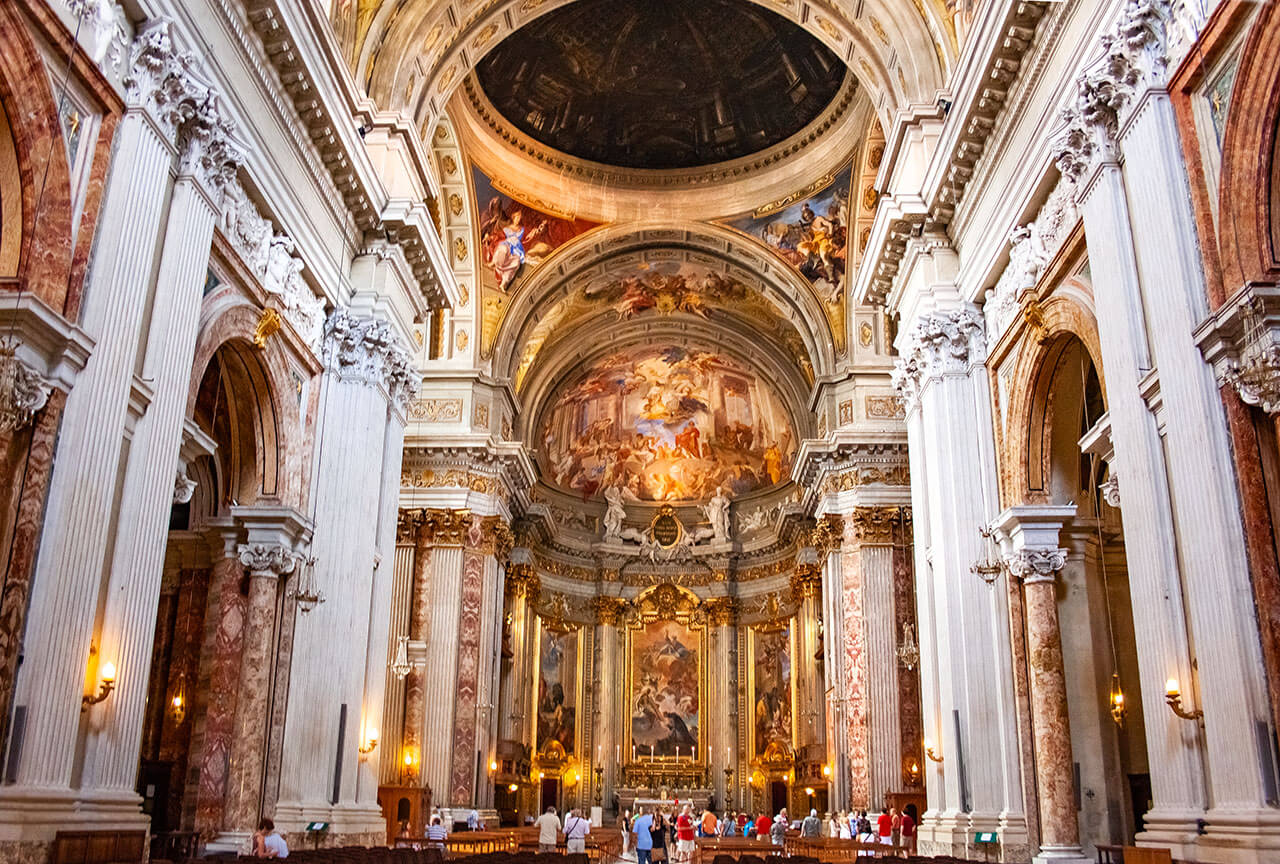
.
.
A Church Born of Necessity: The Jesuit Order in Rome
.
To fully appreciate Sant’Ignazio Church, one must delve into the historical context of the Jesuit Order during the 17th century. Emerging during the Reformation and Counter-Reformation, the Jesuits were at the forefront of the Catholic Church’s efforts to reaffirm its legitimacy.
The Jesuits, passionate about spreading Catholicism globally, commissioned grand churches in Rome to serve as their spiritual hubs. Sant’Ignazio Church, originally intended to boast a magnificent dome, faced financial setbacks during construction, prompting the ingenious solution of a painted dome—a compromise that preserved the grandeur envisioned by the Jesuits.
.
Andrea Pozzo: The Virtuoso Painter Priest
.
Andrea Pozzo‘s role in Sant’Ignazio’s transformation from architectural compromise to artistic wonder cannot be overstated. A true Renaissance man, a Jesuit lay brother and painter, Pozzo seamlessly integrated his spiritual devotion with his artistic pursuits. His extensive travels in the contested lands of central Europe, where Catholicism battled Protestantism, laid the groundwork for his fervent dedication to portraying Catholic ideals through frescoes. In addition to his skills as a painter, Pozzo’s expertise in mathematics and perspective, evident in his influential treatises, played a crucial role in the development of illusionistic techniques like trompe l’oeil.
ALSO READ: Rome Safety and Travel Tips: Ensuring a Secure and Enjoyable Visit
.
Illusionary Marvel: The Fake Dome
.

.
Step inside, and the ordinary transforms into the extraordinary. The story of the church’s fake dome is a testament to the creative genius of Andrea Pozzo. Between 1685 and 1694, Pozzo embarked on a remarkable endeavor—painting a replica of a 3-dimensional dome on the flat ceiling.
The painted perspective, complete with supporting ribs and columns, appears like an authentic dome until one approaches the altar. Suddenly at that point, the grand illusion collapses, exposing the flat ceiling beneath and inviting contemplation on the boundaries between reality and artifice. The clever use of vanishing points creates a three-dimensional effect, deceiving many into believing they are witnessing a tangible architectural marvel.
.
ALSO READ: Why are the Spanish Steps so Famous? Explore this iconic symbol of Rome
..
The Glory of Saint Ignatius
.
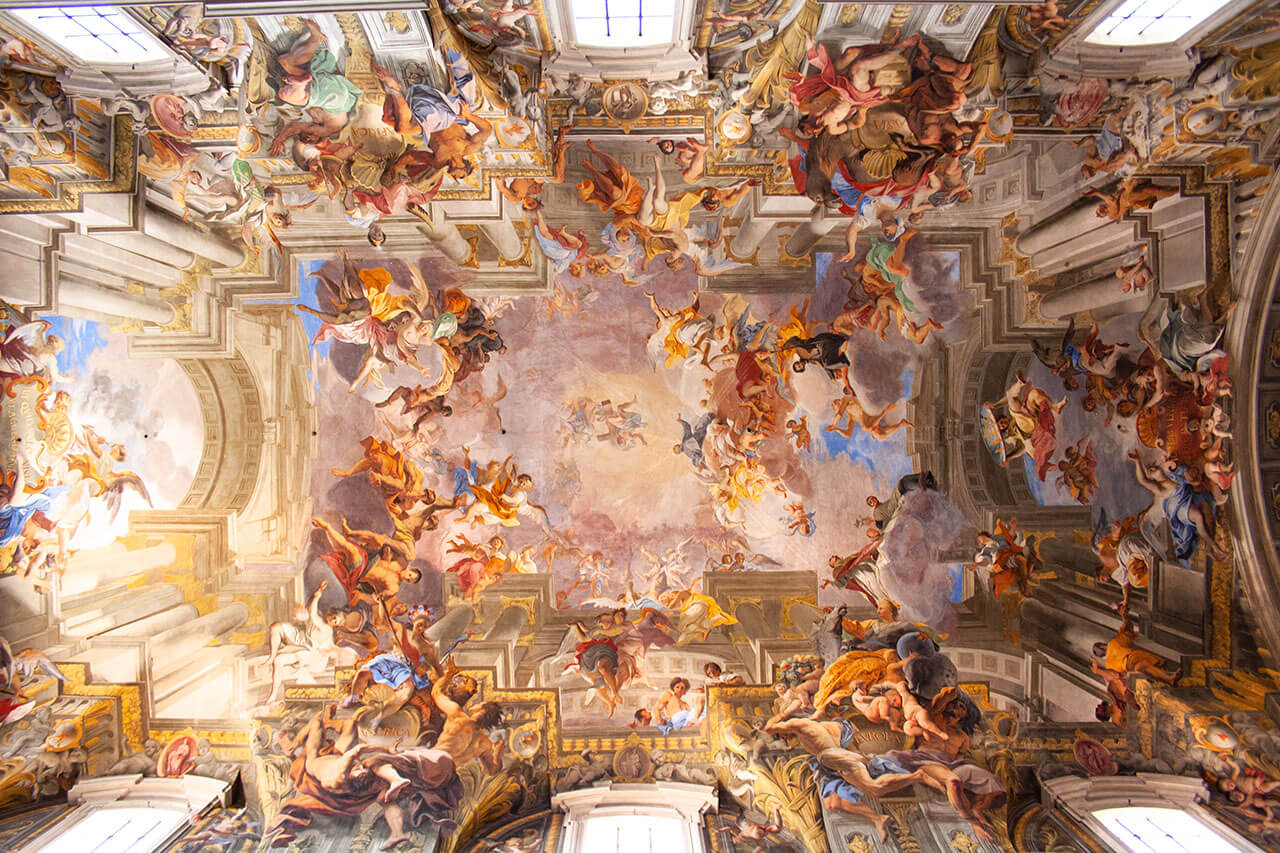
..
.
The pièce de résistance of Sant’Ignazio Church is Pozzo’s optical masterpiece, a sprawling fresco that adorns the entire ceiling. Pozzo’s technique, known as Quadratura, goes beyond mere decoration; it creates a visual spectacle that seems to stretch the confines of the church into a celestial expanse. The central painting glorifying Saint Ignatius of Loyola and the angels showcases Pozzo’s mastery of perspective, bringing a sense of divine splendor into the architectural space.
This breathtaking masterpiece seamlessly extends the church’s architecture into a celestial realm. Ignatius of Loyola ascends to divine realms, accompanied by angels, while personifications of Asia, Africa, America, and Europe surround the scene. This allegory, celebrating the zeal of St. Ignatius, also asserts Europe’s divine dominance over the globe, a reflection of the geopolitical context of the time.
ALSO READ: Beyond the Colosseum: Exploring Rome’s Hidden Architectural Gems
…
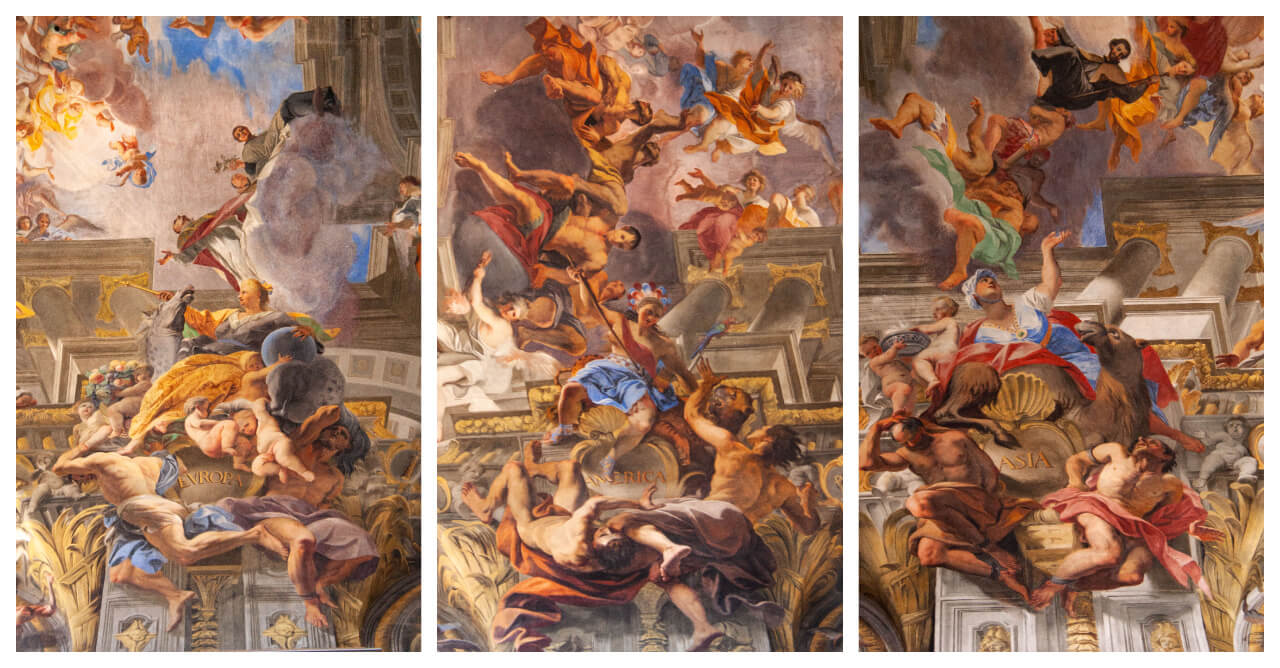
.
Sant’Ignazio Church emerges not merely as a place of worship but as a canvas for the convergence of faith, creativity, and human ingenuity. Beyond its unassuming exterior lies a world of illusions crafted by Andrea Pozzo, capturing the essence of the Jesuit Order’s mission and devotion.
Whether you are exploring Rome on Rome tours, or on an independent exploration of the Eternal City, make a point to stop inside the church of Sant’Ignazio. Visiting this hidden gem in Rome offers not just a glimpse into Baroque artistry but also a journey through the interplay of faith, creativity, and the boundless possibilities of illusion—a testament to the enduring allure of Sant’Ignazio Church as part of Rome’s architectural and artistic heritage.
.
ALSO READ: Unveiling Rome’s Secrets: 7 Hidden Gems You Must See
.
.
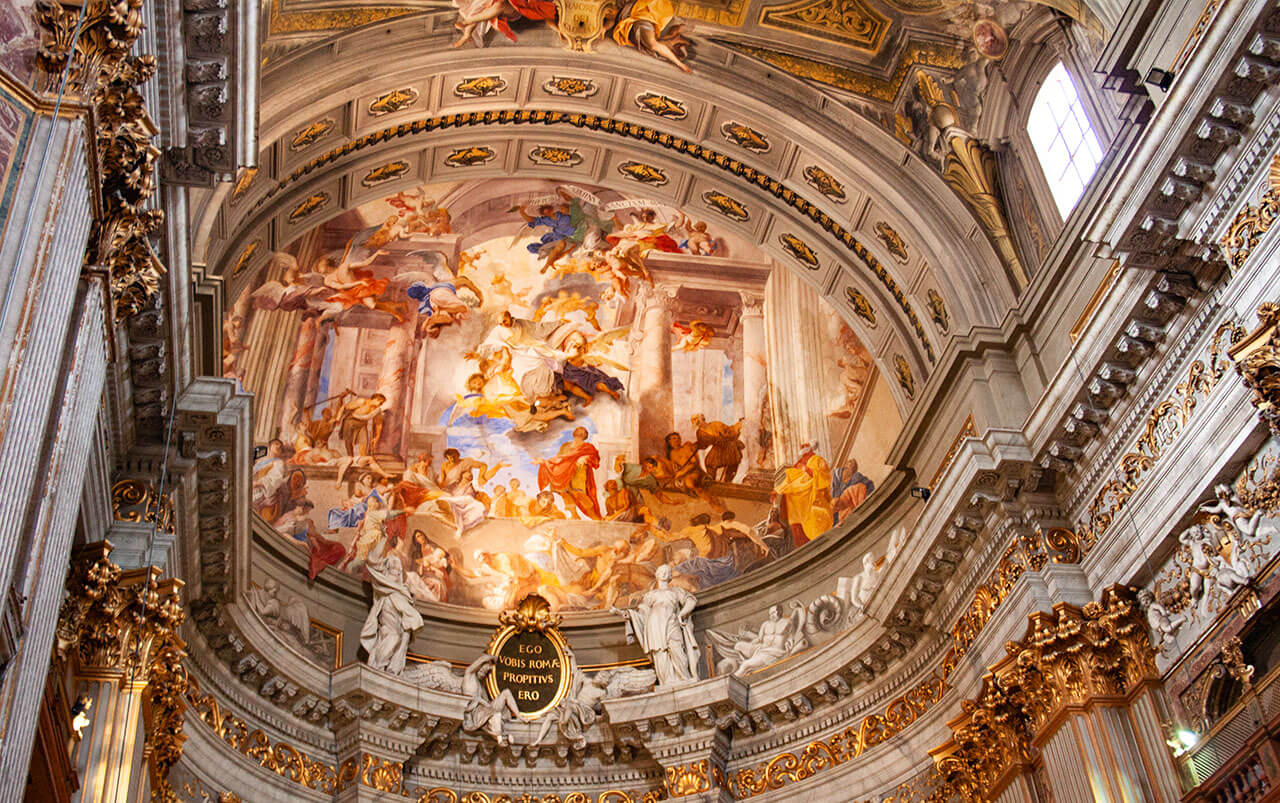
.
.
Check out our other Italy Travel Blogs by RomeCabs:
https://rome-cabs.org/
https://rome-cabs.net/
https://romecabsdotnet.wordpress.com/
https://romecabs.wordpress.com/
.
* Find us online also on:
- RomeCabs FACEBOOK
- RomeCabs PINTEREST
- RomeCabs TWITTER
- RomeCabs INSTAGRAM
- RomeCabs FLICKR Photo Gallery
- RomeCabs Recommended on Cruise Critic
.
.
.
.
.
.
Beneath Piazza Navona: Domitian’s Stadium of Ancient Rome
.
If you stroll through the heart of Rome today, you might find yourself sipping a coffee in the picturesque Piazza Navona. This charming square, with its elegant fountains, outdoor cafes, and lively atmosphere, is a must-visit destination for travelers and history enthusiasts alike.
You’re not merely savoring the charm of a Baroque square; you’re treading upon the same ground where ancient athletes displayed their prowess and where gladiators fought for their lives. The echoes of history persist, whispered in the wind and etched into the very stones beneath your feet. Let’s delve into the fascinating history of Piazza Navona’s past as a grand Roman Stadium from which it also takes its name.
.
.
.
.
.
Domitian’s Stadium – An Ancient Roman Architectural Marvel
.
Piazza Navona’s story begins in the 1st century AD, during the reign of the Roman Emperor Domitian. In an era where gladiatorial contests often took center stage, Domitian had a different vision. He commissioned the construction of a stadium designed for athletic competitions, reminiscent of the ancient Greek Olympic games.
Domitian’s Stadium, as it was originally known, was a remarkable architectural achievement. Its shape, an elongated ellipse measuring 192 meters in length and 54 meters in width, closely mirrored the Greek stadium in Olympia. The stadium’s structure accommodated thousands of spectators who gathered to witness a variety of athletic events.
.
The Athletic Extravaganza at Domitian’s Stadium in Ancient Rome
While the Colosseum is more famously associated with gladiatorial combat, Domitian’s Stadium hosted a different kind of spectacle. At a time when the Roman elite was captivated by Greek culture, these contests were a way to celebrate and emulate the ancient Greek Olympic games. Competitors often hailed from Greece and its neighboring regions, and victorious athletes were rewarded with Roman citizenship.
Domitian’s Stadium provided a stark contrast to the bloodthirsty spectacles of the Colosseum, signaling a shift in the Roman public’s taste from violence to athleticism.
.

.
.
Javelin Throwing:
A spectator in this colossal stadium could witness the breathtaking precision of javelin throwing. Athletes, like modern-day archers with spears, demonstrated both accuracy and distance in their throws. The historical significance of this event extended beyond the stadium walls, as these skills were equally vital in the art of warfare, underscoring the Romans’ fusion of athletic prowess and practical military acumen.
Long Jump:
Another amazing spectacle was the long jump. Athletes would dash down a sandy runway, leaping skyward to clear impressive distances. What sets this event apart is the use of halteres—weights that athletes carried during their leaps, only to cast them aside mid-flight, propelling themselves even further. This ingenious strategy not only hinted at the strategy of modern sports but also lent a historical mystique to the stadium’s legacy.
Relay Races:
The stadium also played host to relay races, adding an element of teamwork and coordination to the competitions. Torchbearers would pass flaming torches, not batons, to their teammates, adding a brilliant visual dimension to the races. The lampadedromia was an exhilarating spectacle that combined swiftness with precision, all beneath the watchful gaze of the ancient audience.
Long-Distance Races:
The dolichos, a long-distance race, celebrated the athletes’ endurance. Known as oplitodromia, this contest tasked competitors with running substantial distances while bearing shields and helmets. This resembled the modern steeplechase but with an added twist. The use of shields and helmets not only showcased physical endurance but also emphasized the interplay between athleticism and martial prowess.
Wrestling Without Restraints:
Wrestling was a no-holds-barred competition, a raw and unfiltered form of combat. Athletes grappled and struggled, seeking to dominate their adversaries. What’s intriguing is that these competitions occasionally featured male versus female bouts, demonstrating the rich diversity of competitors. Both wrestling and boxing events could only be stopped by submission, blinding, or death, adding a level of intensity and brutality to these contests that stood in stark contrast to the lofty ideals of the Olympic games.
Ancient Roman Boxing:
Boxing was another physically demanding sport featured in the stadium. These ancient boxing matches used leather straps as gloves, known as himantes, and sometimes even included metal “padding“.
The sports held in Domitian’s Stadium were a testament to the athleticism, strength, and diversity of ancient Roman culture. While the games celebrated physical prowess, they also embraced the multifaceted nature of life in ancient Rome.
As you soak in the vibrant atmosphere of Piazza Navona, remember that you are in a place where these ancient games once enthralled and entertained the people of Rome, leaving behind a rich and storied legacy for all to explore. You can almost hear echoes of the roars of tens of thousands of spectators!
.
Changing Times and Purpose of Domitian’s Stadium
.
In the annals of history, Domitian’s Stadium saw a multitude of transformations and adaptations, reflecting the shifting sands of time and the varied fates of the Roman Empire. One might say it was a witness to the colorful tapestry of Roman life.
In 217 AD, a calamitous event would forever alter the course of the Colosseum’s history. A devastating fire, with its ravenous flames, dealt a severe blow to the iconic amphitheater. As a result, the Colosseum temporarily lost its place as the epicenter of gladiatorial combat and grand spectacles.
.
The Rise of Gladiatorial Contests in Domitian’s Stadium
In a bold move, the authorities turned to Domitian’s Stadium to fill the void. This colossal arena, with its elliptical design and unobstructed views, became the new stage for gladiatorial contests for a few years. The stadium’s vast structure provided an ideal backdrop for these brutal battles, offering a change of scenery from the more traditional arenas like the Roman circuses.
Some accounts, including the vivid descriptions found in the Historia Augusta, told of grand arcades took on an altogether different role – that of brothels. In a bizarre twist, the emperor Severus Alexander used the revenue generated from these establishments to fund the stadium’s restoration.
.
Domitian’s Stadium: A Place of Martyrdom
During the reign of Emperor Diocletian, it is believed that St. Agnes met her tragic end within or in close proximity to one of the stadium’s arcades. Her unwavering commitment to her beliefs, even in the face of adversity led to her martyrdom.
A millennium later, the architectural genius of Borromini brought to life the Church of St. Agnes in Agone. This Baroque masterpiece now graces the vibrant square, standing as an enduring tribute to St. Agnes’s memory.
.
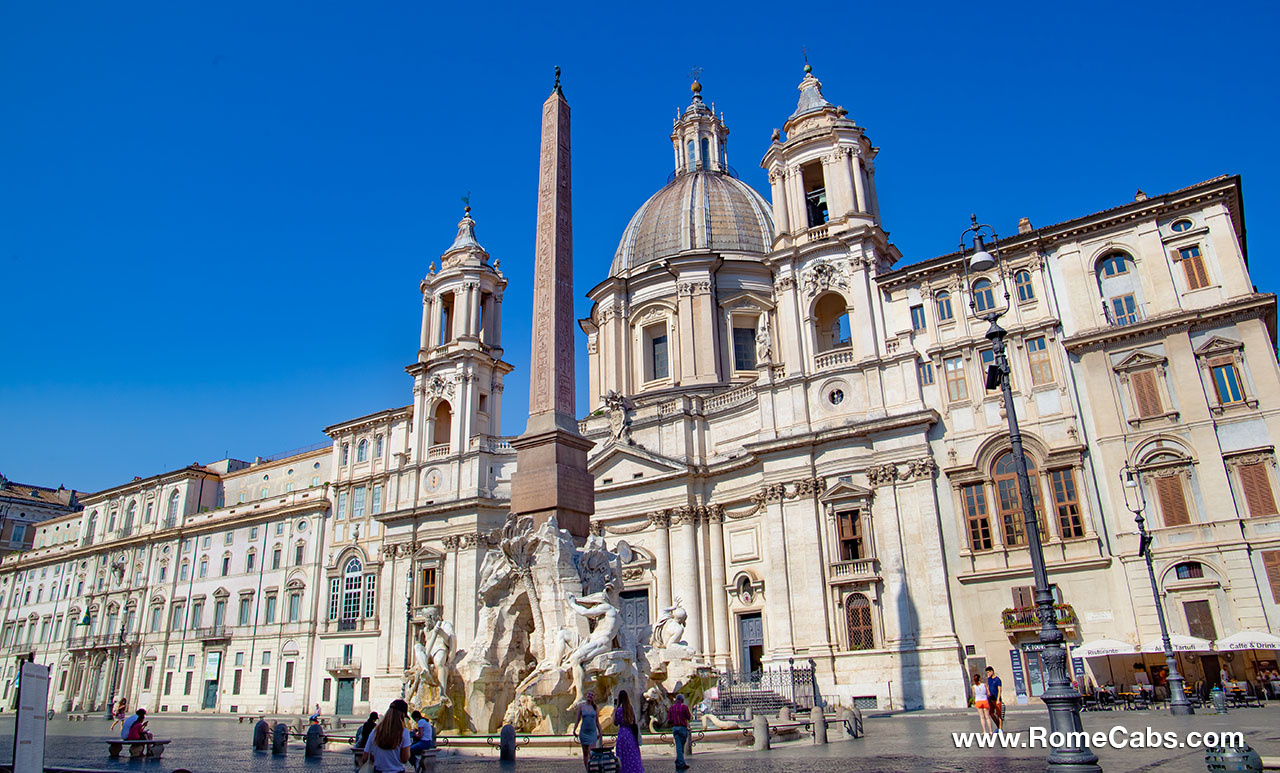
.
.
Domitian’s Stadium from Fall of the Roman Empire into the Middle Ages
.
As the Roman Empire slowly entered the twilight of its existence, the stadium, like the empire itself, began to wane. The grand athletic events that once reverberated through its walls gradually became less frequent. The decline of Rome was marked by economic hardships, political instability, and a shifting focus away from the once grandiose sporting spectacles.
As the Roman Empire weathered economic and political storms in its later years, the magnificent arena transformed into a different kind of social hub. The arcades, once echoing with the cheers of athletes, now provided shelter for the impoverished, becoming a place where the poor found refuge. It’s a reflection of the changing times, as Rome grappled with its own evolving identity.
Even into the Renaissance era, substantial portions of the stadium managed to stand the test of time. However, instead of cheers and applause, these remnants faced a different fate. They were mined and plundered for valuable building materials, as the Renaissance architects sought to breathe new life into the ever-evolving city.
.
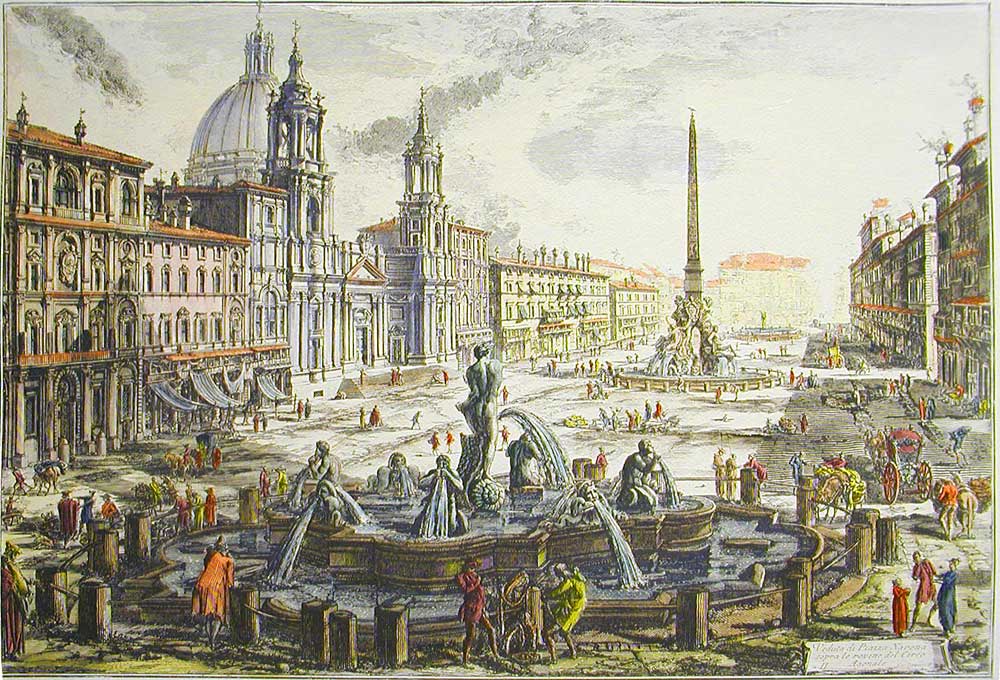
.
.
Piazza Navona Emerges
.
Fast forward to the Baroque period, and you’ll find a different scene entirely. The original stadium had long vanished, replaced by the stunning Piazza Navona. This transformation was part of a broader effort to convert ancient Rome into a more modern and aesthetically pleasing city.
Pope Innocent X, of the Pamphilj family, played a pivotal role in the square’s makeover. He envisioned Piazza Navona as Rome’s new epicenter, transforming the former racetrack into what he called “Rome’s drawing room.” The result was a grand piazza featuring remarkable Baroque architecture and iconic fountains that remain as captivating today as they were centuries ago.
.
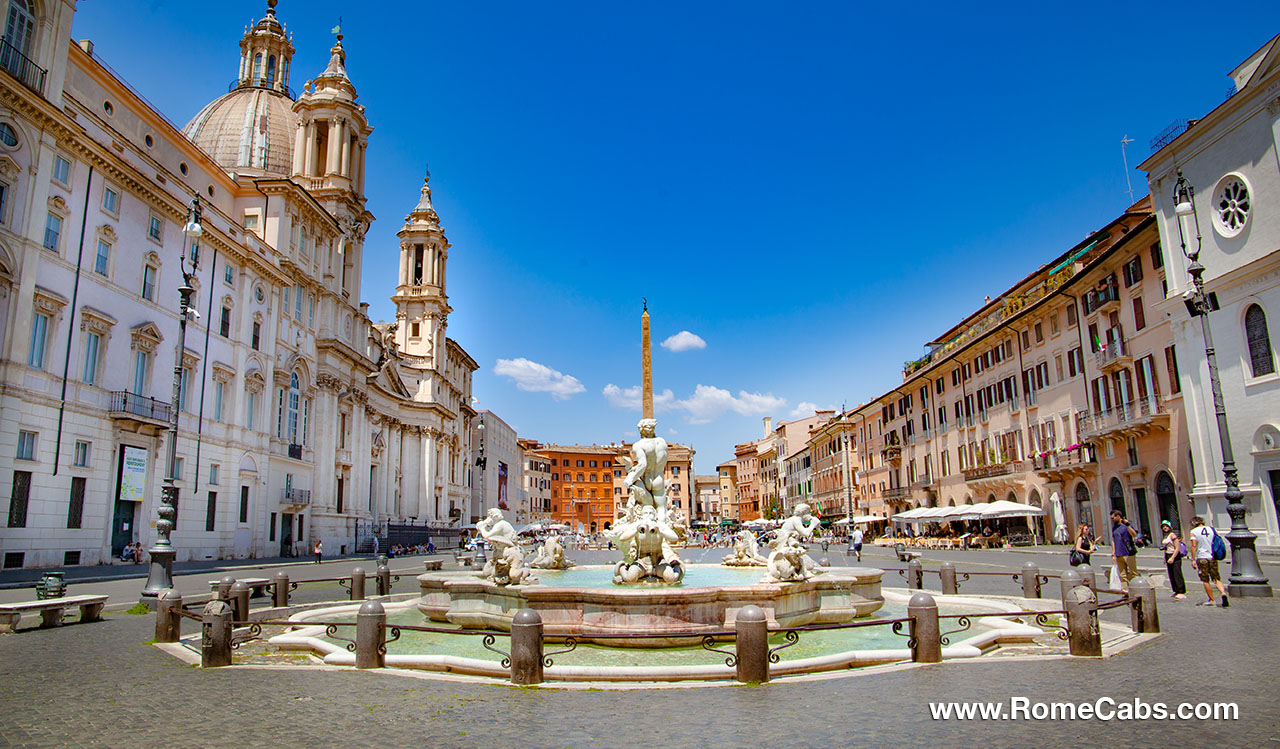
.
Domitian Stadium Underground Visit
.
If you’re a history enthusiast and want to delve deeper into the stadium’s history, a visit to Domitian’s Stadium, accessible from Via di Tor Sanguigna on the northern side of Piazza Navona, offers a unique glimpse into the past. You can descend 12 meters beneath the square to explore the remains of the stadium and appreciate the remarkable preservation of this 2,000-year-old travertine and brick stadium.
Among the captivating remains, you can find a copy of Praxiteles’ Apollo Lykeios from the 4th century BC, made of Pentelic marble. It’s a fascinating journey into ancient history right beneath your feet.
Piazza Navona, with its vibrant present and rich historical past, stands as a testament to Rome’s enduring legacy, making one of the must see places in Rome. From the athletic competitions of ancient times to the Baroque beauty of today, this square is a living record of the city’s evolution. It’s a place where the past and present seamlessly coexist, offering a glimpse into Rome’s diverse and ever-evolving history.
.
Check out our other Italy Travel Blogs by RomeCabs:
https://rome-cabs.org/
https://rome-cabs.net/
https://romecabsdotnet.wordpress.com/
https://romecabs.wordpress.com/
.
Find RomeCabs online also on:
- RomeCabs FACEBOOK
- RomeCabs PINTEREST
- RomeCabs TWITTER
- RomeCabs INSTAGRAM
- RomeCabs FLICKR Photo Gallery
- Rome Cabs Recommended on Cruise Critic
.
5 Simple Things to Do in Rome to Feel More Like a Local
.
Buongiorno and welcome to RomeCabs Travel blog!
Rome, the Eternal City, is not just a destination; it’s an experience. While visiting the iconic landmarks is a must, to truly feel like a local, you need to go beyond the touristy façade. Rome’s rich culture and vibrant way of life are best discovered through the eyes of its residents.
In this travel blog, discover 5 simple things to do in Rome to feel more like a Roman, while also adding a bonus tip for a truly immersive adventure. From savoring an Italian breakfast to leisurely evening strolls, learning basic Italian phrases to savoring local dishes, and exploring bustling markets, these activities will make your Roman holiday unforgettable.
.
1. Skip Hotel Breakfast: Dive into the Local Breakfast Scene
.
To kickstart your day the Roman way, begin with breakfast. While hotels may offer continental spreads, skip the familiarity of your hotel’s breakfast and opt for a true Italian experience. Head to a local café, preferably the ones where Romans start their day.
Here, you can enjoy an authentic Italian breakfast of “cappuccino” (a creamy espresso coffee with foamed milk) and “cornetto” (a croissant-like pastry). It’s a simple but indulgent delight, and it’s a great opportunity to observe locals as they prepare for their day. Some famous spots include Sant’Eustachio Il Caffè and Caffè Tazza d’Oro near the Pantheon, and Caffè Greco near the Spanish Steps, where you can taste the city’s history with every sip.
.

.
.
2. Embrace the Passeggiata in Rome
.
The “passeggiata” is a beloved Italian tradition, especially in the eternal city. It’s the evening ritual of leisurely strolling, an opportunity for Romans to unwind, socialize, and soak in the city’s charm. To truly feel like a local, indulge in this unhurried evening stroll. Wander along bustling streets, piazzas, and parks, and immerse yourself in the enchanting ambiance.
Lose yourself along ancient streets in the charming Trastevere neighborhood, discover Aventine Hill, or visit Villa Borghese gardens for a serene experience. Or stroll along Via del Corso which connects Piazza del Popolo to Piazza Venezia. The “passeggiata” is the perfect time to admire Rome’s stunning architecture, indulge in people-watching, and even savor some delicious gelato. Whether you’re alone or with company, this ritual helps you appreciate Rome’s unique atmosphere and connect with its people.
.
ALSO READ: 5 Ways to Minimize Your Need for Public Transportation in Rome
.
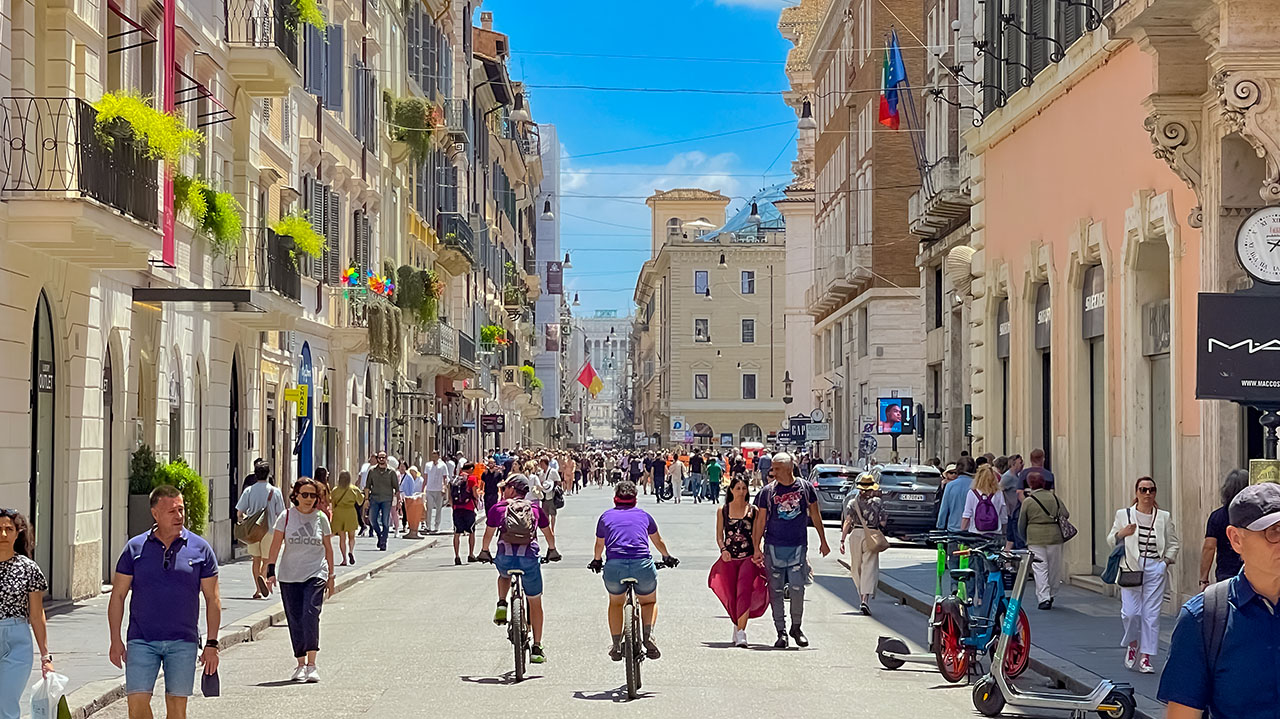
.
.
3. Learn Some Basic Italian Phrases
.
While many Romans speak English, making an effort to learn basic Italian phrases can significantly enhance your Roman experience. It’s a sign of respect for the local culture and language, and it can lead to deeper connections with the people you encounter.
Start with simple greetings like “Buongiorno” (good morning), “Grazie” (thank you), and “Per favore” (please). These polite gestures go a long way in creating a positive interaction. Don’t be afraid to practice your newfound language skills – most locals appreciate the effort and will gladly assist you. Learning a few phrases can transform your trip from being a passive observer to an active participant in the Roman way of life.
.

.
.
4. When in Rome, Dine Like a Roman
.
When it comes to dining in Rome, it’s not just about pizza and pasta, although they are undeniably delicious. To dine like a local, explore the world of traditional Roman cuisine. Try dishes like “Cacio e Pepe” (cheese and pepper pasta), “Amatriciana” (pasta with tomato and pancetta), and “Supplì” (fried rice balls with cheese).
Venture beyond the touristy areas to find local trattorias and osterias. These charming eateries offer an authentic experience, where the atmosphere is cozy, and the food is exceptional. Pair your meal with a local wine, and you’ll experience the true essence of Roman culinary traditions. Engaging in the dining culture will make you feel like a resident, not just a tourist.
.
ALSO READ: Unveiling Rome’s Secrets: 7 Hidden Gems You Must See
.
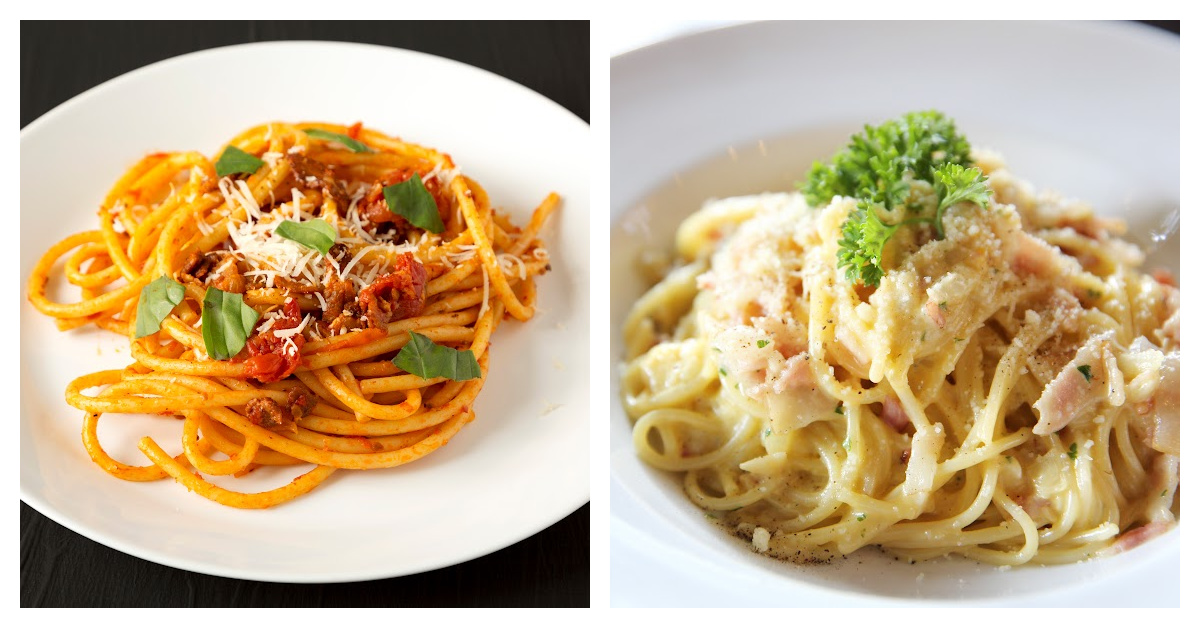
.
.
5. Visit Local Markets in Rome like a local
.
Exploring local markets is a delightful way to experience Rome as a local. One such market worth visiting if you are in the historical center is Campo de’ Fiori, where you can immerse yourself in a bustling atmosphere filled with locals and an array of delightful goods. You’ll find fresh produce, artisanal cheeses, aromatic spices, and a variety of local delicacies. Interact with the vendors, sample their products, and perhaps pick up some Roman ingredients to recreate a traditional Roman meal in your accommodation.
The market provides a window into the daily lives of the locals, as they shop for their culinary needs. It’s a chance to appreciate the city’s vibrant food culture and even pick up some unique souvenirs to remember your Roman adventure.
If you can’t make it to an outdoor market, consider a visit to a nearby local supermarket to discover the culinary delights enjoyed by Italians. If you are staying in a rented apartment, shop for local ingredients for an authentic Italian dinner, or simply replenish your fridge with essential provisions for your stay, the local market is your gateway to an array of local options.
.
ALSO READ: 5 Ways to Stay Cool Touring in Rome this Summer
.
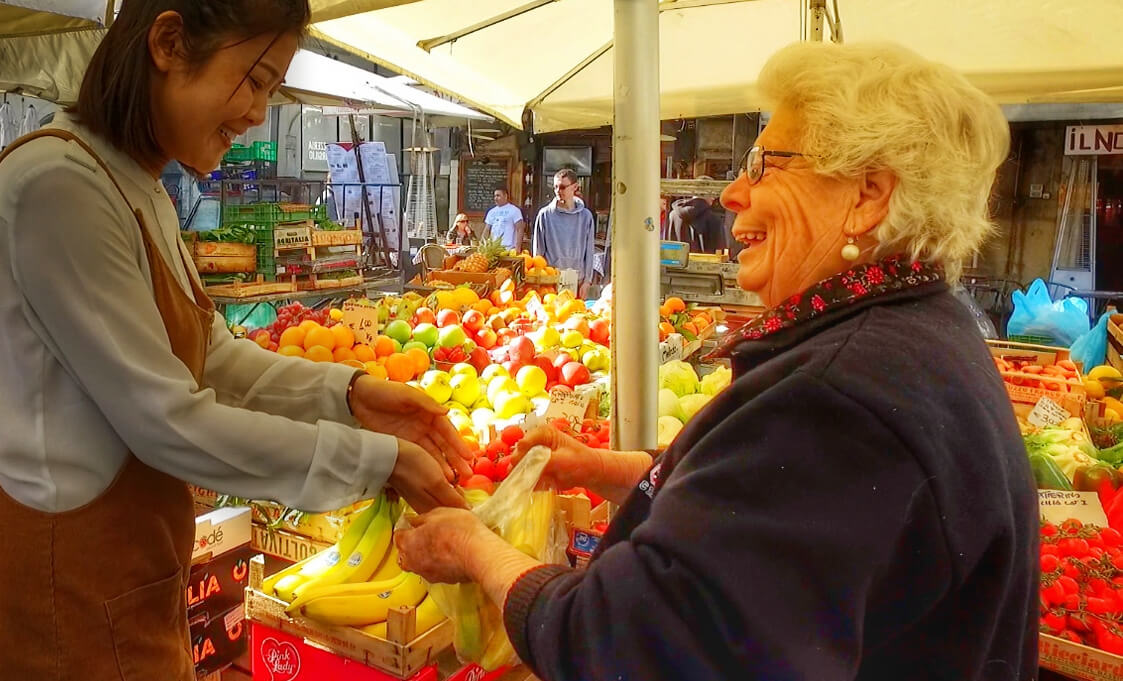
.
.
Bonus Tip: Immerse Yourself in the Aperitif Culture
.
To truly embrace the Roman way of life, partake in the beloved tradition of the aperitif. Just before dinner, many locals head to their favorite bars and cafes to enjoy an “aperitivo“. This pre-dinner ritual typically involves sipping on a refreshing cocktail like the classic Aperol Spritz or a Negroni while indulging in a spread of delectable snacks. It’s a time for relaxation, socializing, and unwinding after a day’s work.
To experience this cultural delight, seek out local bars and cafes, especially in neighborhoods like Trastevere and Testaccio, where you’ll find a thriving aperitif scene. Soak up the ambiance and let the delightful flavors and lively atmosphere set the stage for a memorable evening. Embracing the aperitif culture is the perfect way to feel like a Roman and discover the city’s convivial spirit.
ALSO READ: TOP 7 ROME AND ITALY TRAVEL TIPS
.

.
Rome’s charm isn’t confined to its iconic landmarks but extends into the heart of its local culture. By skipping the hotel breakfast for an Italian café experience, embracing the passeggiata, learning some basic Italian phrases, dining like a Roman, and exploring local markets, you can truly immerse yourself in the city’s way of life. Moreover, embracing the aperitif culture adds another layer of local experience to your Roman adventure allowing you to connect with locals, traditions, and flavors that define this eternal city.
As you leave Rome, you’ll carry with you not only memories of its grand history but also the warmth of its people and their cherished customs. Buon viaggio! (Have a great journey!)
.
* Find us online also on:
- RomeCabs FACEBOOK
- RomeCabs PINTEREST
- RomeCabs TWITTER
- RomeCabs INSTAGRAM
- RomeCabs FLICKR Photo Gallery
- Recommended on Cruise Critic
.
.
Val d’Orcia – A UNESCO Landscape in Tuscany: Where Timeless Beauty Meets Cultural Heritage
.
Buongiorno and welcome to RomeCabs!
In the heart of Tuscany, Italy, there lies a place where nature and culture intertwine, where rolling hills painted with vibrant flora give way to charming medieval towns. Val d’Orcia, often affectionately referred to as the “Orcia Valley“, is a UNESCO World Heritage Site that captivates all who wander its enchanting landscape.
In this blog, we’ll embark on a journey through Val d’Orcia, exploring the intricate tapestry of its natural beauty and cultural significance that led to its designation as a UNESCO landscape.
.
.
.
A Portrait of Val d’Orcia in Tuscany
.
Nestled within the provinces of Siena and Grosseto, Val d’Orcia spans approximately 800 square kilometers, offering one of Tuscany’s most iconic landscapes. This enchanting valley stretches southward from Siena, weaving its way through a tapestry of undulating hills, meandering rivers, and ancient, picturesque towns such as Pienza, San Quirico d’Orcia, and Montalcino. Its sweeping views, often framed by perfectly aligned rows of cypress trees and dotted with rustic farmhouses, embody the quintessential Tuscan countryside that has captivated artists, filmmakers, and poets for generations.
The valley’s beauty is timeless, and it’s not just the landscapes but the rich cultural and agricultural heritage that defines it. Here, the rhythms of rural life are palpable, with seasonal cycles of wheat harvests, grape cultivation, and olive picking still practiced in much the same way as centuries ago. A drive along its winding country roads leads to breathtaking vantage points, where medieval towns and Renaissance villages rise from the rolling hills like ancient guardians of the past. Declared a UNESCO World Heritage site, Val d’Orcia preserves its historical and agricultural legacy, with fertile fields producing Pecorino cheese, Brunello di Montalcino wine, and Tuscan olive oil, further enriching the local culture.
Val d’Orcia’s natural beauty is punctuated by more than just its landscapes. The region is home to some of Italy’s most charming thermal springs, such as those in Bagno Vignoni, where warm, mineral-rich waters have been enjoyed since Roman times. Whether walking through its vine-covered hills, photographing the golden wheat fields, or wandering the cobblestone streets of fortified villages, visitors will find themselves enchanted by a valley where time seems to stand still. This tranquil and timeless beauty invites all who visit to slow down, reconnect with nature, and experience the pure essence of Tuscany.
.
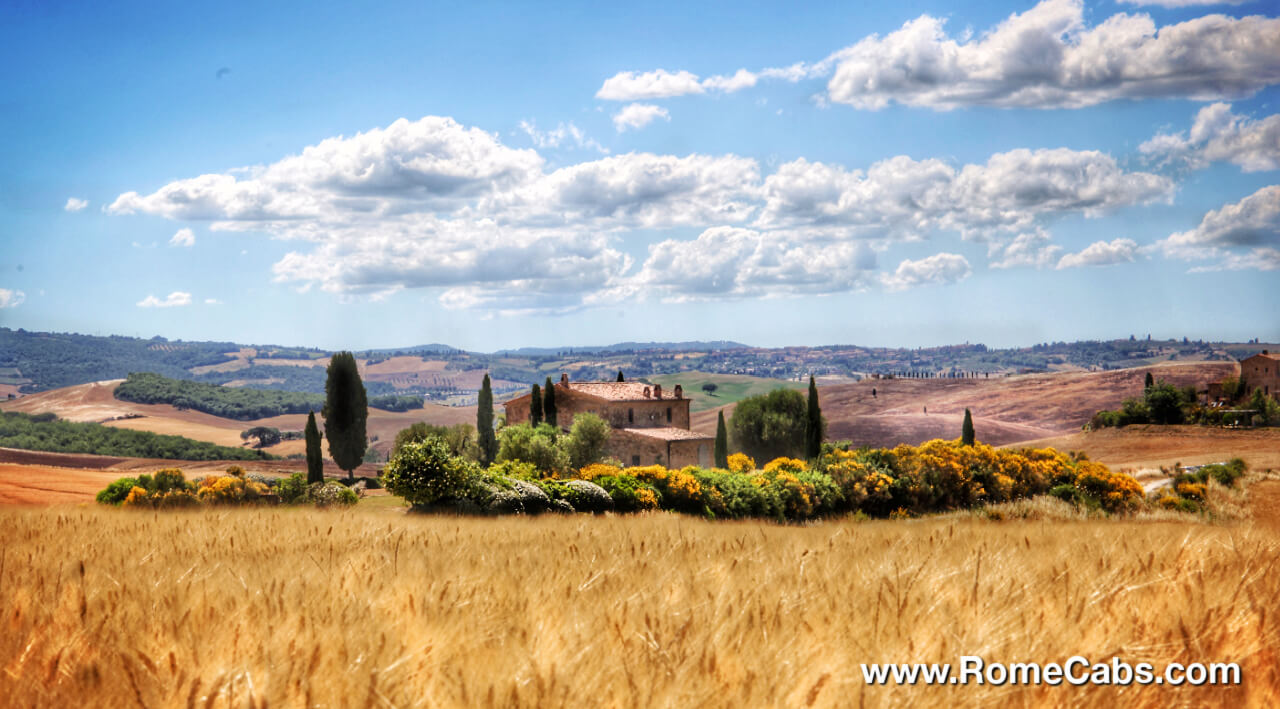
.
.
.
A Journey Through Time: Val d’Orcia’s History
.
Val d’Orcia’s history is a layered narrative that unfolds like the pages of a well-worn novel. From its Etruscan origins to the zenith of Roman influence, the valley has silently observed the ebb and flow of civilizations. But it was in the Middle Ages that Val d’Orcia faced a lull as its agricultural and pastoral pursuits waned, leaving traces of abandonment.
The renaissance of this enchanting valley commenced in the 10th and 11th centuries when economic rejuvenation and political stability breathed new life into the region. Monasteries flourished, the ancient Via Francigena (a significant religious and trade route linking Rome and northern Italy) gained prominence, and villages proliferated under a feudal system.
The 13th and 14th centuries witnessed the rise of the Sienese city-state, which played a pivotal role in shaping the distinctive rural panorama of Val d’Orcia. This lush landscape became a beacon of Renaissance ideals, an ideology that was artfully expressed in a circa 1339 painting by Ambrogio Lorenzetti, displayed in Siena’s Town Hall.
Wealthy Siennese merchants, inspired by their dreams of agricultural prosperity, introduced an innovative land tenure system that spurred productivity. They invested in settlements, constructed fortifications, villas, and churches, and commissioned masterpieces from artists like Giovanni di Paolo and Sano di Petri to encapsulate the Renaissance utopian vision they embodied.
The late 16th century marked the twilight of Siennese influence over Val d’Orcia, causing a gradual decline in its economic importance. Paradoxically, this decline preserved traditional land-use patterns and structures, maintaining the Renaissance aura that continues to grace the landscape today.
.
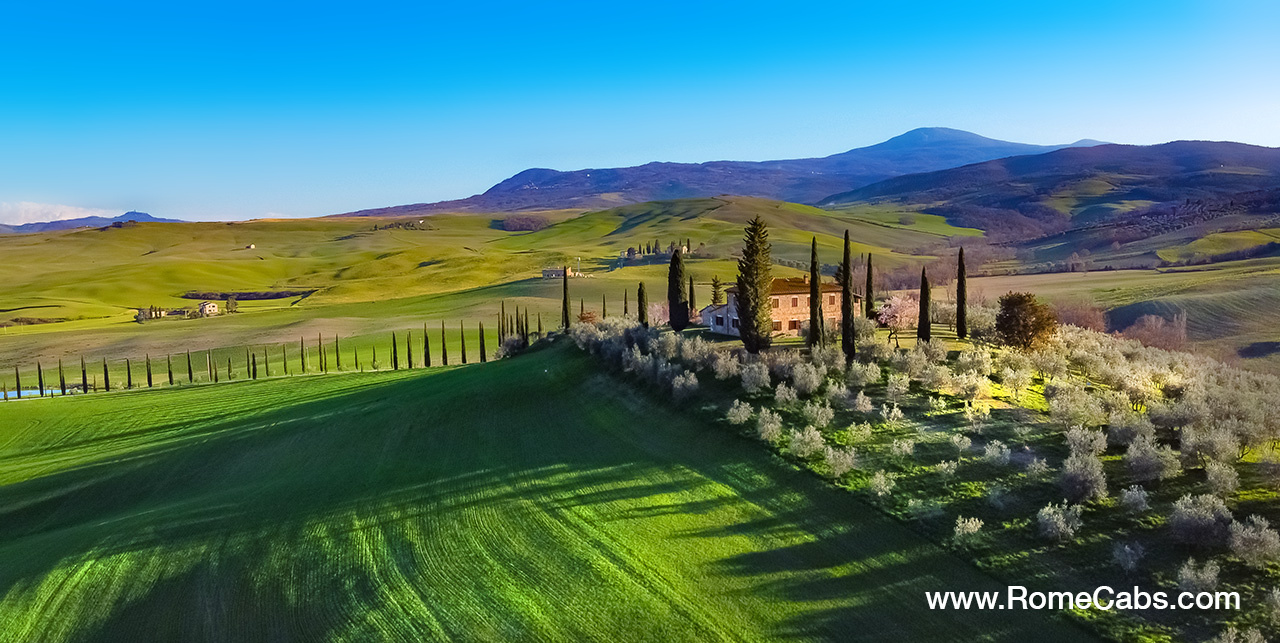
.
.
Val d’Orcia’s UNESCO Designation
.
In 2004, the United Nations Educational, Scientific and Cultural Organization (UNESCO) recognized the cultural and natural significance of Val d’Orcia by designating it as a World Heritage Site. Val d’Orcia is a prime example of a harmonious coexistence between humans and their environment, a place where cultural and natural heritage converge in breathtaking splendor.
The UNESCO designation celebrates the region’s historical agricultural practices, which continue to shape the landscape today. The traditional farming methods, terraced fields, and farmhouses coexist seamlessly with the natural beauty of the valley, creating a unique and harmonious cultural landscape.
.
Exploring Val d’Orcia: What to See and Do in this UNESCO Gem
.
Val d’Orcia’s timeless beauty isn’t just a feast for the eyes; it’s a place that invites you to immerse yourself in its rich culture, indulge in delectable cuisine, and savor the tranquility of rural life. As you venture through this UNESCO-designated landscape, here’s a glimpse of what awaits you in Val d’Orcia.
.
Scenic Drives and Hikes through Val d’Orcia
The winding roads of Val d’Orcia offer some of the most scenic drives in Italy. Cypress-lined avenues, rolling hills, and picture-perfect panoramas make it a paradise for road trippers.
One of the highlights of our Tuscany day tours from Rome is the scenic drive. For hikers and nature lovers, the valley’s terrain is dotted with trails that lead to secluded spots and hilltop vistas.
.

.
.
Explore Charming Tuscan Towns
Val d’Orcia is home to several charming towns, each with its own unique character and historical significance. Today, Val d’Orcia stands as a living testament to the enduring connection between humans and nature and its charming towns reflect the beauty of this region.
.
1. Pienza: The Renaissance Gem
Just a few kilometers from Vitaleta, Pienza is renowned as the “ideal Renaissance town.” This UNESCO World Heritage Site was designed by Pope Pius II and is celebrated for its stunning architecture, including the Cathedral of Santa Maria Assunta and Piazza Pio II. Strolling through its cobbled streets, you’ll discover numerous artisan shops where you can sample Pecorino di Pienza, a sheep’s milk cheese that is a local specialty. The panoramic views from Via del Castello provide breathtaking vistas of the Val d’Orcia countryside, making Pienza a must-see destination.
.
2. Bagno Vignoni: Thermal Baths and Tranquility
A short drive from Vitaleta takes you to Bagno Vignoni, a village famous for its ancient thermal baths. At the heart of the town is Piazza delle Sorgenti, a large pool fed by natural hot springs that has been used for centuries. Although bathing in the central pool is no longer allowed, visitors can relax at the Parco dei Mulini nearby, where you can indulge in the region’s rejuvenating thermal waters. For those who enjoy hiking, Bagno Vignoni also offers scenic trails through the surrounding countryside.
.
.
.
3. San Quirico d’Orcia: A Taste of Medieval Tuscany
Just a stone’s throw from Vitaleta, San Quirico d’Orcia is a quintessential Tuscan village with a rich medieval history. Its highlight is the Collegiata di San Quirico e Giulitta, a Romanesque church with a beautifully detailed portal. Don’t miss the chance to wander through the peaceful Horti Leonini, a 16th-century Italian garden that offers a serene escape. Traditional trattorias in the village serve local delicacies such as pici pasta and Pecorino cheese, perfect for a delicious Tuscan meal.
.
4. Monticchiello: Medieval Charm and Views
Perched on a hilltop, Monticchiello is a quiet medieval village offering stunning panoramic views of the Val d’Orcia. Its narrow stone streets, lined with ancient houses, lead to the Church of Santi Leonardo e Cristoforo, which dates back to the 13th century. Monticchiello is also famous for its community-run Teatro Povero, where locals have been performing plays for decades, offering an authentic glimpse into rural Tuscan life. It’s a peaceful retreat compared to the busier towns nearby.
.
.
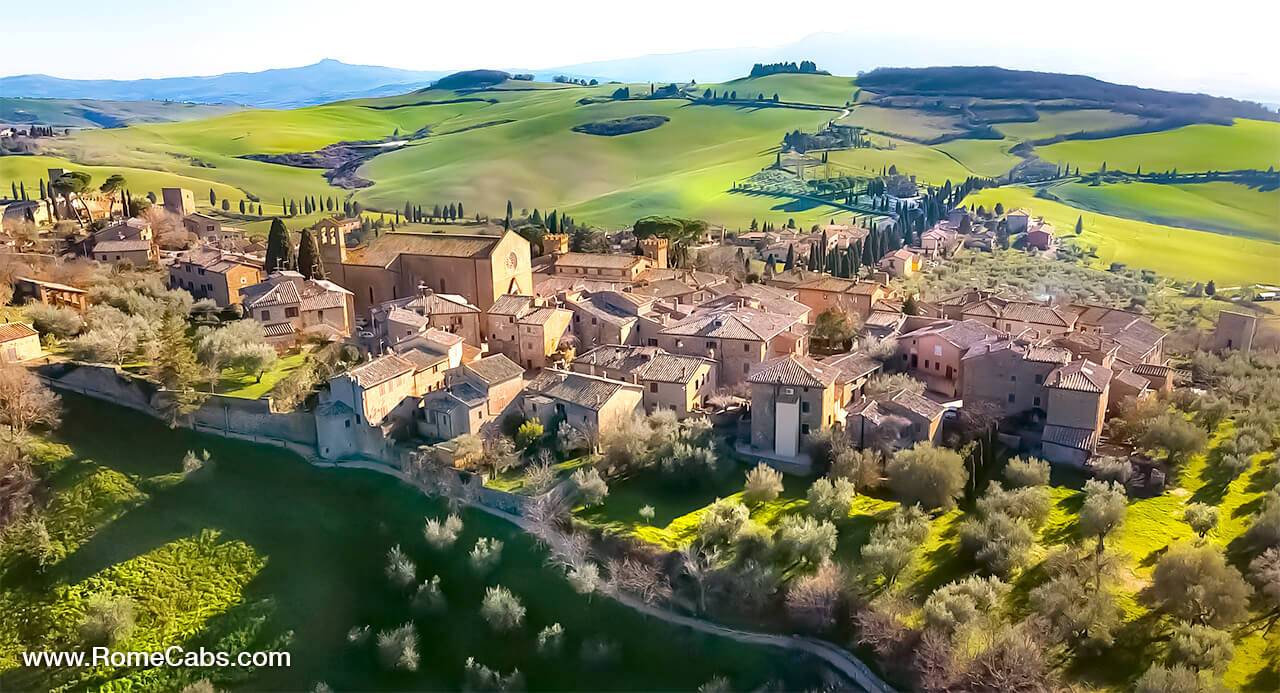
.
.
5. Montalcino: Home of Brunello
A short drive from Vitaleta brings you to Montalcino, a medieval hilltop town renowned for its world-famous Brunello di Montalcino wine. The town is dominated by the imposing Rocca di Montalcino, a fortress offering breathtaking views of the surrounding vineyards and rolling hills. Montalcino is a wine lover’s paradise, with numerous wineries and tasting rooms where you can sample the region’s exceptional wines. Beyond its wine culture, Montalcino offers charming piazzas, churches, and cafes where visitors can soak in the Tuscan atmosphere.
.
6. Hiking to Cappella della Madonna di Vitaleta
If you want to experience the landscape of Val d’Orcia up close, hiking to the Chapel of Vitaleta is a must. Starting from San Quirico d’Orcia or Pienza, you can follow scenic paths through the Tuscan hills. As you approach the chapel, the sight of its iconic silhouette framed by cypress trees will take your breath away. This immersive hike allows you to explore the Tuscan countryside at a leisurely pace, offering a deeper connection to the area’s natural beauty.
.
.

..
.
7. The Chapel of Vitaleta
The Chapel of Vitaleta, nestled among the rolling hills of Val d’Orcia, is one of Tuscany’s most iconic and picturesque landmarks. Framed by cypress trees and surrounded by sweeping landscapes, this small yet striking chapel embodies the timeless beauty of the region. Located between San Quirico d’Orcia and Pienza, the chapel’s serene and isolated setting makes it a favorite among photographers and travelers seeking a peaceful connection to Tuscany’s countryside. Its simple yet elegant design stands as a testament to the area’s deep historical and cultural heritage, making Vitaleta a must-see destination for anyone exploring Val d’Orcia.
.
Savor Tuscan Culinary Delights
Tuscany’s culinary heritage is a reflection of its rich agricultural landscape, and Val d’Orcia offers a true taste of the region’s bounty. A visit to the area wouldn’t be complete without sampling the famed Pecorino di Pienza, a prized sheep’s milk cheese that ranges from soft and mild to aged and tangy, depending on how long it matures. Many local shops and markets in Pienza offer tastings, allowing you to appreciate the unique flavors of this renowned cheese.
In addition to Pecorino, the region is known for its rich dishes featuring wild truffles, which are often paired with handmade pasta, such as pici, or used to enhance succulent meat dishes. You can enjoy these specialties at family-owned trattorias scattered throughout the countryside, where the recipes are passed down through generations. Pair your meal with local olive oil and fresh, seasonal ingredients, such as roasted vegetables or hearty soups like ribollita, for a complete Tuscan dining experience. Every dish in Val d’Orcia is a celebration of simple, authentic flavors that tell the story of the region’s deep culinary traditions.
.
.

.
.
Wine Tasting in Tuscany
No trip to Val d’Orcia is complete without experiencing the world-class wines that have put Tuscany on the global map. Just a short drive from Vitaleta lies Montalcino, home to the legendary Brunello di Montalcino, one of Italy’s most prestigious wines. Wine enthusiasts can explore the region by booking a Wine Tasting Tour in Tuscany, where local vineyards open their doors to offer guided tours of their estates and cellars.
Here, you’ll learn about the meticulous winemaking process behind Brunello and other regional wines, such as Rosso di Montalcino and Vino Nobile di Montepulciano. Stroll through lush vineyards while sipping on wines that reflect the unique terroir of the area, with views stretching across the vine-covered hills and rolling countryside.
Many wineries also offer tastings paired with local Tuscan specialties like salumi, aged cheeses, and artisanal breads, giving you a true farm-to-table experience. Whether you’re a seasoned oenophile or a casual wine lover, a visit to the wineries of Val d’Orcia offers an unforgettable immersion into Tuscany’s celebrated wine culture.
.
.
.
..

.
.
Relaxation and Tranquility in Val d’Orcia
Above all, Val d’Orcia is a place to unwind and reconnect with the simple pleasures of life. Whether you choose to sit under the shade of a cypress tree, sip wine as you watch the sunset, or simply breathe in the clean country air, Val d’Orcia invites you to embrace serenity and tranquility.
Val d’Orcia is a place where time takes a different shape, where nature and culture harmonize, and where history whispers in the wind. It is a landscape that epitomizes the very essence of Tuscany’s beauty and heritage.
The UNESCO designation acknowledges not only the valley’s natural beauty but also the rich cultural history that has shaped it. As you wander through the picturesque towns, hike the rolling hills, and savor the flavors of the region, you become a part of Val d’Orcia’s ongoing story—an enchanting narrative that has unfolded for centuries and will continue to captivate all who visit this timeless UNESCO landscape in Tuscany.
* Find us online also on:
Rome Cabs Flickr Photo Gallery


 RomeCabs Transfers and Tours in Italy (Rome Cabs)