The Lake of Piazza Navona: A 200-Year Tradition You Never Imagined
Buongiorno and welcome to RomeCabs Rome Travel Blog! Today, Piazza Navona is known for its beautiful Baroque fountains, bustling cafés, and lively street performances. But did you know that this iconic square was once transformed into a lake during the summer months? Yes, the “Lago di Piazza Navona” ( Lake of Piazza Navona) was an extraordinary tradition that turned the square into a shallow lake where Romans of all social classes gathered to cool off, celebrate, and make memories.
This fascinating custom began in the 17th century under Pope Innocent X, who, along with his powerful sister-in-law Donna Olimpia Maidalchini, envisioned a revitalized Piazza Navona that could serve as a grand public space for both nobility and commoners. In the spirit of Roman creativity and celebration, Innocent X introduced a summer spectacle unlike any other in Europe.
How The Lake of Piazza Navona Began: A Pope’s Grand Vision
In the mid-1600s, Piazza Navona was a shadow of its former glory. Although it had once been the site of Emperor Domitian’s massive stadium for athletic games, by the Middle Ages, it had become a simple public space used mainly during Carnival. For the rest of the year, it was often neglected, littered with debris from the city’s markets.
Pope Innocent X, who had a family palace built nearby, saw an opportunity to turn Piazza Navona into a symbol of the Baroque splendor he envisioned for Rome. On June 23, 1652, he inaugurated the first “Lago di Piazza Navona” at the suggestion of his sister-in-law, Donna Olimpia, a formidable figure in Rome’s political and social circles. The idea was simple but brilliant: by blocking the drains of the square’s central fountain, the entire area could be flooded, transforming it into a shallow lake.
And so, each weekend in August, the heart of Rome became a “lake” where Romans would gather to enjoy music, cool off, and celebrate together—a perfect escape from the summer heat.
The Lake of Piazza Navona Comes to Life: A Roman Spectacle
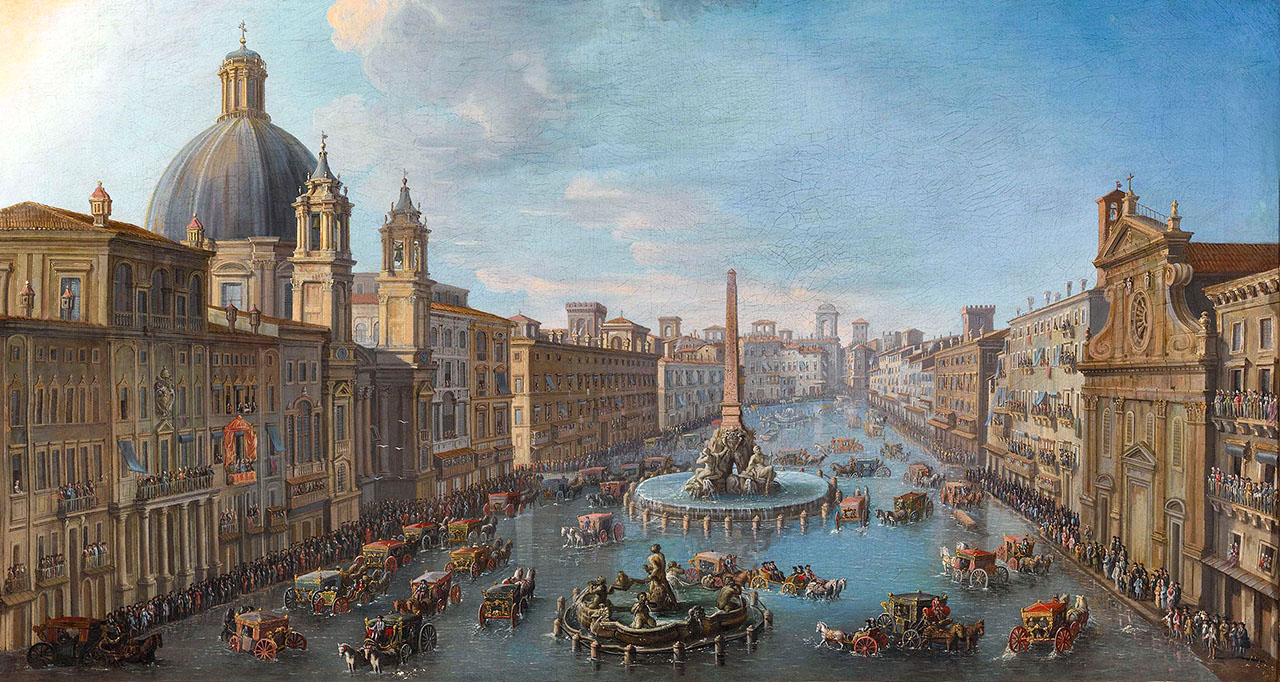
On Saturdays and Sundays, Romans would flock to Piazza Navona to enjoy the artificial lake that transformed the square. The scene was lively and festive, with musical performances adding to the ambiance. Nobles arrived in grand carriages, while children splashed around, and families picnicked by the water’s edge.
But the Lake of Piazza Navona was more than just a place to cool off. It became a social and cultural event where the city’s aristocrats showcased their creativity. Some families went all out, commissioning elaborate carriages shaped like gondolas or ships made of wood and papier-mâché.
These vessels, complete with sails and rowers, sailed across the “lake” to the delight of spectators. Imagine the thrill of watching gondolas gliding through the heart of Rome—a scene that would be unimaginable today!
How Piazza Navona Kept Its Waters Under Control
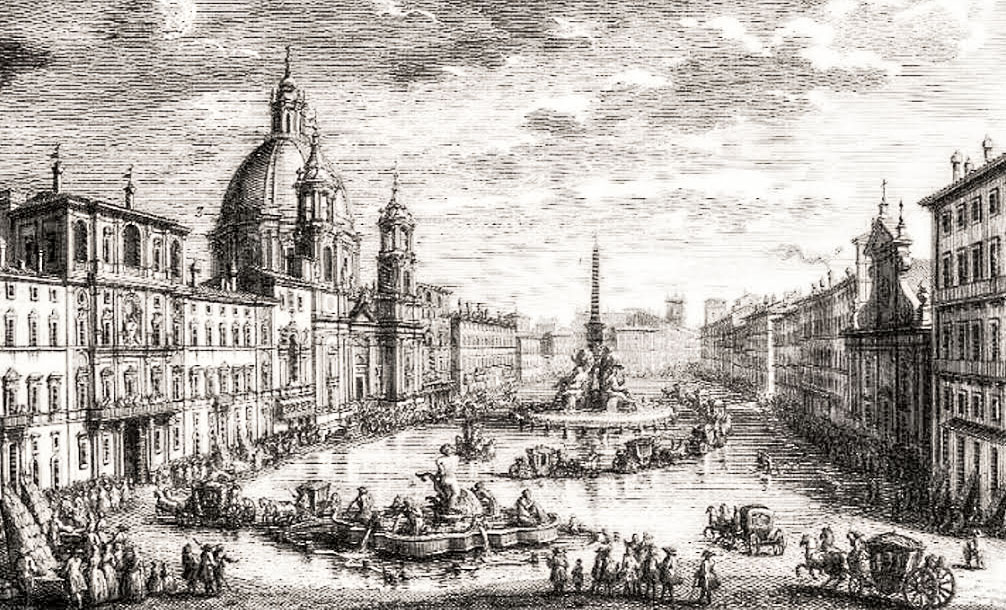
One of the most fascinating aspects of the Lake of Piazza Navona was the engineering behind its containment. Despite filling an entire Roman piazza with water, organizers managed to keep the artificial lake within the boundaries of the square, preventing it from spilling into surrounding streets or homes. Here’s how they achieved this feat of water control in the heart of the city:
Utilized the square’s concave design: Piazza Navona’s original layout, inherited from the ancient Stadium of Domitian, played a crucial role. The piazza was constructed with a gentle concave shape, meaning its center was slightly lower than the edges. This natural dip acted as a basin, helping to contain the water safely within the confines of the square.
They blocked drainage points: To create the lake effect, event organizers would temporarily block the drainage outlets of the central fountains. Without an outlet, water slowly accumulated across the piazza, eventually creating a shallow “lake.” This method allowed them to flood the area to a controlled depth of around 50 centimeters (1.5 feet)—enough to cover the square’s surface without reaching the height needed to overflow.
Controlled depth limit: The water level was carefully monitored to avoid excessive depth. By keeping the water shallow, the organizers could create the lake effect while ensuring that water stayed comfortably within the edges of the square, preventing it from spilling out into the surrounding streets.
The Lake was temporary and supervised: The Lake of Piazza Navona was a brief summer event, taking place on certain weekends in August. Organizers closely supervised water levels, and once the festivities were over, the drains were unblocked, allowing the water to recede gradually. Within a short time, the piazza would return to its regular state, ready to welcome vendors, locals, and visitors again.
With these simple yet effective techniques, the Lake of Piazza Navona became a spectacular, controlled display that captured the public’s imagination and demonstrated the ingenuity behind Rome’s festive traditions.
Fun and Follies of Lake of Piazza Navona
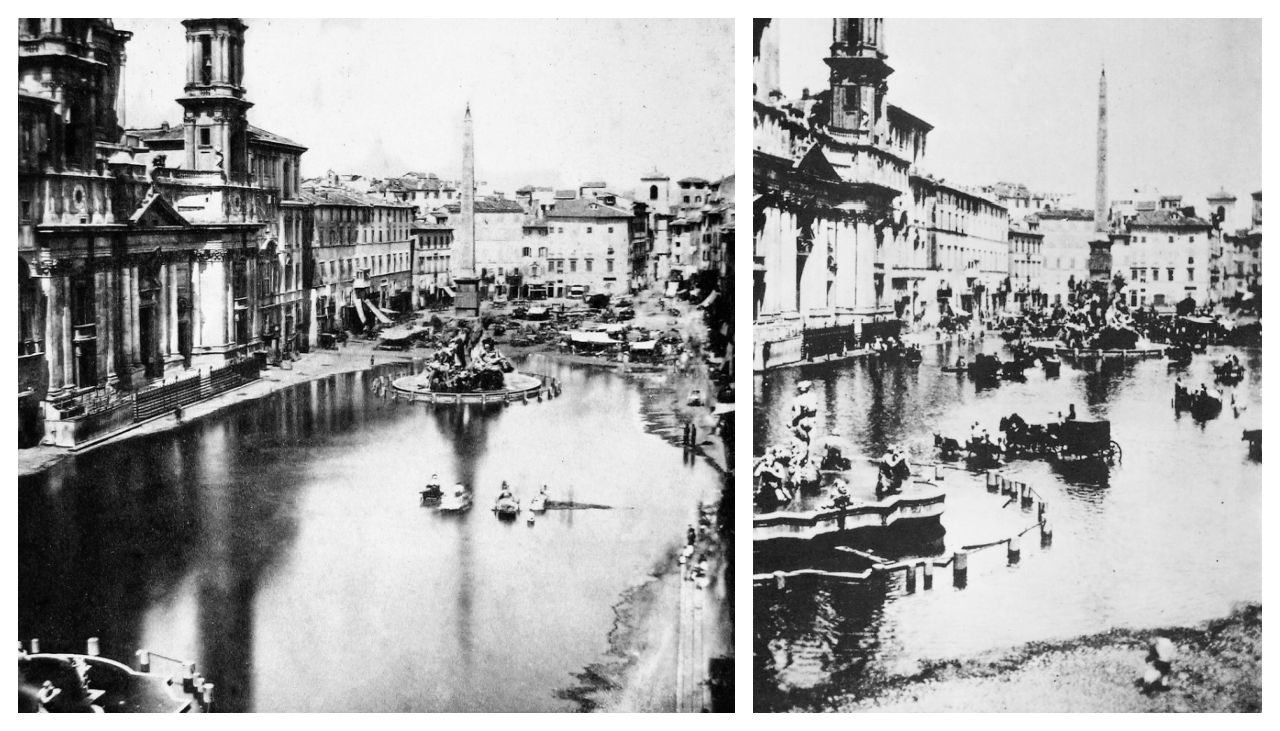
The Lake of Piazza Navona brought together people from all walks of life, creating an atmosphere of shared enjoyment and lighthearted mischief. Young men and women took the opportunity to mingle, court, and make memories in a setting as playful as it was picturesque. Even children and commoners joined in, splashing in the water, playing games, and pulling pranks.
Some legends have survived the centuries, adding to the lake’s mystique. One famous story tells of how, in 1717, several noblewomen, “perhaps heated by wine,” decided to shed their outer garments and take a spontaneous dip. Their merriment took a dangerous turn when they nearly drowned, saved only by bystanders who heroically dove in fully clothed to pull them to safety.
Another tale tells of a marquis whose horse accidentally drowned after one of its legs got stuck in a submerged hole. These stories, though likely exaggerated, captured the public’s imagination and added to the lake’s legendary status. Some accounts even claimed that the water reached a depth of over a meter, though historical evidence suggests it was likely no more than half a meter deep.

Health Concerns, Suspensions, and Revivals
Despite its popularity, the Lake of Piazza Navona was not without its controversies. In 1676, the tradition was temporarily halted due to fears that stagnant water in the square might lead to “bad air” or miasma, which was believed to cause illness. This concern wasn’t unusual; in the pre-modern world, stagnant water was often linked to poor health.
The lake was brought back in 1703 to honor Queen Maria Casimira of Poland, who was visiting Rome. At the time, the pope’s personal physician, Giovanni Maria Lancisi, assured Pope Clement XI that there were no health risks associated with the lake. That summer, Prince Giovanni Battista Pamphilj, a descendant of Innocent X, famously entered the water in a gilded gondola, adding even more splendor to the festivities.

The Lake’s Decline and Last Hurrah
By the 19th century, Rome was changing rapidly, and Piazza Navona’s days as a lake were numbered. When the city became the capital of the newly unified Kingdom of Italy, the square’s layout was modified, including the addition of sidewalks and raised areas. These changes made it more difficult to flood the piazza, and public attitudes shifted as well. The last recorded Lake of Piazza Navona event took place in 1865, marking the end of an era.
Though the lake tradition faded away, Piazza Navona continued to be a place of public gatherings and entertainment. In the early 20th century, another popular event, the “gioco della cuccagna”, took place here in May. Participants would attempt to climb a slippery pole with prizes at the top—a playful reminder of the square’s festive spirit.
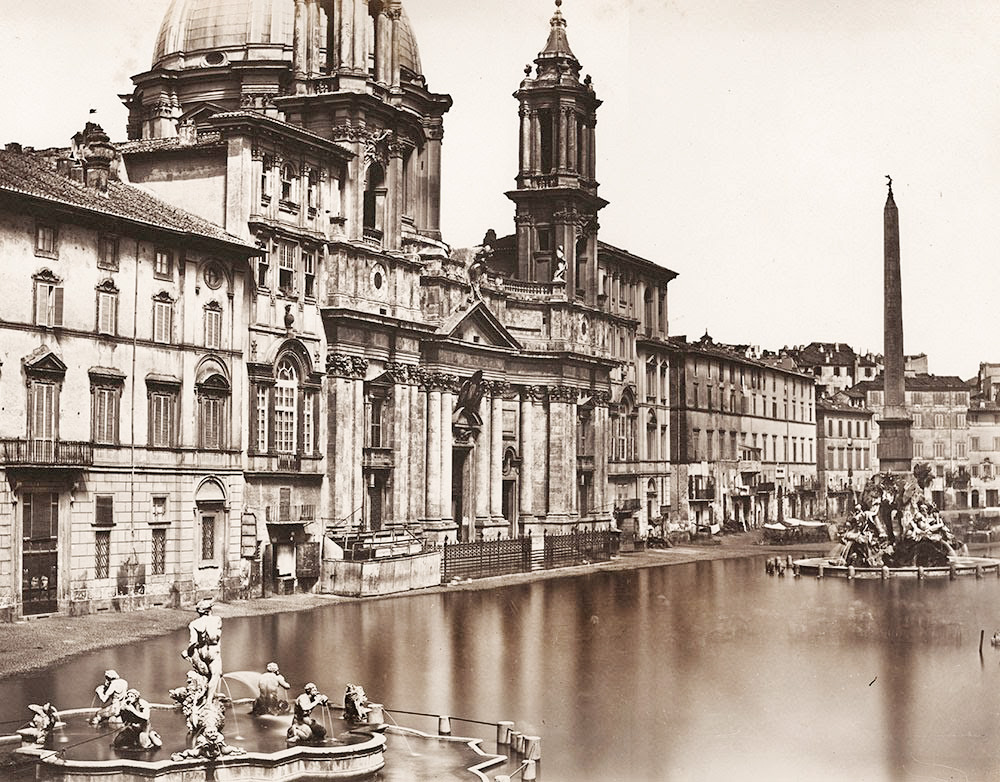
Piazza Navona: Still the Timeless Square in Rome
The Lake of Piazza Navona may be a thing of the past, but its legacy lives on in the joyful and communal spirit that still defines the square today. Now, visitors gather to admire the Fontana dei Quattro Fiumi (Fountain of the Four Rivers), enjoy a coffee at a nearby café, or watch street performers entertain the crowds. Though the lake is gone, Piazza Navona remains a cultural heart of Rome, where history, art, and daily life converge.
Imagine what it must have been like to see carriages shaped like gondolas floating in the middle of Rome, or children splashing around while music filled the air. Piazza Navona’s lake was more than an unusual event—it was a celebration of life, community, and creativity, qualities that still make Rome enchanting today.
So, next time you find yourself in Piazza Navona, take a moment to picture the lake that once filled this iconic square. While the water is gone, the magic of Rome’s “lost lake” remains, as vibrant as ever.
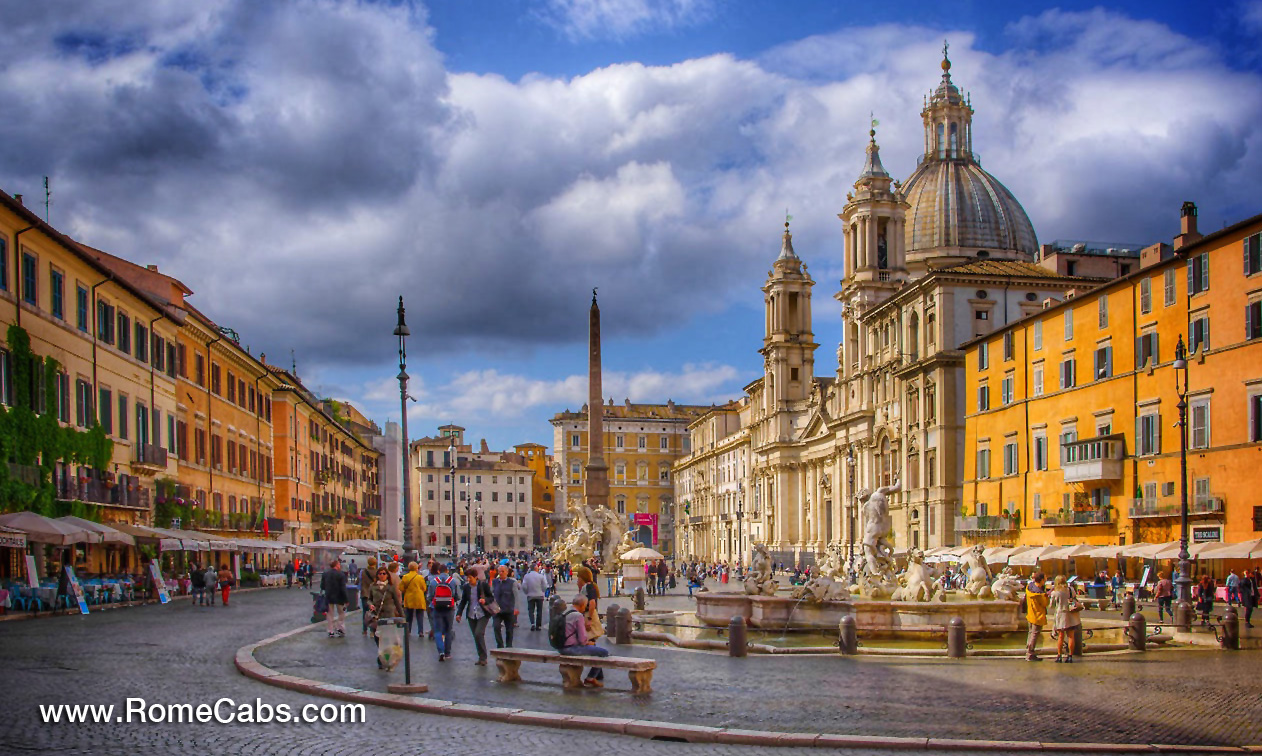
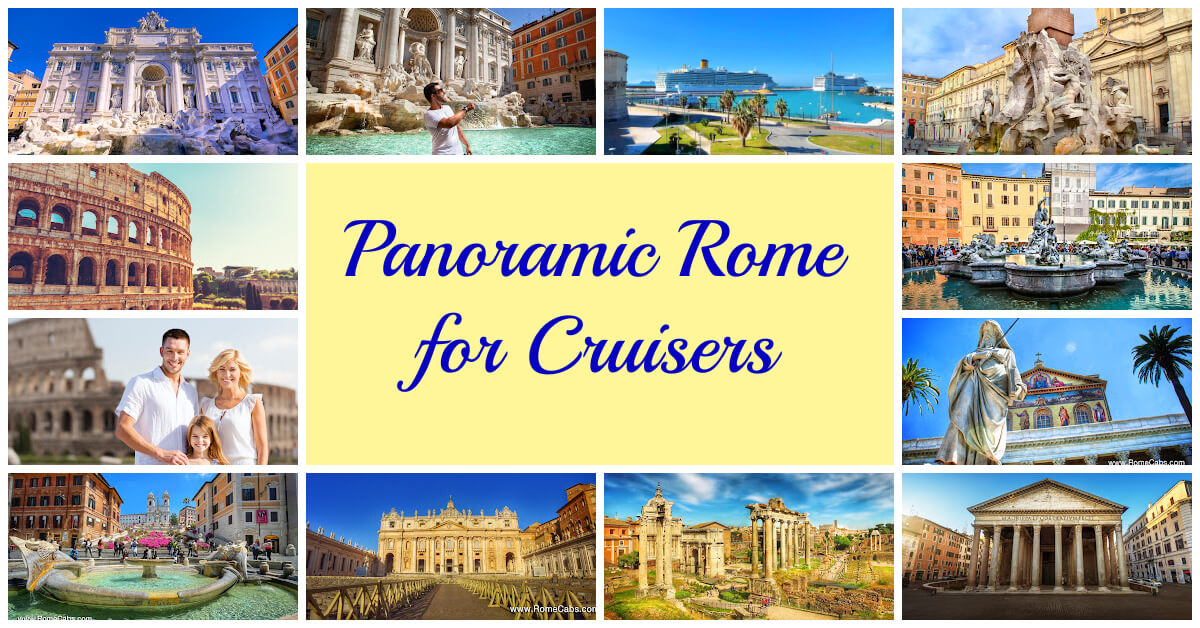
RomeCabs’ Rome Tours by Car & Shore Excursions from Civitavecchia
to Piazza Navona
Exploring Rome’s treasures, including the iconic Piazza Navona, is effortless with RomeCabs. RomeCabs’ Rome Tours by Car provide a comfortable and luxurious way to discover the Eternal City, complete with an English-speaking driver who ensures a seamless and informative experience. RomeCabs’ Rome tours by car are designed to help you make the most of your time in Rome.
For cruise passengers, RomeCabs’ Shore Excursions from Civitavecchia include a memorable visit to Piazza Navona. After enjoying the scenic drive from the port, you’ll have the opportunity to immerse yourself in the vibrant history and architecture of Rome including a stop to Rome’s most famous squares.
RomeCabs Customer Reviews from real customers:
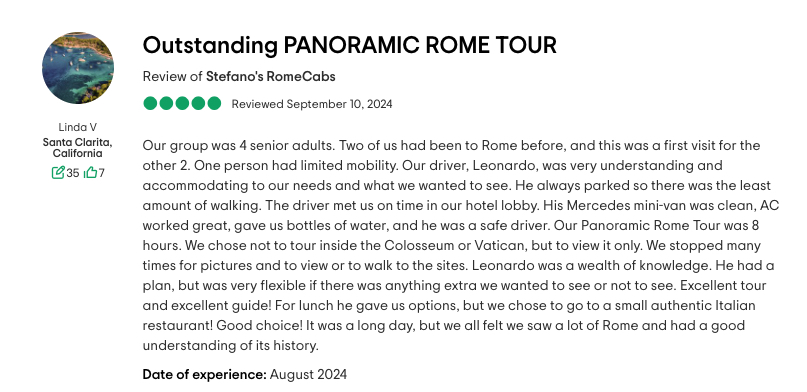
Linda V from Santa Clarita, California wrote:
Outstanding PANORAMIC ROME TOUR
Our group was 4 senior adults. Two of us had been to Rome before, and this was a first visit for the other 2. One person had limited mobility. Our driver, Leonardo, was very understanding and accommodating to our needs and what we wanted to see. He always parked so there was the least amount of walking. The driver met us on time in our hotel lobby. His Mercedes mini-van was clean, AC worked great, gave us bottles of water, and he was a safe driver. Our Panoramic Rome Tour was 8 hours. We chose not to tour inside the Colosseum or Vatican, but to view it only. We stopped many times for pictures and to view or to walk to the sites. Leonardo was a wealth of knowledge. He had a plan, but was very flexible if there was anything extra we wanted to see or not to see. Excellent tour and excellent guide! For lunch he gave us options, but we chose to go to a small authentic Italian restaurant! Good choice! It was a long day, but we all felt we saw a lot of Rome and had a good understanding of its history.
Date of experience: August 2024
Robert S from Tennessee wrote:
Excellent does not begin to describe Romecabs
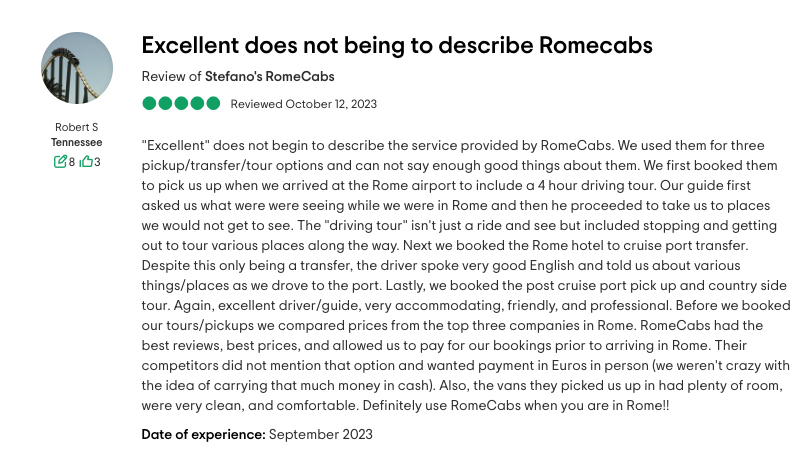
“Excellent” does not begin to describe the service provided by RomeCabs. We used them for three pickup/transfer/tour options and can not say enough good things about them. We first booked them to pick us up when we arrived at the Rome airport to include a 4 hour driving tour. Our guide first asked us what were were seeing while we were in Rome and then he proceeded to take us to places we would not get to see. The “driving tour” isn’t just a ride and see but included stopping and getting out to tour various places along the way. Next we booked the Rome hotel to cruise port transfer. Despite this only being a transfer, the driver spoke very good English and told us about various things/places as we drove to the port. Lastly, we booked the post cruise port pick up and country side tour. Again, excellent driver/guide, very accommodating, friendly, and professional. Before we booked our tours/pickups we compared prices from the top three companies in Rome. RomeCabs had the best reviews, best prices, and allowed us to pay for our bookings prior to arriving in Rome. Their competitors did not mention that option and wanted payment in Euros in person (we weren’t crazy with the idea of carrying that much money in cash). Also, the vans they picked us up in had plenty of room, were very clean, and comfortable. Definitely use RomeCabs when you are in Rome!!
* Find RomeCabs online also on:
- RomeCabs Facebook: https://www.facebook.com/RomeCabsToursAndTransfers
- RomeCabs Pinterest: https://www.pinterest.it/romecabs
- RomeCabs Twitter: https://twitter.com/RomeCabs
- RomeCabs Instagram: https://www.instagram.com/romecabs/
- RomeCabs Flickr Photos: https://www.flickr.com/photos/romecabs/
- RomeCabs Recommended on Cruise Critic
Tips for Civitavecchia Transfers, Rome Tours & MORE on RomeCabs Travel Blog


 RomeCabs Transfers and Tours in Italy (Rome Cabs)