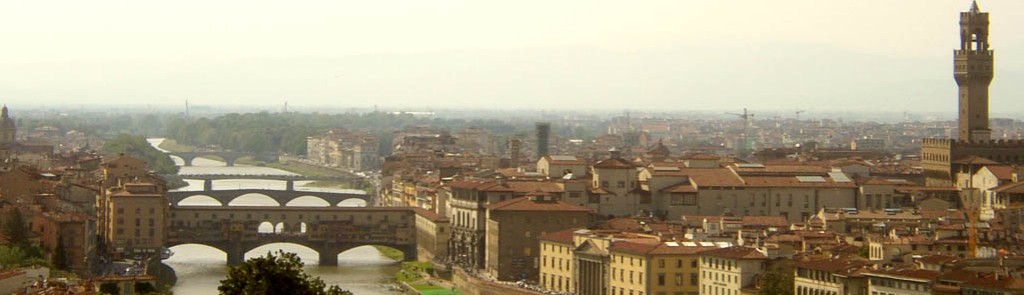
A Day in Assisi in the Middle Ages: The World of Saint Francis
This imagined depiction of a day in Assisi in the Middle Ages and the words of Saint Francis is a creative interpretation based on historical context. While it aims to portray a day in Medieval Assisi during the early 1200s and Francis’s teachings, specific details and dialogues are reconstructed and may not reflect actual events or precise historical accuracy. Images are imagined sceneries for story-telling purposes and may not be historically accurate. This narrative is intended to illuminate a day in year 1210
The year is 1210, and the sun rises over the hills of Umbria, casting a golden light over the stone city of Assisi. High above the valley, the town clings to the slopes of Mount Subasio, its limestone buildings glowing softly in the morning air. Assisi is much smaller than the sprawling cities of today, but it is a bustling hub of medieval life. This is the home of Saint Francis, a man who has just begun to shake the foundations of society with his radical ideas of poverty, humility, and devotion.
This is a day in the life of Assisi during the Middle Ages, a time of transformation, faith, and simplicity.
Dawn in Assisi in the Middle Ages
As the first pale light of dawn begins to filter through the mist, Assisi awakens slowly, its streets still cloaked in the quiet of early morning. The soft hues of the town—gray and pink stone, rough and weathered—seem to glow faintly in the delicate light, as though the ancient city itself is stretching after a long night. The cobbled streets, worn smooth by the feet of countless generations, lie empty, their stillness broken only by the occasional echo of a distant rooster.
In the heart of the town, the Piazza del Comune stands silent, a place where history and daily life intersect. The towering Temple of Minerva, once a grand symbol of Rome’s glory, looms in the soft light, its six Corinthian pillars casting long shadows across the square. It feels ancient, watching over the town as it has for centuries, yet its purpose has changed. Now a church, dedicated to the Virgin Mary, it’s a testament to the way Assisi has embraced both the past and the present, melding pagan and Christian legacies into something new. But this morning, it stands empty, the marble cool to the touch, as if waiting for the day to begin.
A figure appears in the square—Pietro, a local craftsman, on his way to his workshop. His footsteps echo faintly as he walks, the cobblestones beneath his feet cool and damp from the morning dew.
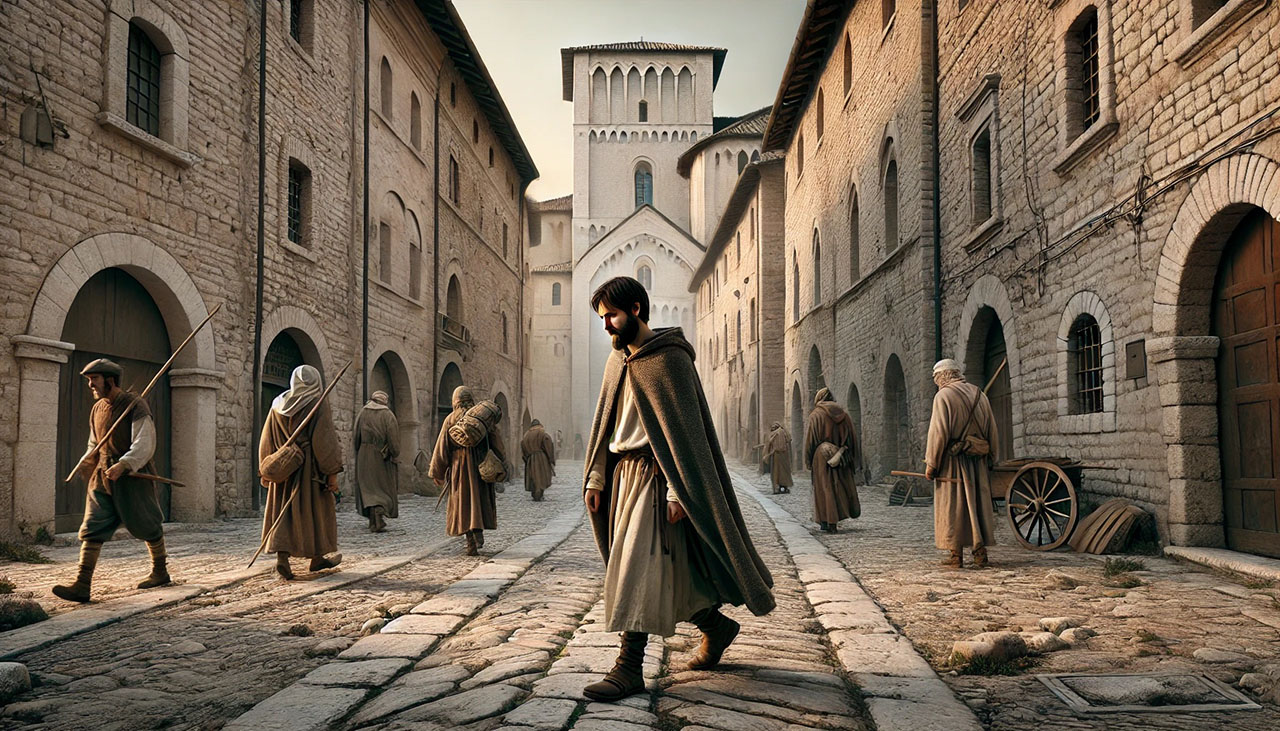
As he passes the temple, Pietro looks up, remembering how, just a decade ago, the town rose up and destroyed the Rocca Maggiore, the once-menacing fortress where Duke Corrado of Lutzen ruled with a heavy hand. The fortress had symbolized imperial power, oppressive and distant, until the townsfolk brought it down in a burst of rebellion. Now, with the communal government in place, there is a sense of self-determination, though the tension between the Guelphs and Ghibellines—supporters of the Pope and the Empire—simmers beneath the surface.
As Pietro walks on, the air is scented with the woodsmoke from nearby hearths. Around him, a few peasants are already up and about, moving quietly through the streets in their simple woolen cloaks. Their faces, lined and weathered, tell stories of long days in the fields, of harsh winters and brief summers. They walk with purpose, heading beyond the walls of the town to begin their day of labor, the tools slung over their shoulders clinking faintly as they pass.

The streets begin to stir as more townsfolk emerge from their homes. Women sweep doorways, sending faint clouds of dust into the cool morning air, while shopkeepers raise the shutters on their stalls, preparing for the day’s business. From a nearby alley, the low murmur of Benedictine monks can be heard, their chants drifting softly on the breeze as they begin their morning prayers in the chapel. Pietro glances toward the communal courthouse, housed in part of the ancient temple. Here, the Capitano del popolo will soon take his seat, overseeing the affairs of the town, and ensuring that the will of the people is carried out.
As Pietro nears the edge of the town, the Roman walls come into view, their stonework still standing firm after centuries. These walls, once the boundary of the town, now seem almost too small to contain the growing life of Assisi. Beyond them, the fields stretch out under the rising sun, waiting for the peasants and farmers to sow and harvest, just as their ancestors did.
Morning Mass at Cathedral of San Rufino
The golden light of dawn illuminated the cobblestones beneath his feet as he walked toward the Cathedral of San Rufino. Though Pietro had always been a man of habit, today felt different—an inexplicable sense of weight hung in the air. The morning was cool, with a faint breeze carrying the lingering smell of dew on stone and the earthy scent of the previous night’s rain.
Ahead of him, the cathedral stood, a silent sentinel to centuries of faith. Pietro joins the steady stream of townsfolk making their way toward the Cathedral of San Rufino. The air inside is rich with the mingling scents of beeswax candles and incense, the aroma weaving through the stone arches and ancient frescoes. The priest, clad in simple yet ornate vestments, begins the Latin prayers, his voice resonating softly through the cathedral. Pietro bows his head, joining in the collective devotion of the congregation.

The priest, clad in simple yet ornate vestments, leads the congregation in Latin prayers. His voice reverberates gently through the cathedral, merging with the murmurs of devotion from the gathered townspeople. Amid the sea of worshippers, a young man stands out with his humble appearance—dressed in a tattered robe cinched with a simple rope belt.
Despite his tattered attire, this figure exudes a profound serenity that seems to transcend the ordinary. As he kneels on the cold, uneven floor, his posture reflects deep reverence and devotion. His choice to live a life of voluntary poverty contrasts sharply with the more elaborately dressed congregation, underscoring his commitment to humility and service.
As the Mass concludes, the townsfolk slowly begin to disperse, their footsteps echoing softly through the cathedral’s sacred space. The cathedral, now emptying, returns to its tranquil state, a silent witness to the profound choices that shape the lives of those who enter its doors.
A Day in Medieval Assisi
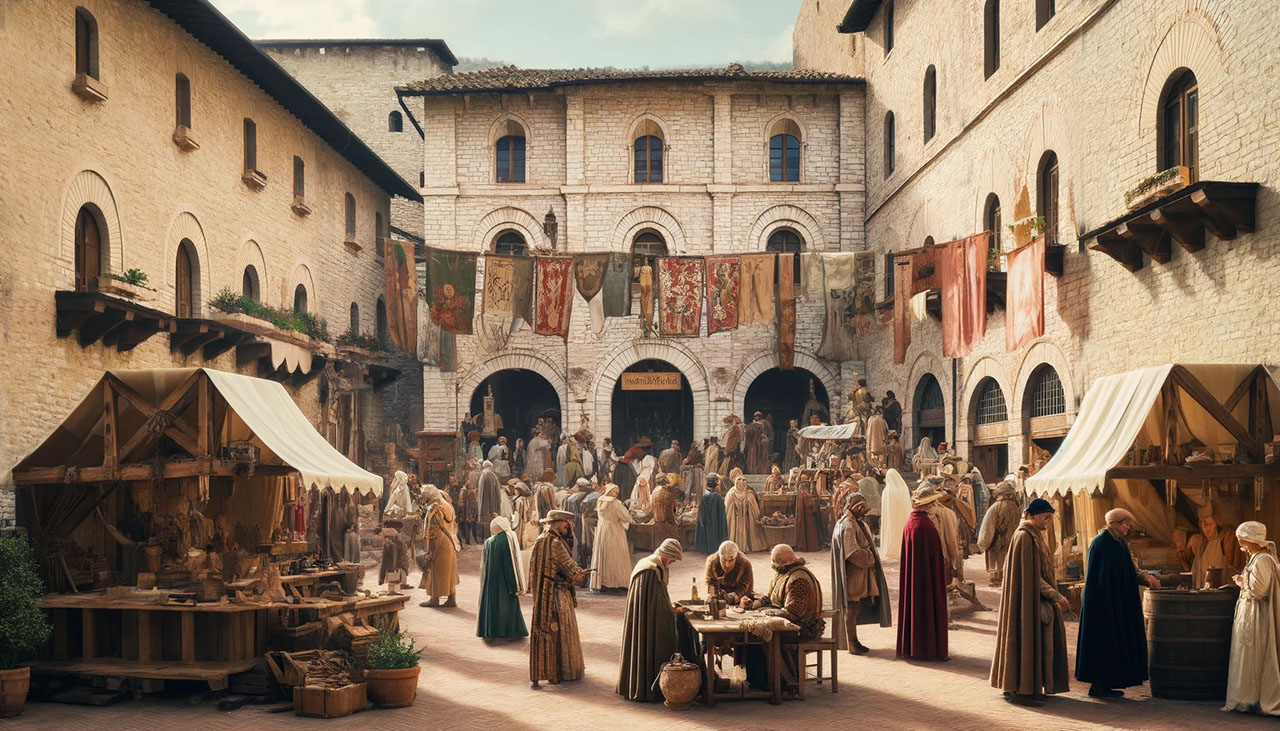
Pietro steps out of the church and makes his way to the nearby Piazza del Comune. The square, now fully awakened, is alive with the energy of the market. Merchants, their faces flushed with the effort of setting up, arrange their wares with practiced efficiency. The rhythmic clinking of coins and the spirited bartering of voices blend into a lively symphony, punctuated occasionally by the neighing of horses tethered to wooden posts.

The marketplace is a feast for the senses. The air is filled with the aroma of fresh bread baking, mingling with the sharp scents of cured meats and pungent cheeses. As he navigates the market, the earthy notes of basil and thyme from herb vendors blend seamlessly with the sweet fragrance of ripe, sun-kissed fruits.
The blacksmith’s forge, just a short walk away from the square, sends out rhythmic clangs that punctuate the market’s background hum. The heat and metallic scent of his work mingle in the nearby streets, a testament to the craftsmanship that supports the town’s daily life.
Similarly, the potter’s shop, a little off the main thoroughfare, showcases expertly crafted vessels. The soft thud of clay being shaped and the steady spin of the wheel create a rhythmic background to the potter’s art. Though not directly in the square, their presence is felt through the fine wares displayed by market vendors.
A Chance Encounter with Francis
After purchasing a loaf of freshly baked bread and a wheel of cheese from the market, Pietro tucks his purchases securely under his arm and begins making his way through the bustling streets of Assisi towards his workshop. The town is alive with activity, but amidst the clamor, Pietro’s attention is drawn to a figure who stands apart from the usual flurry of merchants and townsfolk.
Francis of Assisi, clad in a threadbare robe and walking barefoot, stands at the edge of a vegetable stall. His simplicity contrasts sharply with the richly dressed townsfolk moving about their business. Instead of commanding a raised platform, he engages with small, gathered groups, his voice rising gently above the din of the marketplace.
“Dear friends,” Francis’s voice carries a soothing warmth, “look around you at the wonders that surround us. Observe the olive trees, steadfast and enduring through the harshest winters. They weather the cold and storms, yet they yield their fruit when the season is right. Their resilience teaches us a sacred truth.”
Francis gestures toward the distant olive groves, their gnarled branches and vibrant leaves framed by the soft morning light. His message is delivered with a serene intensity that captivates those who pause to listen.
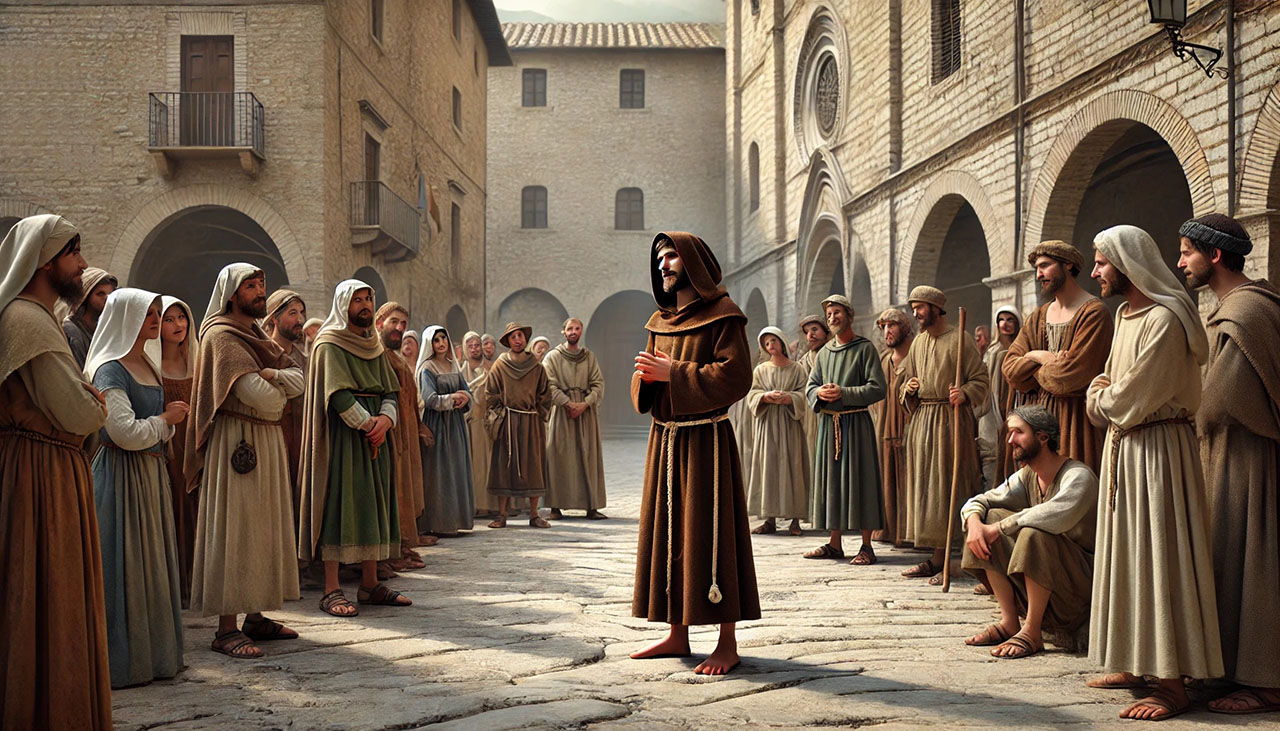
“Just as the olive tree stands firm, so must we remain steadfast in our love and service to one another. Life will present us with trials—famine, disease, and the bitter cold of hardship. Yet, if we root ourselves in love and compassion, we will bear fruit in the form of peace and joy, both for ourselves and for those around us.”
He continues, his tone gentle yet impassioned, “True contentment does not lie in the wealth of the world or in the splendor of our possessions. It is found in the simple acts of kindness we offer to each other. It is found in moments of gratitude for our blessings, however modest.”
Francis pauses, allowing his words to resonate. The crowd, a mixture of peasants, artisans, and traders, listens attentively, their usual concerns momentarily forgotten.
“Imagine,” Francis says softly, “a life where we measure our worth not by the riches we amass, but by the love we share. Envision a community where each person is valued and every act of kindness contributes to the whole. This is the life to which we are called—a life of humility and service. By embracing simplicity, finding joy in humble moments, and serving one another with open hearts, we serve Christ himself. In this simplicity, we draw closer to the essence of our faith.”
As Pietro observes, he sees the impact of Francis’s presence. The crowd’s faces reflect a deep contemplation, their usual preoccupations momentarily set aside. Francis’s simple, profound message transforms the atmosphere, offering a vision of a life imbued with purpose and grace.
With a renewed sense of reflection, Pietro continues his journey through the narrow, winding streets, leaving behind the market’s bustle. As he walks, he notes the grander buildings within the town walls. Constructed from finer stone, these structures contrast sharply with the modest homes of the peasants. Inside, he imagines the wealthier families enjoying luxuries and comforts not accessible to the poorer citizens whose labor sustains the town.

The disparity between the opulence of the wealthier families and the hardships of the peasants underscores the town’s social divide. Yet, it is the message of Francis—one of simplicity, service, and humility—that resonates deeply as Pietro heads towards his workshop. The sight of Assisi’s varied dwellings and the enduring spirit of its people weave together a rich tapestry of life in this medieval town.
A Workday of a Craftsman in Medieval Assisi
Entering his workshop, Pietro is greeted by the familiar sights and sounds of his trade. The space is filled with the earthy scent of freshly cut wood and the faint aroma of the leather he uses for crafting. His hands move deftly, shaping and refining the items for the day’s orders. The steady hum of his work blends with the occasional creak of the wooden floor and the distant clatter of horse-drawn carts on the cobblestones outside.
Throughout the day, Pietro’s workshop becomes a hive of activity. Local artisans drop by to discuss their needs, exchanging news and gossip with Pietro as they do so. The rhythmic clinking of tools and the soft murmur of conversations form a backdrop to his efforts. The sunlight filtering through the small window casts a warm glow over the room, making the intricate patterns of his work stand out with clarity.

As the sun climbs higher in the sky, the town’s bustle reaches its peak. Merchants call out their wares, children play in the streets, and the air is filled with the lively clamor of a vibrant community. Pietro takes a moment to step outside, savoring the fresh air and the sounds of the town. The marketplace remains a lively spectacle, with people haggling over goods, while the scent of freshly baked bread and rich cheeses continues to waft through the streets.
By midday, the sun is high, and Pietro takes a break to enjoy a simple meal. He finds a quiet spot in the shade of a nearby archway, savoring the bread and cheese he purchased earlier. As he eats, he watches the flow of life around him—the comings and goings of townsfolk, the distant toll of the church bells, and the constant movement that characterizes a thriving medieval town.
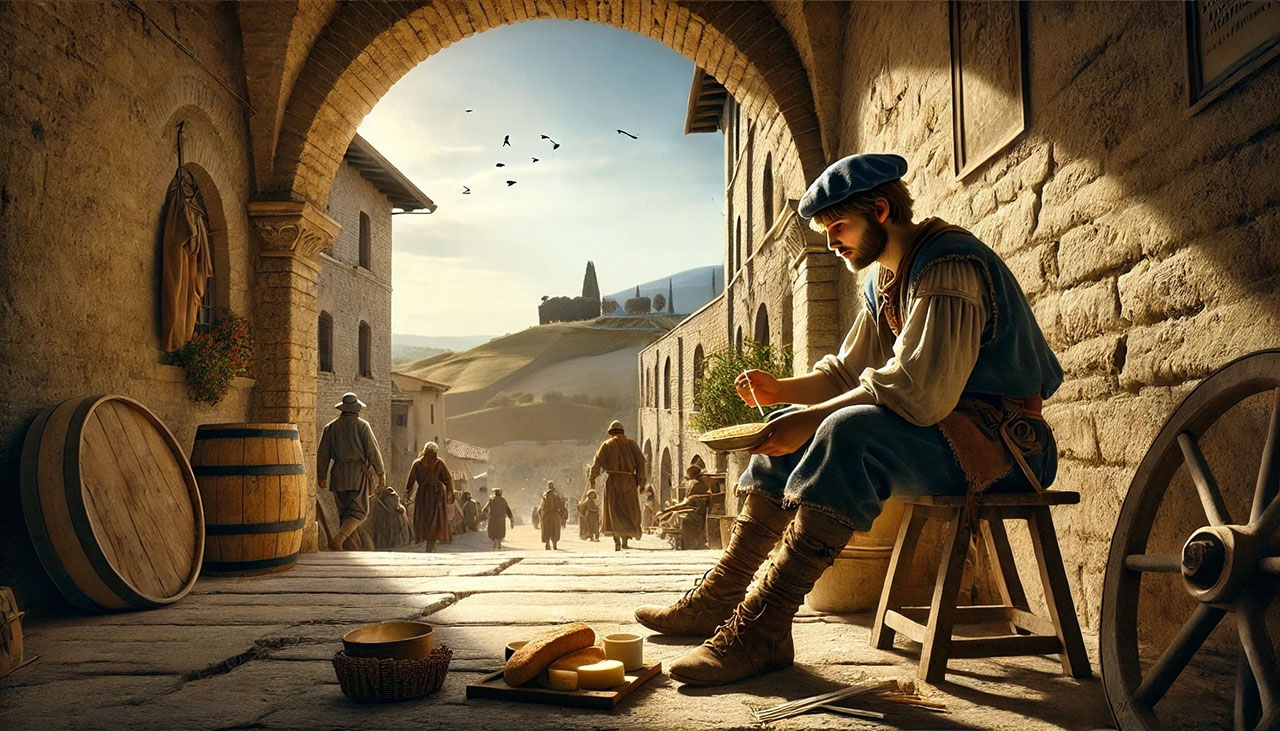
As afternoon wanes, the light softens, casting long shadows across the cobblestones. Pietro returns to his workshop, where he continues his work until the light begins to fade. With the approach of evening, the energy of the town gradually shifts from the bustle of daytime activity to a more subdued, reflective mood.
Nightfall in Medieval Assisi
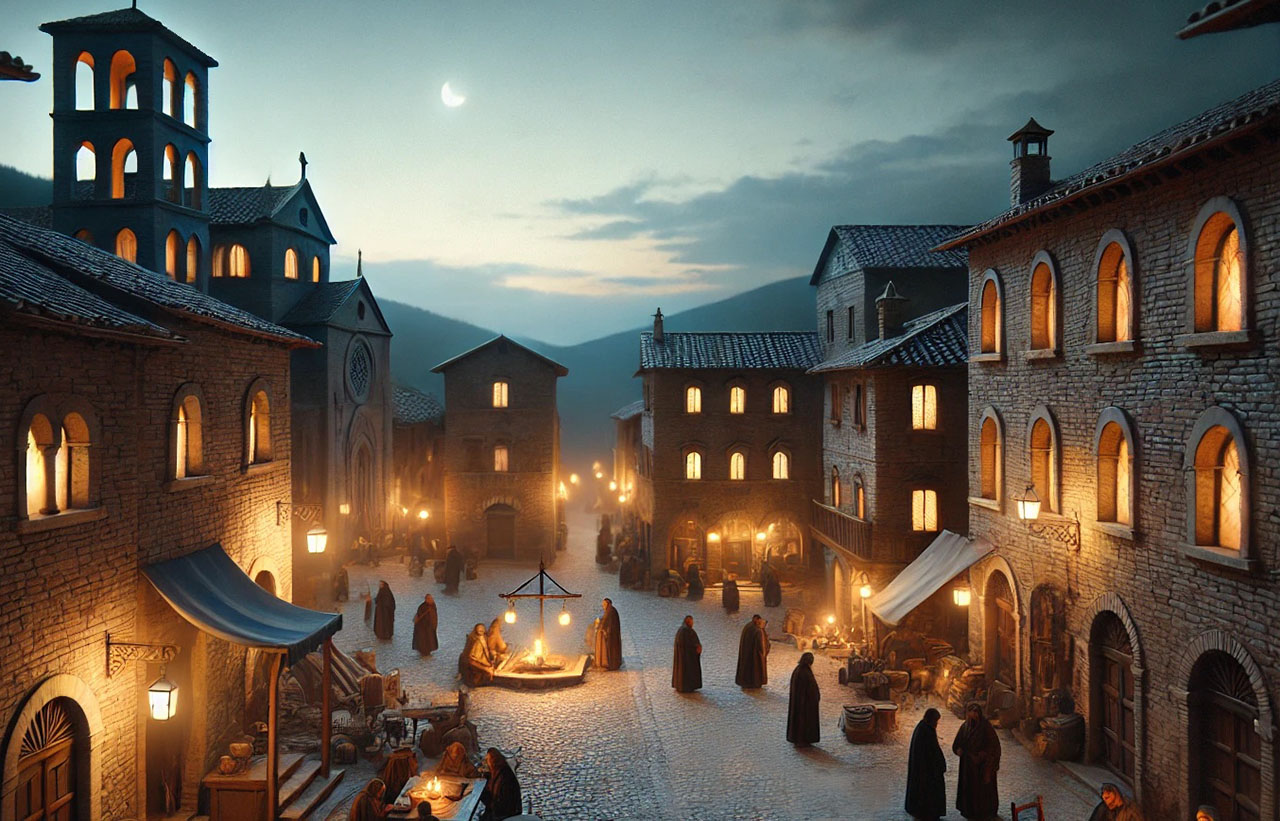
As evening settles over Assisi, the once-busy streets now exude a calm stillness, illuminated softly by the glow of lanterns. The air is cooler, carrying the comforting scent of cooking fires from the homes that line the streets.
In the central square, the warm light of lanterns creates a cozy ambiance. A few families and friends gather in small groups, their voices mingling with the gentle strumming of lutes and the soothing melodies of songs from local musicians.
As night deepens, Assisi embraces a peaceful quiet. Lanterns flicker in the windows of the town’s stone buildings, their soft light dancing across the darkened streets. The occasional call of a watchman and the distant rustle of nighttime creatures punctuate the stillness, adding to the tranquility of the evening.
The townspeople find solace in their nightly routines. Many retreat to their homes, their thoughts turning to their faith and the promise of a new day. In the stillness of the night, the simple rhythms of life continue as families prepare for rest, their day’s work complete.
Amidst this tranquil darkness, Pietro falls asleep imagining what tomorrow will bring.
A Glimpse into the History of Assisi
Located on the side of Mount Subasius in Umbria, Assisi is a town steeped in rich history and vibrant cultural heritage. Its story unfolds over millennia, from its early Roman roots to its pivotal role in the medieval era and beyond.
Assisi’s origins trace back to the ancient Roman period. Originally a modest settlement, it grew under Roman rule, flourishing as a center of trade and culture. The town was encircled by Roman walls, remnants of which can still be seen today. The Temple of Minerva, with its imposing Corinthian columns, stands as a testament to the town’s Roman legacy. After the fall of the Roman Empire, Assisi, like many towns, transitioned into the medieval period, adapting to new political and social dynamics.

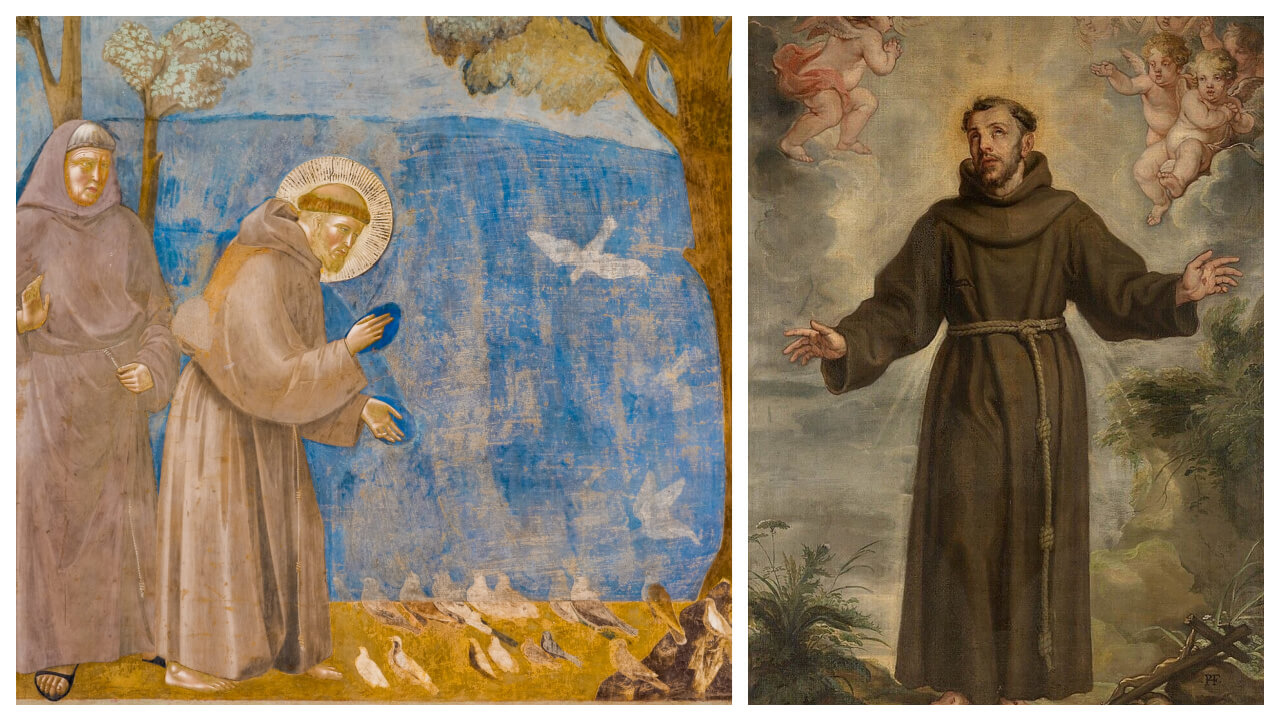
The medieval era marked a turning point for Assisi. By the early 13th century, the town had become a hub of religious and political activity. The rise of the Franciscan Order, founded by St. Francis of Assisi in 1209, brought significant change.
St. Francis, born Giovanni di Pietro di Bernardone, chose a life of poverty and service, profoundly influencing the town’s character and its role in the broader Christian world. His teachings and the Franciscans’ emphasis on humility and simplicity resonated deeply, shaping Assisi’s identity.
The Rise of the Commune and the Guelph-Ghibelline Rivalry in Assisi
The 12th and 13th centuries saw Assisi emerge as a free commune, a reflection of the broader Italian trend towards municipal independence. In 1198, the town experienced a popular uprising against the feudal authorities, leading to the demolition of the Rocca Maggiore, the fortress of Duke Corrado of Lutzen.
This was part of a larger struggle between the Guelphs, who supported the papacy, and the Ghibellines, who aligned with the Holy Roman Empire. Assisi, like many Italian towns, was embroiled in this factional conflict, which influenced its political and social landscape.

Assisi’s Religious and Artistic Legacy
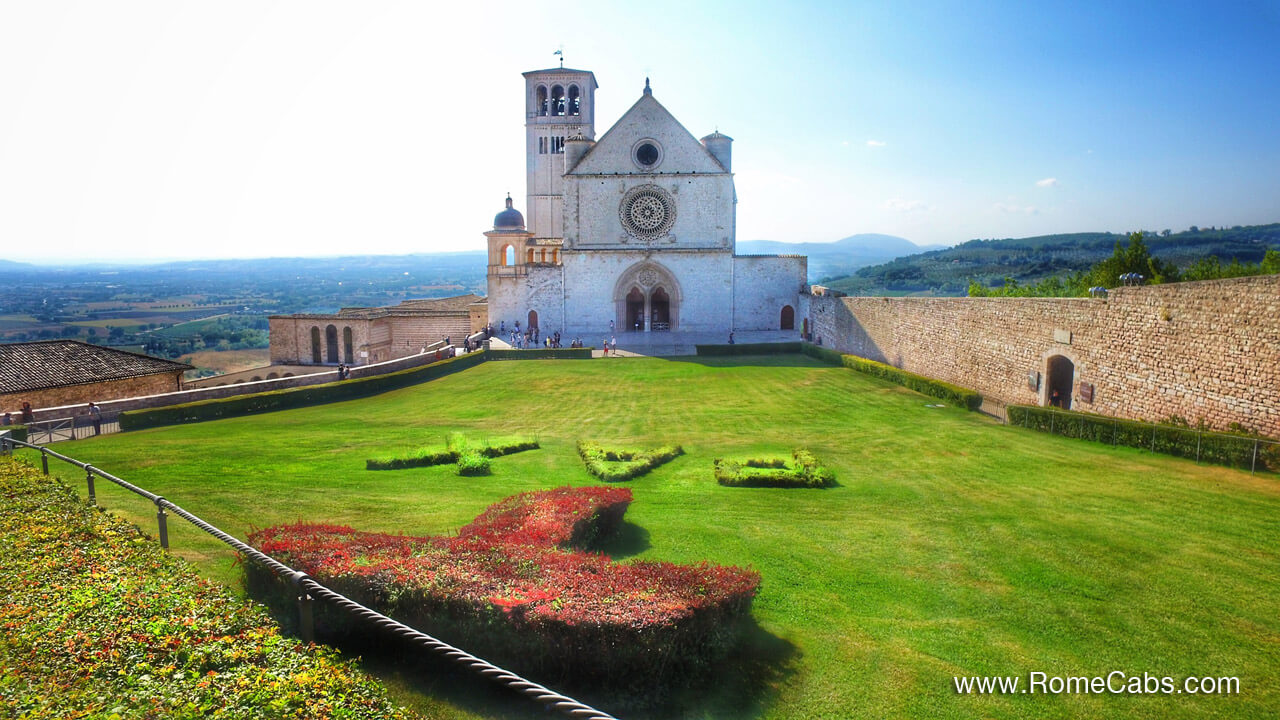
The influence of St. Francis extended beyond his lifetime, as the Franciscan Order grew to become a major force within the Catholic Church. Assisi became a pilgrimage site, attracting visitors from across Europe. The Basilica of San Francesco, with its stunning frescoes by Giotto and Cimabue, was constructed to honor St. Francis and remains one of the town’s most significant landmarks.
Throughout the Renaissance and beyond, Assisi continued to develop while preserving its historical essence. Its architecture, including medieval buildings and churches, reflects the town’s enduring legacy. Today, Assisi is celebrated for its well-preserved medieval character and its role in the history of Christianity.
Assisi Today
In modern times, Assisi remains a beacon of historical and spiritual significance. Visitors from around the world come to explore its ancient streets, fun festivals, and the enduring spirit of St. Francis. The town’s blend of historical depth, architectural beauty, and spiritual resonance makes it a unique destination, offering a window into the past and a continuing celebration of its rich heritage.
From its Roman origins through its medieval transformations to its present-day allure, Assisi’s history is a captivating story of change, continuity, and enduring faith.

Visiting Assisi from Rome
For those looking to experience Assisi firsthand, RomeCabs offers convenient day tours from Rome to Assisi, providing a private English-speaking driver at your service. You can also explore Assisi and Orvieto together, immersing yourself in the historical and cultural treasures of these remarkable destinations. Whether you’re drawn to the medieval charm of Assisi or the captivating beauty of Orvieto, these tours offer a seamless and enriching way to experience the heart of Italy’s historical landscape.
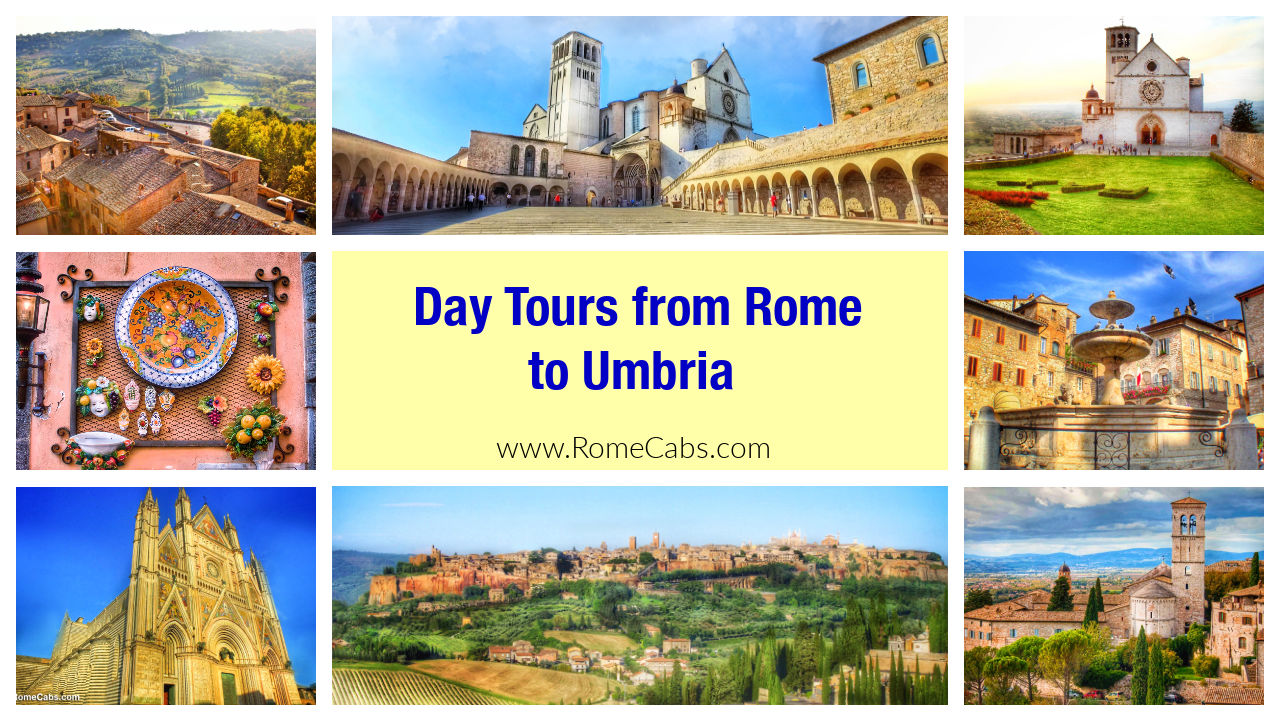
Day Tours from Rome to Assisi
Embark on a journey to the enchanting medieval city of Assisi, the birthplace of Saint Francis, with our exclusive Day Tour from Rome. This tour offers a unique opportunity to delve into the rich history and spiritual legacy of Assisi while traveling in the comfort of a private, climate-controlled deluxe vehicle. With a personal English-speaking driver at your service, you’ll experience the serene beauty of Umbria and the charm of Assisi in a way that’s both luxurious and personalized.
Please note that you will Self Tour independently while away from the vehicle.
Assisi Tour from Rome Itinerary:
- Santa Maria degli Angeli Church: Begin your tour with a visit to this significant site, where you’ll see the Porziuncola, the humble chapel where the Franciscan movement began, and the Capella del Transito, the place where Saint Francis passed away.
- Basilica of St. Francis: Explore both the lower and upper basilicas dedicated to Saint Francis. Admire the stunning frescoes and architectural marvels that commemorate the life and teachings of this revered saint.
- Piazza del Comune: Stroll through the main square of Assisi, a vibrant hub surrounded by historical buildings and charming cafes.
- Santa Maria Sopra Minerva: Visit this church in the main square, originally a Roman temple, which reflects Assisi’s layered historical narrative.
- Basilica of Saint Clare: Discover the basilica dedicated to Saint Clare, a close companion of Saint Francis and founder of the Poor Clares.
- San Damiano Monastery: Wander through this serene monastery, surrounded by olive groves and offering breathtaking views of the landscape.
Jewels of Umbria – Assisi and Orvieto Tour from Rome
.
Uncover the hidden gems of Umbria with RomeCabs’ day tour from Rome to Assisi and Orvieto. This private tour provides an immersive experience of two of Umbria’s most captivating destinations, combining historical exploration with scenic beauty. RomeCabs’ private tours ensure optimal comfort and flexibility, with a dedicated English-speaking driver to enhance your experience. Enjoy the convenience of pick-up and drop-off at your hotel in Rome, making your exploration of Umbria both effortless and enjoyable.
Please note that you will Self Tour independently while away from the vehicle.
Jewels of Umbria Assisi and Orvieto Tour Itinerary:
Visit Assisi:
- Basilica of Saint Francis: Begin with a visit to this iconic basilica, home to extraordinary frescoes and a site of pilgrimage.
- Basilica of Saint Clare: Explore the basilica dedicated to Saint Clare, renowned for its spiritual significance and architectural beauty.
- Lunch and Stroll in the Town Square: Enjoy a delightful lunch at a local restaurant and take a leisurely stroll through the charming town square.
Visit Orvieto:
- Discover Orvieto, perched high on a volcanic rock, and explore its rich history and stunning architecture.
- Cathedral of Orvieto: Visit the magnificent cathedral, known for its striking facade and intricate frescoes.
- Free Time: Enjoy leisure time for sightseeing, shopping, wine tasting, or simply soaking in the town’s atmosphere.

.
Assisi offers a rare glimpse into Italy’s Medieval past, where the town’s rich history, spirituality, and centuries-old traditions are still palpable today. Much of its medieval architecture remains intact, allowing visitors to explore its storied streets, ancient churches, and historic squares much as they were centuries ago. From the majestic Basilica of Saint Francis to the humble San Damiano Monastery, Assisi preserves the essence of its medieval roots, offering a deeply immersive experience.
For modern travelers, this journey into history is made even more accessible through day tours, such as those offered by RomeCabs, where you can explore Assisi’s timeless beauty and culture in comfort, guided by an expert driver, ensuring a seamless and memorable experience.
.
* Find RomeCabs online also on:
- RomeCabs Facebook: https://www.facebook.com/RomeCabsToursAndTransfers
- RomeCabs Pinterest: https://www.pinterest.it/romecabs
- RomeCabs Twitter: https://twitter.com/RomeCabs
- RomeCabs Instagram: https://www.instagram.com/romecabs/
- RomeCabs Flickr Photos: https://www.flickr.com/photos/romecabs/
- RomeCabs Recommended on Cruise Critic
Step back in Time with RomeCabs travel blogs!


 RomeCabs Transfers and Tours in Italy (Rome Cabs)