Exploring the Majesty of Basilica of Saint Mary Major – Santa Maria Maggiore in Rome
.
Buongiorno and welcome to RomeCabs Italy Travel Blog! The Basilica of Saint Mary Major, also known as Basilica di Santa Maria Maggiore in Italian, stands as a testament to Rome’s rich history and spiritual significance. As one of the Seven Pilgrim Churches of Rome, it is a major papal basilica and the largest Catholic Marian church in the city. Let’s explore the majesty of the Basilica of Santa Mary Major in Rome.
.
A Tale of Snow and Devotion: Our Lady of the Snows
.
The endearing title “Our Lady of the Snows” bestowed upon the Basilica di Santa Maria Maggiore encapsulates a fascinating tale that traces its roots to the 14th century. Steeped in devotion and wonder, the legend unfolds during the pontificate of Liberius, when a Roman patrician named John and his wife found themselves without heirs. Seeking divine guidance, they fervently prayed to the Virgin Mary, vowing to dedicate their possessions in her honor.
.

.
In a celestial response that would become the stuff of legends, the night of August 5 witnessed a miraculous event on the Esquiline Hill—the heart of ancient Rome. Snow, an unusual occurrence during the Roman summer, descended upon the hill, blanketing it in a pristine layer of snow. Taking this celestial event as a divine sign, John and his wife, inspired by a shared vision of the Virgin Mary, decided to erect a basilica on the very spot where the snow had fallen.
The legend, although first reported after the year 1000, became increasingly popular in the 14th century. It tells of a couple’s unwavering faith and the extraordinary intervention of the Virgin Mary. As a result of this heavenly guidance, the Basilica di Santa Maria Maggiore came into existence, a tangible testament to the couple’s commitment and the enduring connection between the divine and the mortal.
The feast of the Dedication of the Basilica celebrated annually, serves as a poignant reminder of this miraculous event. White rose petals, symbolizing the celestial snowfall, are dropped from the dome during the Mass and Second Vespers of the feast, keeping the legend alive and connecting the present-day pilgrims to the miraculous origins of the basilica.
.
A Rich History of Devotion and Construction
.

.
The earliest building on the site, the Liberian Basilica, is associated with Pope Liberius, who dreamed of a summer snowfall and marked the future church’s location. The present structure was consecrated by Pope Sixtus III in 434 to honor the Virgin Mary, following the Council of Ephesus, which declared Mary as the Mother of God.
Despite multiple construction projects and the earthquake of 1348, the core of the original structure remains. The Basilica symbolizes not only the centrality of Rome in the Roman Empire but also its role as the center of the Christian world.
.
Mosaics: A Glimpse into Christian Late Antiquity
.
Step inside the Basilica, and you’ll be greeted by some of the oldest representations of the Virgin Mary in Christian Late Antiquity. The mosaics, especially those on the triumphal arch and nave, depict scenes from Mary’s life, Christ’s story, and Old Testament narratives. These masterpieces are milestones in the depiction of the Virgin and provide a visual narrative that transcends time.
.

.
Crypts and Chapels: Unveiling Sacred Treasures
.
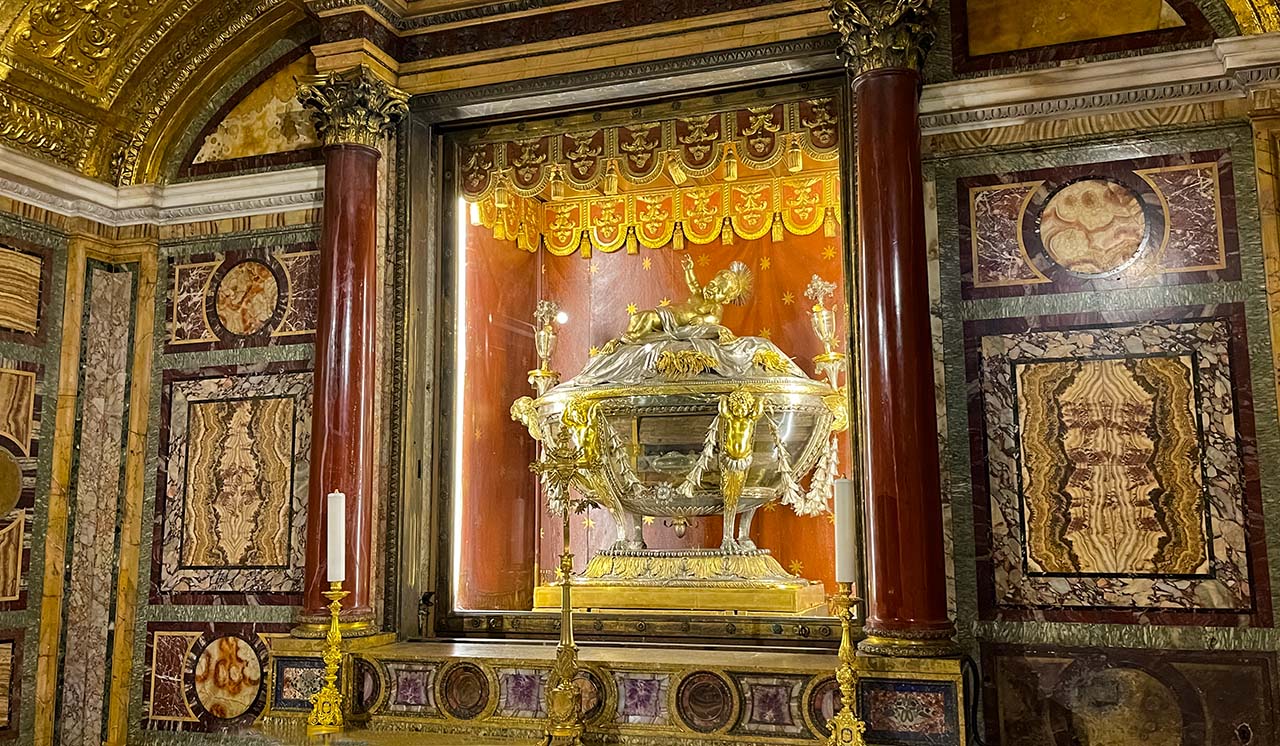
The depths of Basilica di Santa Maria Maggiore hold not only architectural marvels but also hidden treasures steeped in centuries of sacred significance. Journeying beneath the high altar, visitors encounter the Crypt of the Nativity, a sacred space below the canopy believed to cradle wood from the Holy Crib, a relic of profound spiritual resonance.
.
.
The Crypt of the Nativity, nestled beneath the imposing high altar, invites contemplation and reflection. Pilgrims and curious explorers alike stand in awe as they ponder the connection between this sacred space and the nativity of Jesus Christ.
The crystal reliquary, designed by Giuseppe Valadier, serves as a vessel for the revered wood.
.

.
Venturing further, fragments of a sculpture attributed to the skilled hands of Arnolfo di Cambio are discovered beneath the altar of the Sistine Chapel, a place of devotion named after Pope Sixtus V.
It is crucial to distinguish this chapel from its more famous counterpart in the Vatican, which bears the name of Pope Sixtus IV who contributed significantly to the basilica’s restoration and embellishment. . Each fragment serves as a testament to the artistic prowess of Arnolfo di Cambio and the reverence bestowed upon these sacred relics.
This chapel, with its gilded bronze angels by Sebastiano Torregiani supporting the ciborium, stands as a testament to the artistic and religious fervor that characterized the Renaissance period.
Intriguingly, the chapel also houses the tombs of Pope Sixtus V and his early patron Pope Pius V. It serves as a poignant reminder of the interconnectedness of history, art, and spirituality within the hallowed walls of Santa Maria Maggiore.
.

.
The Oratory or Chapel of the Nativity adds another layer to the basilica’s sacred narrative. Ignatius of Loyola celebrated his first Mass as a priest in this serene space on December 25, 1538, marking a profound moment in the basilica’s living history.
As visitors explore these crypts and chapels, they are immersed not only in the tangible relics of Christianity but also in the echoes of centuries-old prayers and devotions, creating an experience that transcends time and connects the present to the sacred mysteries of the past.
.
Bernini’s Legacy: Tomb in Basilica di Santa Maria Maggiore
.

.
Gian Lorenzo Bernini (1598-1680), a paramount sculptor of the Baroque era, found his final resting place in Basilica di Santa Maria Maggiore. Interred with humility to the right of the high altar, his tomb bears a Latin inscription:
IOANNES LAVRENTIVS BERNINI / DECVS ARTIS ET VRBIS / HIC HVMILITER QVIESCIT
Giovanni Lorenzo Bernini, glory of the arts and of the city, humbly rests here.
After Pope Benedict XIV conferred nobility upon the Bernini family in 1746, additional inscriptions, including the family coat of arms, were added, noting:
NOBILIS FAMILIA BERNINI / HIC / RESVRRECTIONEM EXPECTAT
The noble Bernini family here awaits resurrection
Bernini’s tomb stands as a testament to his monumental contributions and enduring legacy within the hallowed confines of this Roman basilica.
.
Papal Basilica and Ongoing Devotion
.
Santa Maria Maggiore serves as a papal basilica, with the Pope often presiding over the Feast of the Assumption of Mary on August 15. The basilica is entrusted to an archpriest, and a chapter of canons resides within. Pope Francis, known for his devotion to the Salus Populi Romani, frequently visits the basilica, considering it a place of great spiritual significance.
Whether exploring Rome on private tours, or venturing on your own, a visit to Basilica di Santa Maria Maggiore is a journey through time, art, and devotion. Its rich history, legends, and stunning mosaics make it a must-see destination for pilgrims, art enthusiasts, and history buffs alike.
.
DISCOVER MORE OF ROME with ROME CABS:
Rome’s 7 Hidden Gems You Must See
Beyond the Colosseum: Exploring Rome’s Hidden Architectural Gems
Origins of Santa Maria in Trastevere and Early Foundations
Exploring the Eternal City: Is Rome Safe? Top 20 Travel Safety Tips from Rome Cabs
Your Roman Holiday: How to Make Your Rome Visit Extraordinary
.
* Find us online also on:


 RomeCabs Transfers and Tours in Italy (Rome Cabs)